

Key takeaways
- Checked and verified against current regulatory guidelines by practising CAs/CSs.
- Covers key requirements, step-by-step registration procedures, and statutory compliance timelines.
- Includes actionable insights tailored for Indian founders and business owners.
TL;DR
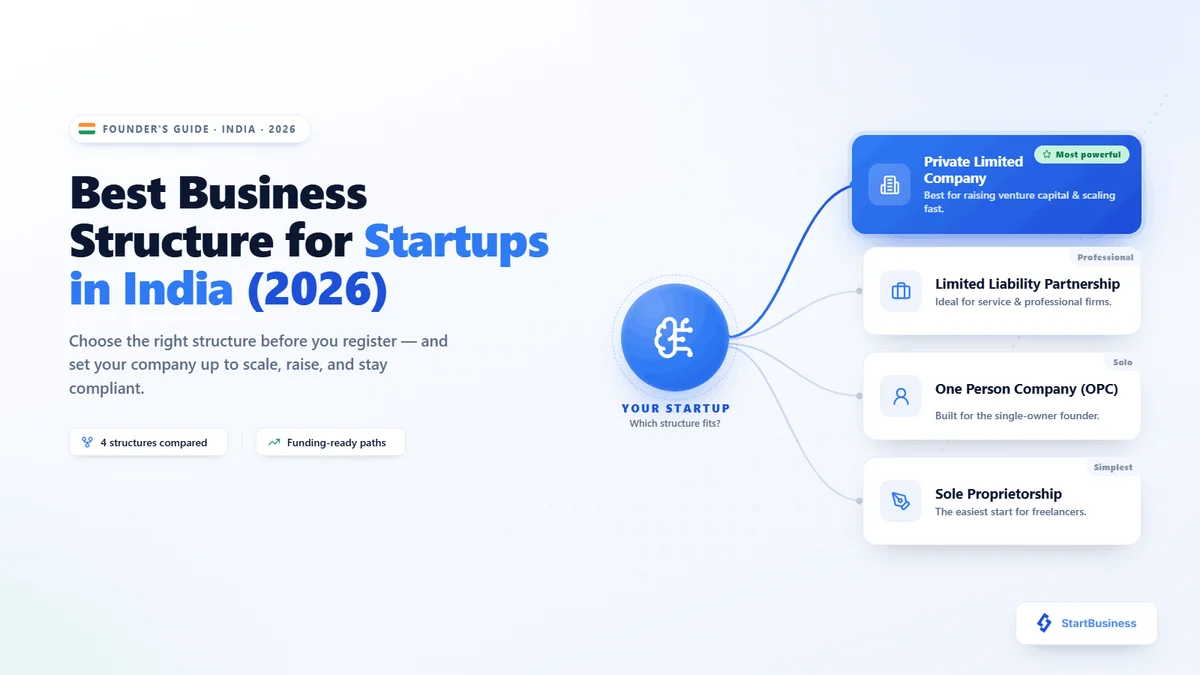
For most Indian startups seeking investment or scale, a Private Limited Company is the best business structure. If you are a solo founder, an OPC is a simpler alternative. For professional service firms or small partnerships, an LLP works well. Sole proprietorship suits freelancers and micro-businesses only. Your choice depends on funding plans, co-founders, liability tolerance, and compliance appetite.
Introduction
Before you register your startup, one decision will quietly shape your funding options, your tax liabilities, your compliance burden, and your ability to bring on co-founders or investors. That decision is: which business structure to choose.
Most founders make this choice quickly — either by copying what a friend did, or by defaulting to whatever their CA suggests without fully understanding the trade-offs. That is a mistake.
This guide is not about how to register. It is about helping you decide which structure actually fits your startup's stage, goals, and growth path — before you file a single document.
Once you have made your decision, you can move to the relevant registration or compliance guide. Here are the deep-dives: Pvt Ltd registration, LLP vs Pvt Ltd comparison, and Sole Proprietorship registration.
What Is a Business Structure?
A business structure is the legal form your business takes. It determines who owns the company, who is liable for its debts, how profits are taxed, and how the business can raise money.
In India, the main options regulated by the Ministry of Corporate Affairs (MCA) and governed under different acts are: Sole Proprietorship, Partnership, LLP, One Person Company (OPC), and Private Limited Company.
Each structure is a different contract between you, the government, your creditors, and your investors. Pick the wrong one and you will either under-build (limiting growth) or over-build (drowning in compliance costs).
Business Structures Available to Indian Start-ups
Here is a decision-relevant overview of each option. These are intentionally high-level — detailed registration processes are covered in separate guides linked throughout.
1. Sole Proprietorship
A single-owner business with no legal separation between owner and business. Zero compliance overhead, but zero protection and zero ability to raise equity funding.
| Best For Freelancers, individual consultants, and hyperlocal micro-businesses with no plans to scale or raise funding. |
|---|
2. Partnership Firm
Two or more people sharing ownership and profits under a Partnership Deed. Governed by the Indian Partnership Act, 1932. Unlimited liability for all partners — a major risk.
| Best For Traditional family businesses or short-term joint ventures between trusted individuals. Not recommended for tech startups or businesses seeking outside investment. |
|---|
3. Limited Liability Partnership (LLP)
A hybrid between a partnership and a company. Partners have limited liability (only up to their contribution), and the LLP is a separate legal entity. Lower compliance burden than a Pvt Ltd but cannot issue equity shares.
| Best For Professional services firms (law, consulting, design), small B2B agencies, or businesses where founders want flexibility without heavy regulatory compliance. |
|---|
4. One Person Company (OPC)
A company structure for single founders. Introduced under the Companies Act, 2013, it gives a solo entrepreneur the protection of a limited liability company without needing a second shareholder. Mandatory conversion to Pvt Ltd once turnover crosses Rs. 2 crore or paid-up capital crosses Rs. 50 lakh.Mandatory conversion thresholds no longer apply — as of 2021, an OPC can voluntarily convert to Pvt Ltd at any time. NRIs are also now eligible to incorporate an OPC.
| Best For Solo founders building a product or service business who want legal protection but are not ready for the full Pvt Ltd compliance framework. |
|---|
5. Private Limited Company
The most common structure for fundable start-ups. A Pvt Ltd is a separate legal entity with limited liability, up to 200 shareholders, and the ability to issue equity shares to investors, ESOPs to employees, and convertible instruments to angels and VCs.
| Best For Any startup planning to raise external funding, hire with ESOPs, apply for Startup India recognition, or scale with multiple co-founders. |
|---|
Which Business Structure Should You Choose? (By Start-up Type)
The right answer depends on your specific situation. Here is a breakdown by the most common founder profiles.
SaaS Startups
If you are building a SaaS product — even at the idea stage — register a Private Limited Company from day one. Here is why:
• Angels and VCs will not invest in an LLP or proprietorship
• ESOPs require share capital — only Pvt Ltd can issue them
• Startup India DPIIT recognition (and its tax benefits) is open to Pvt Ltd entities
• International payments and contracts are easier to handle under a registered company
If you are applying for Startup India benefits, read the Startup India registration guide once you have incorporated.
| Verdict: Private Limited Company. No exceptions if you plan to raise funding. |
|---|
D2C Brands (Direct-to-Consumer)
D2C brands have a specific challenge: they often start small (Instagram, local markets) and scale fast. The structure needs to grow with the business.
• Start as Sole Proprietorship only if you are testing the idea on a very small budget (under Rs. 20-30 lakh revenue)
• Move to Pvt Ltd the moment you want to list on Amazon/Flipkart at scale, raise a seed round, or bring on a co-founder
• LLP works if you have two founders and firmly do not want external equity investment
| Verdict: Sole Proprietorship for early MVP testing only. Private Limited Company for any serious D2C business with growth plans. |
|---|
Agencies (Digital, Design, Consulting)
Agencies typically have multiple partners, project-based revenue, and limited appetite for external investors. This is one of the few cases where LLP genuinely competes with Pvt Ltd.
• LLP: lower ROC filings, no mandatory audit below Rs. 40 lakh turnover, partners share profits flexibly
• Pvt Ltd: needed if you plan to scale beyond a boutique, bring on non-partner employees with ESOPs, or eventually exit
| Verdict: LLP for boutique agencies with no external funding plans. Pvt Ltd if you are building an agency to scale or exit. |
|---|
Freelancers & Independent Consultants
Sole Proprietorship is the default for freelancers, and for good reason — it has almost zero setup friction and no compliance overhead beyond your personal tax filing.
• If your annual revenue is under Rs. 20-25 lakh, there is little practical reason to incorporate
• If you are billing international clients regularly, consider an OPC or Pvt Ltd for credibility and cleaner forex compliance
• If clients are starting to ask for company invoices instead of personal ones, that is your signal to incorporate
| Verdict: Sole Proprietorship is fine until you hit scale or need corporate credibility. Then consider OPC or Pvt Ltd. |
|---|
Solo Founders Building a Product
A solo founder building a product has a unique problem: Pvt Ltd requires at least two shareholders (you and a nominee), which can complicate ownership. OPC solves this.
• OPC gives you limited liability protection without needing a second shareholder
• If you expect to bring on a co-founder or investor within 12-18 months, start with Pvt Ltd and add the second director
• OPC mandates conversion to Pvt Ltd once you cross Rs. 2 crore turnover or Rs. 50 lakh paid-up capitalOPC no longer has mandatory conversion thresholds — voluntary conversion to Pvt Ltd is available at any time
| Verdict: OPC if you are firmly solo for the foreseeable future. Pvt Ltd if you expect co-founders or investors soon. |
|---|
Family Businesses
Family businesses in India are typically either traditional (partnership or proprietorship) or scaling (Pvt Ltd). The right choice depends on whether external capital is on the table.
• If the business will stay within the family and does not need external funding: LLP with a clear LLP Agreement is a clean structure
• If the family business is expanding aggressively, adding professional management, or considering PE investment: Pvt Ltd is the only viable option
Quick Comparison Table
Use this table to compare the key decision factors — not registration steps — across all structures.
| Structure | Liability | Equity Funding | Compliance | Best Stage |
|---|---|---|---|---|
| Sole Proprietorship | Unlimited | Not possible | Very low | Freelancers / Idea stage |
| Partnership | Unlimited | Not possible | Low | Traditional / Small |
| LLP | Limited | Not possible | Medium | Agencies / Services |
| OPC | Limited | Difficult | Medium | Solo founders |
| Private Limited | Limited | Yes (equity) | High | Scalable startups |
The Investor Perspective: Why Structure Matters for Funding
This is the section most guides skip. But if you have any intention of raising money — angel rounds, seed, Series A — your business structure is not a formality. It is a gating criterion.
Why Investors Prefer Private Limited Companies
• Investors can receive equity shares — LLPs and proprietorships cannot issue equity
• SAFEs, CCDs (Compulsorily Convertible Debentures), and convertible notes work only in companies
• Cap tables, drag-along rights, and voting rights are only possible in a Pvt Ltd
• ESOP pools — critical for hiring senior talent — require share capital
• Pvt Ltd entities are eligible for DPIIT recognition, which unlocks tax exemptions under Section 80-IAC
When Will an Investor Accept an LLP?
Rarely, and only in specific scenarios:
• Debt-based investment (not equity) where investors are treated as secured creditors
• Some family offices and HNI investors who prefer profit-share structures
• Impact funds or grant-based programs with non-equity instruments
| Key Takeaway: If you are going the VC or angel route, register a Private Limited Company. There is no workaround. Converting an LLP to a Pvt Ltd later is possible but messy, time-consuming, and expensive. |
|---|
Common Mistakes Founders Make When Choosing a Structure
Mistake 1: Registering a Sole Proprietorship "to keep things simple" while planning to raise funding
You will have to re-register entirely. There is no conversion path from proprietorship to company. Every contract, bank account, and business relationship has to be rebuilt.
Mistake 2: Choosing LLP because it sounds professional, without knowing it blocks equity funding
LLP sounds corporate, and many founders assume it is similar to a Pvt Ltd. It is not. An LLP cannot issue equity shares. If your roadmap includes any investor capital, LLP is the wrong choice.
Read the full LLP vs Private Limited Company comparison before making this decision.
Mistake 3: Choosing Pvt Ltd for a solo freelance practice and drowning in compliance
Pvt Ltd requires annual ROC filings, audited accounts (regardless of turnover), board meetings, and director KYC updates. For a solo consultant billing Rs. 8-10 lakh a year, this is unnecessary overhead.
If you are already a Pvt Ltd, review your annual compliance checklist to stay on top of your filings.
Mistake 4: Not registering a trademark before funding
This is structure-adjacent but critical: the moment you decide on a Pvt Ltd and start operations, file your trademark. A funded startup that loses its brand name to a prior registrant is a nightmare that plays out more often than founders expect.
Learn about Trademark Registration in India and file early.
Mistake 5: Delaying incorporation while the product gains traction
Many founders delay registration because they are "still figuring things out." But unregistered businesses cannot sign vendor contracts cleanly, receive investments, or open proper business bank accounts. Traction without a legal structure creates complications that are expensive to untangle.
Final Decision Matrix
Use this as your last check before moving to registration.
| Your Situation | Recommended Structure |
|---|---|
| Solo founder, no plans to raise funding | OPC |
| Solo founder, planning to raise funding within 2 years | Private Limited Company |
| Two or more co-founders, planning VC / angel funding | Private Limited Company |
| Professional services agency, no equity funding planned | LLP |
| Freelancer / consultant, revenue under Rs. 25 lakh | Sole Proprietorship |
| D2C brand testing an idea with minimal capital | Sole Proprietorship (initially) |
| D2C brand ready to scale / raise | Private Limited Company |
| Family business, staying within the family | LLP |
| Family business in aggressive growth / PE track | Private Limited Company |
| SaaS startup at any stage | Private Limited Company |
Read: ROC Compliance Checklist for Private Limited Companies
Conclusion
The business structure decision is not bureaucratic paperwork — it is the foundation your startup sits on. Get it wrong and you will rebuild from scratch at the worst possible time: when you have momentum.
For most growth-oriented Indian startups, the answer is Private Limited Company. For solo founders not planning to raise, OPC is the cleaner option. For service businesses with no equity funding plans, LLP works well. Everything else — partnership, proprietorship — is a trade-off that limits your options.
Make the decision deliberately. Then move fast on the registration.
FAQ — Frequently Asked Questions
These answers are structured for Google Featured Snippets and AI Overviews.
Q1. What is the best business structure for a startup in India?
For most startups — especially those seeking investment or planning to scale — a Private Limited Company is the best structure. It offers limited liability, the ability to raise equity funding, ESOP issuance, and DPIIT recognition eligibility.
Q2. Can I register an LLP and later convert it to a Private Limited Company?
Yes, LLP to Pvt Ltd conversion is allowed under the Companies Act, but the process is lengthy, involves court approval, and can disrupt existing contracts and bank accounts. It is better to choose the right structure upfront.
Q3. What is the minimum number of people needed to register a Private Limited Company in India?
A minimum of two directors and two shareholders are required. The same person can be both a director and a shareholder, so a two-founder team is sufficient.
Q4. Is OPC better than Pvt Ltd for a solo founder?
OPC is simpler and has slightly lower compliance for a solo founder with no near-term plans to raise funding. But if you plan to raise external investment or bring on a co-founder within 12-18 months, start with a Pvt Ltd and add a nominee director.
Q5. Can an LLP raise venture capital in India?
No. An LLP cannot issue equity shares. VCs and most angel investors invest in equity instruments, which are only possible in a Private Limited Company. An LLP can only accept loans or capital contributions from its partners.
Q6. Is Sole Proprietorship good for a startup?
Only at the very early, pre-revenue testing stage. Sole Proprietorship offers no liability protection, cannot raise equity funding, and is difficult to scale cleanly. It is suitable for freelancers or hyperlocal micro-businesses, not startups with growth ambitions.
Q7. What happens when OPC exceeds Rs. 2 crore turnover?
An OPC is mandatorily required to convert into a Private Limited Company within six months of exceeding Rs. 2 crore in average annual turnover or Rs. 50 lakh in paid-up share capital. This conversion is relatively straightforward.No. The mandatory conversion requirement for OPCs no longer applies. The earlier thresholds — Rs. 2 crore average annual turnover or Rs. 50 lakh paid-up share capital — are no longer relevant. An OPC can now voluntarily convert to a Private Limited Company at any time. Founders who anticipate raising external investment should still plan a proactive conversion to Pvt Ltd, as OPC cannot issue equity shares to investors.
We handle business incorporation and deed drafting end-to-end, tailored to your needs.

Practising from Deccan Gymkhana, Pune since 2017. Has handled 1,000+ incorporations and ongoing compliance for founders across Maharashtra, from single-partner proprietorships to funded private limited companies.