

Key takeaways
- Checked and verified against current regulatory guidelines by practising CAs/CSs.
- Covers key requirements, step-by-step registration procedures, and statutory compliance timelines.
- Includes actionable insights tailored for Indian founders and business owners.
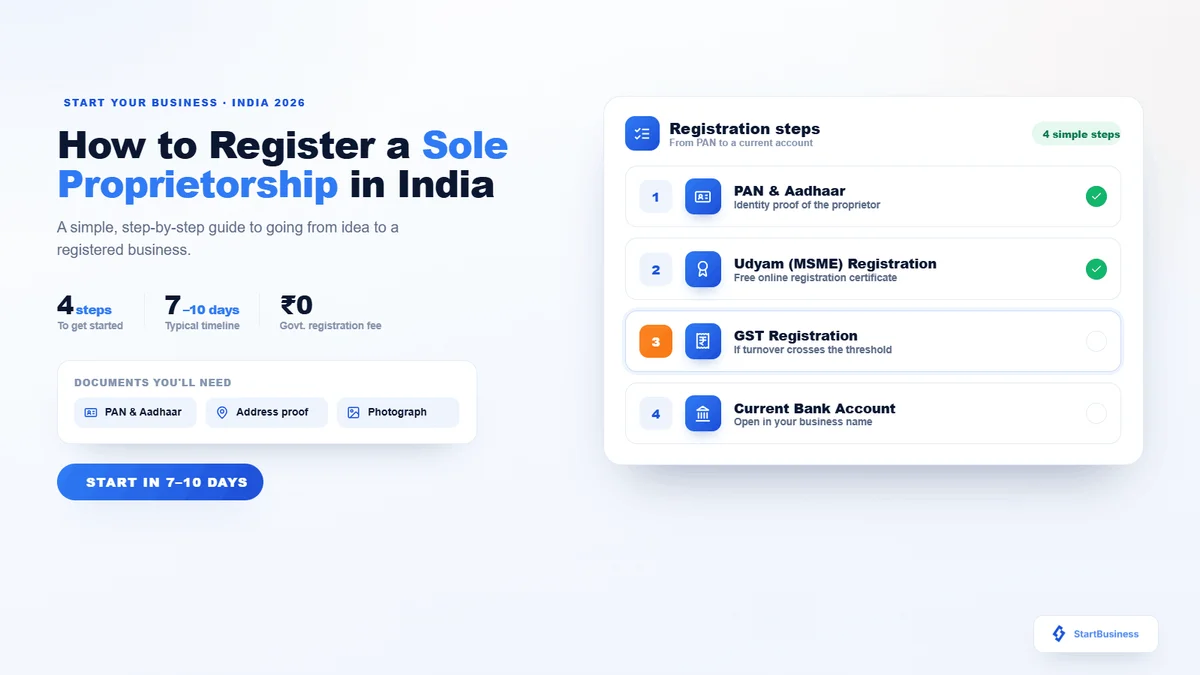
If you are planning to start a business on your own in India, registering as a sole proprietorship is the simplest and most affordable path available. A sole proprietorship business is a single-owner enterprise where you are personally responsible for all operations, profits, and liabilities. There is no separation between you and the business which keeps things lean, fast, and completely under your control.
This guide is written for first-time entrepreneurs, freelancers, consultants, traders, and small business owners who want to start a sole proprietorship without getting lost in legal jargon. We will walk you through every step of sole proprietorship registration in India, from choosing a business name to obtaining the right licenses.
Not sure which business structure suits you best? Read our Company Registration Services guide to compare options before you decide.
Quick Answer: How to Register a Sole Proprietorship in India?
There is no separate government incorporation process for sole proprietorship registration in India. A sole proprietorship is created by obtaining business-related registrations such as GST registration, Shop & Establishment registration, Udyam Registration, and opening a current bank account in the proprietor's name. The exact registrations required depend on the business type, location, and turnover.
What is a Sole Proprietorship Business?
A sole proprietorship is the most basic form of business ownership in India. One person owns and runs the entire business. There is no formal incorporation, no separate legal entity, and no partners or shareholders to report to.
This structure is commonly used by:
• Freelancers and consultants (designers, writers, developers)
• Retail shopkeepers and traders
• Home-based businesses and food vendors
• Service providers such as tutors, tailors, and repair technicians
• Small e-commerce sellers on platforms like Amazon or Flipkart
Example: Ravi opens a laptop repair shop under the name "Ravi Computers." He registers for GST, opens a current account, and operates as a sole proprietor. He files taxes in his own name and keeps 100% of the profits.
Unlike a private limited company, a sole proprietorship has no minimum capital requirement, no board of directors, and no mandatory audit — making it the go-to choice for millions of small businesses across India.
Benefits of a Sole Proprietorship
Here is why thousands of Indian entrepreneurs choose this structure every year:
1. Easy to Start
There is no formal registration process with the Ministry of Corporate Affairs. You can begin operations immediately and register specific licenses as your business requires.
2. Low Cost
Government fees for GST registration, Udyam registration, and shop licenses are minimal. Total setup costs are often under ₹3,000–5,000 if you do it yourself.
3. Minimal Compliance
No annual ROC filings, no board meetings, no complex audits. You only need to file your personal income tax return (ITR-3 or ITR-4) and GST returns if registered.
4. Full Control
All decisions rest with you. No approvals needed from partners, shareholders, or directors. You retain 100% of your profits.
5. Easy to Close
Winding up a sole proprietorship is straightforward — no formal dissolution process required with the government.
Step-by-Step Guide to Sole Proprietorship Registration in India
There is no single "sole proprietorship registration" form issued by the government. Instead, your business is recognised through a combination of registrations and licenses. Here is how to register a sole proprietorship in India:
Step 1: Choose a Business Name
Select a unique name for your proprietorship firm. Your name should:
• Be easy to remember and relevant to your business
• Not infringe on any existing trademark
• Not be identical to a registered company name
Tip: To protect your brand, consider applying for Trademark Registration early. A registered trademark prevents others from using your business name.
Step 2: Obtain PAN Card in Business Owner's Name
Your personal PAN card is used for all tax filings. If you do not have one, apply at the NSDL or UTIITSL website. This is mandatory before any other registration.
Step 3: Open a Current Bank Account
Banks require proof of business identity to open a current account in a proprietorship's name. To open the account, you will typically need:
• PAN card
• Aadhaar card
• GST registration certificate or Shop & Establishment certificate
• Business address proof
A dedicated current account is essential for separating personal and business finances. It also establishes your business's banking credibility.
Step 4: Register for GST (If Applicable)
GST registration is mandatory if your annual turnover exceeds ₹40 lakh (for goods) or ₹20 lakh (for services). It is also required if you sell on e-commerce platforms or deal in inter-state trade. You can complete GST Registration entirely online through the GST portal (gst.gov.in).
Once registered, you will receive a GSTIN (GST Identification Number), which also serves as proof of your sole proprietorship's existence — making it easier to open a bank account and enter business contracts.
Step 5: Obtain Shop & Establishment Registration
If you operate from a physical location — a shop, office, or any commercial space — you must register under your state's Shops and Commercial Establishments Act. This is issued by the local municipal authority or Labour Department.
Key facts:
• Requirement and fees vary by state (e.g., Maharashtra, Delhi, Karnataka have different rules)
• Most states allow you to register proprietorship firm online via their state portal
• Certificate is usually issued within 1–7 working days
Step 6: Register for MSME (Udyam Registration)
Udyam Registration is free, fully online, and gives your business MSME status. Apply at udyamregistration.gov.in. Benefits include priority bank loans, government tender eligibility, and protection against delayed payments. Learn more about MSME Registration and how it can benefit your business.
Step 7: Apply for Any Trade or Professional License (If Required)
Depending on your business type, additional licenses may be needed. For example:
• FSSAI License — for food businesses
• Drug License — for pharmacies or medical suppliers
• IEC (Import Export Code) — for import/export businesses
• Professional Tax Registration — required in some states
Documents Required for Proprietorship Registration
Here is a quick checklist of documents you will need across the various registrations:
| ✅ Document Checklist |
|---|
| 1. PAN Card — of the business owner (mandatory for all registrations). Must be a valid, active PAN linked to your Aadhaar. |
| 2. Aadhaar Card — must be linked to your active mobile number for OTP-based verification on GST and Udyam portals. |
| 3. Business Address Proof — rental agreement or sale deed if you own the premises. The address must match across all registration applications. |
| 4. Bank Account Proof — a cancelled cheque or recent bank statement showing your name and account number. Required for GST registration. |
| 5. Utility Bills — electricity or water bill for the business address (not older than 2 months). Used for address verification on GST and Shop & Establishment applications. |
| 6. Passport-Size Photograph — recent colour photograph of the proprietor. Required for Shop & Establishment registration and some state-level licenses. |
| 7. NOC from Property Owner — No Objection Certificate required if you are operating from rented or family-owned premises. This is mandatory for GST registration when the premises are not in your name. |
Cost of Sole Proprietorship Registration in India
One of the biggest advantages of this structure is its low cost. Here is a realistic cost breakdown:
| Registration Type | Govt. Fee | Professional Fee (Approx.) |
|---|---|---|
| GST Registration | Free | ₹500 – ₹1,500 |
| Udyam (MSME) Registration | Free | ₹300 – ₹800 |
| Shop & Establishment License | ₹200 – ₹1,000 (varies by state) | ₹500 – ₹1,500 |
| Current Bank Account | Nil (minimum balance may apply) | N/A |
| Trademark Registration (Optional) | ₹4,500 – ₹9,000 per class | ₹2,000 – ₹5,000 |
| Total (Estimated) | ₹500 – ₹3,000 | ₹1,500 – ₹4,000 |
Note: Professional fees vary depending on your service provider. Using a professional service ensures error-free applications and faster processing.
Time Required for Sole Proprietorship Registration
Here is a realistic timeline for each registration step:
• GST Registration: 3–7 working days after document submission
• Udyam (MSME) Registration: Immediate — certificate issued on the same day
• Shop & Establishment License: 1–7 working days (varies by state and municipality)
• Bank Account Opening: 1–3 working days after document verification
Total estimated time: You can have all registrations in place within 7–10 working days if documents are in order.
Legal Requirements & Compliance
Once registered, a sole proprietorship has ongoing compliance obligations. Here is what you need to know:
Income Tax Filing
File your personal income tax return annually. Proprietorship income is taxed at individual slab rates under ITR-3 or ITR-4. If your turnover exceeds ₹1 crore (or ₹50 lakh for professionals), a tax audit under Section 44AB is required.
GST Compliance
If registered for GST, you must file monthly or quarterly returns (GSTR-1 and GSTR-3B). Annual GSTR-9 is required if turnover exceeds ₹2 crore. Learn more at our
GST Registration page.
Renewals
Shop & Establishment licenses typically require annual renewal. Fees vary by state. Udyam Registration is permanent and does not require renewal.
Business-Specific Licenses
Depending on your industry, additional licenses (FSSAI, drug license, IEC code) may have their own renewal schedules. Always check requirements specific to your business type.
Common Mistakes to Avoid
Many first-time business owners make these errors during proprietorship registration. Here is how to avoid them:
• Not keeping business and personal finances separate: Always open a dedicated current account for your business.
• Skipping GST registration when mandatory: If your turnover is above the threshold or you sell online, GST registration is non-negotiable.
• Using an address that does not match your documents: All registrations must reflect the same business address. Mismatches cause rejections.
• Not renewing Shop & Establishment license: Expired licenses can result in fines or shutdowns during inspections.
• Operating without any formal registration: Even a simple MSME or GST registration protects you legally and builds credibility with clients and banks.
• Choosing a name that infringes on a trademark: Always check before you brand. See our Trademark Registration service for protection.
Frequently Asked Questions (FAQs)
1. How do I register a sole proprietorship in India?
There is no single registration for a sole proprietorship. You establish your business through a combination of registrations: GST registration (if turnover is above the threshold), Udyam (MSME) registration (free and online), and a Shop & Establishment license from your state government. These together serve as legal proof of your sole proprietorship.
2. How much does it cost to register a sole proprietorship in India?
Government fees for sole proprietorship registration are minimal. GST and Udyam registration are free. Shop & Establishment license fees range from ₹200 to ₹1,000 depending on the state. If you use a professional service, total costs typically range from ₹1,500 to ₹5,000 for all registrations combined.
3. Can an NRI open a sole proprietorship in India?
No, NRIs (Non-Resident Indians) cannot legally operate a sole proprietorship in India, as it requires the owner to be a resident of India for tax and compliance purposes. NRIs looking to do business in India should consider an LLP or a Private Limited Company with FDI, which are permitted structures. Consult our
Company Registration Services for guidance.
4. What are the 5 disadvantages of a sole proprietorship?
The five key disadvantages are: (1) Unlimited personal liability — your personal assets are at risk if the business has debts or losses; (2) Limited funding options — banks and investors rarely fund sole proprietors at scale; (3) No continuity — the business ceases to exist if the owner passes away or becomes incapacitated; (4) Limited scalability — harder to grow or bring in co-owners; and (5) Higher tax burden at higher incomes — income is taxed at individual slab rates, which can be higher than corporate tax rates.
5. Which bank is best for a sole proprietorship?
HDFC Bank, ICICI Bank, SBI, and Axis Bank are popular choices for sole proprietorship current accounts in India. SBI is preferred for businesses seeking government scheme benefits. HDFC and ICICI offer strong digital banking platforms. Choose based on your proximity to a branch, minimum balance requirements, and the banking features most relevant to your business.
6. How long does it take to register a sole proprietorship in India?
The overall process takes 7–10 working days when documents are in order. Udyam Registration is instant. GST registration takes 3–7 working days. Shop & Establishment license processing varies by state but is typically completed within 1–7 working days. Using a professional service speeds up the process by ensuring error-free applications.
7. What type of business is best for a sole proprietorship?
Sole proprietorships are best suited for low-risk, single-owner businesses with moderate revenue. Ideal examples include: freelance professionals (writers, designers, developers), retail traders, local service providers (salons, repair shops, tutors), food vendors and home bakers, small e-commerce sellers, and consultants. If you plan to scale significantly, raise external funding, or take on employees, consider upgrading to an LLP or Private Limited Company structure.
We handle business incorporation and deed drafting end-to-end, tailored to your needs.

Practising from Deccan Gymkhana, Pune since 2017. Has handled 1,000+ incorporations and ongoing compliance for founders across Maharashtra, from single-partner proprietorships to funded private limited companies.