
Key takeaways
- Checked and verified against current regulatory guidelines by practising CAs/CSs.
- Covers key requirements, step-by-step registration procedures, and statutory compliance timelines.
- Includes actionable insights tailored for Indian founders and business owners.
How to Register for Startup India: A Step-by-Step Guide
Introduction
The Startup India initiative, launched by the Government of India, is designed to support entrepreneurs by providing recognition, tax benefits, funding opportunities, and regulatory ease. Registering your business under Startup India can unlock multiple advantages, especially for early-stage startups aiming for growth and innovation.
This blog provides a clear, professional, and step-by-step guide on how to register your startup under the Startup India program.
Read More>> Checklist for Private Limited Companies
What is Startup India?
Startup India is a flagship initiative by the Department for Promotion of Industry and Internal Trade (DPIIT) that aims to build a strong ecosystem for nurturing innovation and startups in India. Once recognized by DPIIT, a startup becomes eligible for several government-backed benefits. If you're planning to register your startup under Startup India, expert assistance can make the process significantly faster and error-free.
---
Benefits of Startup India Registration
Registering under Startup India offers multiple advantages:
- DPIIT Recognition Certificate
- Income tax exemption for up to 3 consecutive years (subject to approval)
- Exemption from angel tax (Section 56)
- Faster patent, trademark, and IPR filings at reduced costs
- Easier compliance and self-certification under labour and environmental laws
- Access to government tenders without prior experience or turnover requirements
- Eligibility for Startup India Seed Fund and other government schemes
---
Eligibility Criteria for Startup India Registration
To qualify as a Startup under Startup India, your business must meet the following conditions:
- Business Structure
- Private Limited Company, or
- Limited Liability Partnership (LLP), or
- Registered Partnership Firm
- Age of the Startup
- Not more than 10 years from the date of incorporation
- Annual Turnover
- Should not exceed ₹100 crore in any financial year since incorporation
- Innovation Requirement
- The startup must be working towards innovation, development, or improvement of products, services, or processes, or
- Have a scalable business model with high potential for employment generation or wealth creation
- Original Entity
- The startup should not be formed by splitting up or reconstructing an existing business
---
Documents Required for Startup India Registration
Keep the following documents ready before starting the registration process:
- Certificate of Incorporation or Registration
- PAN of the company or LLP
- Details of Directors / Partners
- Brief description of the business and innovation
- Proof of concept (optional but recommended):
- Pitch deck
- Website link
- Patent or trademark details (if any)
---
Step-by-Step Process to Register for Startup India
Step 1: Incorporate Your Business
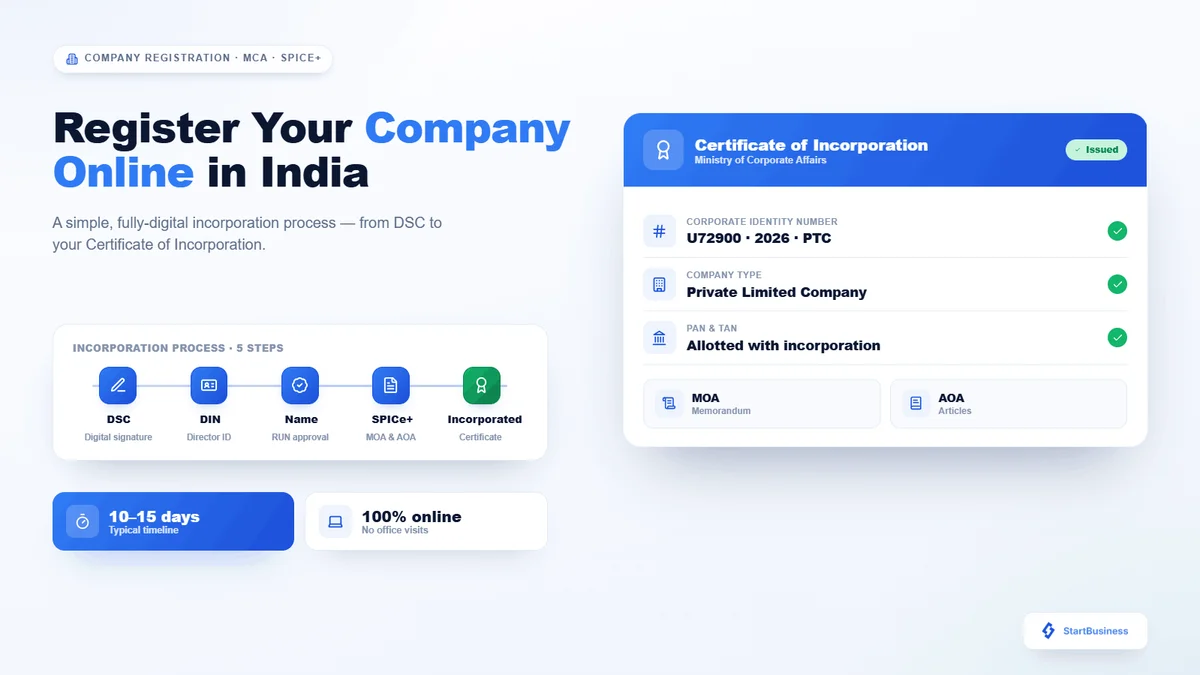
Before applying for Startup India, your business must be legally incorporated in India as a Private Limited Company, LLP, or Partnership Firm.
---
Step 2: Create an Account on the Startup India Portal
- Visit the Startup India official portal
- Click on Register
- Sign up using:
- Name
- Email ID
- Mobile number
- Verify your account using OTP
---
Step 3: Apply for DPIIT Recognition
- Log in to the Startup India portal
- Click on Apply for DPIIT Recognition
- Fill in the required details:
- Entity name and type
- Date of incorporation
- PAN details
- Registered office address
- Industry sector
- Business activity description
Step 4: Upload Required Documents
Upload the following:
- Certificate of Incorporation / Registration
- Authorization letter (if the application is filed by an authorized representative)
- Brief write-up explaining:
- Nature of the business
- Innovation or scalability
- How the startup adds value
---
Step 5: Self-Certification and Declaration
- Confirm that the startup meets all eligibility conditions
- Declare that the information provided is accurate
- Submit the application
---
Step 6: Receive DPIIT Recognition Certificate
- Once submitted, the DPIIT recognition is usually issued within a few working days
- The certificate can be downloaded directly from the Startup India dashboard
---
Post-Registration: Optional but Important Steps
Apply for Tax Exemptions
Apply separately for income tax exemption through the Inter-Ministerial Board (IMB). File Form 56 and supporting documents. You can use the StartBusiness GST Calculator to stay on top of your indirect tax obligations as your startup scales.
Register for IPR Benefits
- Avail fast-track patent and trademark filing
- Get up to 80% rebate on patent filing fees
Explore Government Funding Schemes
- Startup India Seed Fund Scheme (SISFS)
- Fund of Funds for Startups (FFS)
- State-level startup policies and grants
---
Common Mistakes to Avoid
- Providing vague or unclear business descriptions
- Applying without proper incorporation
- Not highlighting innovation or scalability
- Submitting incorrect or mismatched documents
---
Conclusion
Registering your startup under the Startup India initiative is a strategic move that can significantly reduce compliance burden and open doors to funding, tax benefits, and government support. With a simple online process and minimal documentation, DPIIT recognition can be obtained quickly if eligibility criteria are met.
If you are building an innovative and scalable business in India, Startup India registration is a must-have milestone in your entrepreneurial journey.
---
Disclaimer: Government rules and benefits may change from time to time. It is advisable to verify the latest guidelines on the official Startup India portal or consult a professional before applying.
We handle business incorporation and deed drafting end-to-end, tailored to your needs.

Practising from Deccan Gymkhana, Pune since 2017. Has handled 1,000+ incorporations and ongoing compliance for founders across Maharashtra, from single-partner proprietorships to funded private limited companies.