

Key takeaways
- Checked and verified against current regulatory guidelines by practising CAs/CSs.
- Covers key requirements, step-by-step registration procedures, and statutory compliance timelines.
- Includes actionable insights tailored for Indian founders and business owners.
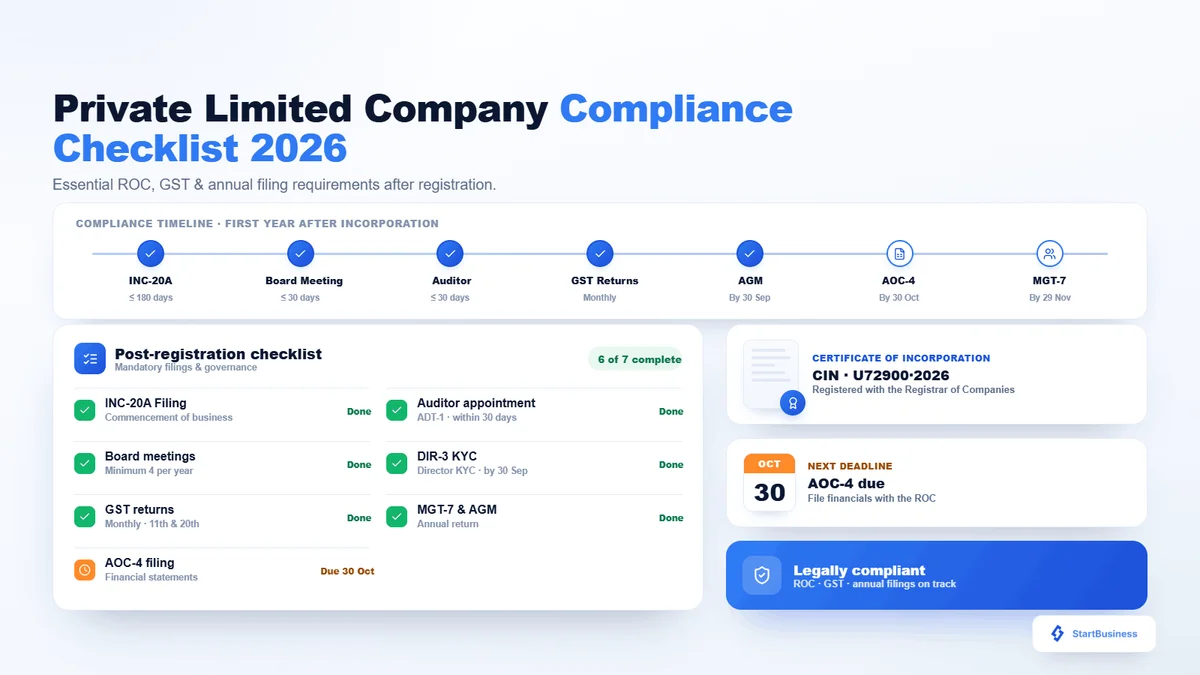
Registering your Private Limited Company is just the beginning. The real work starts the moment your Certificate of Incorporation arrives. Indian company law — primarily the Companies Act, 2013 — imposes a structured set of post-incorporation obligations on every Private Limited Company. Missing these deadlines can attract hefty penalties, director disqualification, or even strike-off. This guide covers everything you need to know: from your very first compliance task to recurring annual filings. If you are planning to register a Private Limited Company, explore our Private Limited Company Registration Service for end-to-end expert assistance.
What Are the Immediate Compliance Steps after Registering a Private Limited Company in India?
Most founders assume compliance begins at the end of the financial year. It does not. Within the first few weeks of incorporation, several time-sensitive obligations kick in.
1. File INC-20A — Declaration of Commencement of Business
This is the single most critical post-incorporation filing. Every company that has a share capital must file Form INC-20A with the Registrar of Companies (ROC) within 180 days of incorporation. It declares that the subscribers have deposited the paid-up capital into the company's bank account.
Note: If you do not file INC-20A on time, your company CANNOT legally commence any business activity.
The penalty is ₹50,000 on the company and ₹1,000 per day on each defaulting director until it is filed.
2. Open a Company Bank Account
Open a current account in the company's name immediately after receiving the Certificate of Incorporation. The account is needed to deposit paid-up share capital — which is a prerequisite for filing INC-20A.
3. Appoint a Statutory Auditor
Under Section 139 of the Companies Act, 2013, a Private Limited Company must appoint its first statutory auditor within 30 days of incorporation via a Board Resolution. Thereafter, file Form ADT-1 with the ROC to formally intimate the appointment. Failure to appoint an auditor can attract penalties under the Act.
4. Issue Share Certificates
Share certificates must be issued to all shareholders within 60 days of incorporation (or allotment). This is a statutory obligation under Section 46 of the Companies Act, 2013, and is not optional.
5. Hold the First Board Meeting
Your first Board Meeting must be held within 30 days of incorporation. During this meeting, you should: appoint the statutory auditor, disclose director interests, note the Certificate of Incorporation, and adopt the company's official address and letterhead.
6. Apply for PAN and TAN
PAN (Permanent Account Number) and TAN (Tax Deduction Account Number) are mandatory for all companies. These are typically applied for during the incorporation process via the SPICe+ form. Verify that both have been issued before commencing any business transactions.
7. Register the Registered Office
File Form INC-22 within 30 days if the registered office details were not finalised at the time of incorporation. The Companies Act requires your company name and CIN (Corporate Identification Number) to be displayed visibly at the registered office address.
What Is INC-20A Filing and Why Is It Important for New Companies?
Form INC-20A is a one-time declaration filed by the directors of a company with the ROC. It certifies that every subscriber to the Memorandum of Association (MoA) has paid their share of the paid-up capital into the company's bank account.
It was introduced in 2018 to curb the formation of shell companies and ensure that companies with registered capital are actually operational. Without this declaration:
• The company cannot legally begin or carry on any business activity
• The company cannot borrow money from any source
• The ROC can initiate proceedings to remove the company's name from the register
Directors face personal monetary penalties
Key Details: INC-20A at a Glance
Who files it: All directors of the company
When to file: Within 180 days of the date of incorporation
What is attached: Bank account statement showing the capital deposit
Government fee: ₹200 (for companies with share capital up to ₹1 lakh) — varies by capital
Penalty for late/non-filing: ₹50,000 (company) + ₹1,000/day per director
What ROC Compliances Must a Private Limited Company Follow Every Year?
Beyond the first-year obligations, a Private Limited Company has a structured annual compliance calendar governed by the Companies Act, 2013. These filings must be made with the Registrar of Companies (ROC) every year, regardless of whether the company has started operations or generated revenue.
Annual General Meeting (AGM)
Every Private Limited Company must hold its AGM within six months of the close of each financial year. Since India follows an April-to-March financial year, this means AGM must be conducted by September 30 each year.
The first AGM, however, must be held within nine months of the end of the first financial year — so if your company was incorporated mid-year, plan accordingly.
Form AOC-4: Filing of Financial Statements
After the AGM, the company must file its audited financial statements (Balance Sheet, P&L Account, Directors' Report, Auditor's Report) using Form AOC-4 within 30 days of the AGM date.
Form MGT-7A / MGT-7: Annual Return
Form MGT-7A is for small companies and OPCs (One Person Companies). Larger Private Limited Companies file Form MGT-7. This return captures ownership structure, director details, shareholding patterns, and other corporate information. It must be filed within 60 days of the AGM.
DIR-3 KYC: Director KYC Update
Every director who holds a Director Identification Number (DIN) must complete their KYC annually by September 30. Web-based DIR-3 KYC is available for directors with no changes to their details. Missing this deadline results in DIN deactivation, which prevents the director from digitally signing any company document.
Form ADT-1: Auditor Reappointment
If the company is re-appointing its auditor for the next term, Form ADT-1 must be filed with the ROC within 15 days of the AGM where the reappointment is approved.
Form MSME-1: MSME Dues Reporting (If Applicable)
If your company has outstanding payments to MSME suppliers beyond 45 days, you must file Form MSME-1 on a half-yearly basis (by April 30 for the October-March period, and by October 31 for the April-September period). Failure to file can attract penalties ranging from ₹25,000 to ₹3 lakh.
What Are the Mandatory Annual Filings for a Private Limited Company in India?
Here is a consolidated view of the most important annual filings a Private Limited Company must complete:
| Filing | Deadline | Penalty | Consequence |
|---|---|---|---|
| INC-20A | Within 180 days of incorporation | ₹50,000 + ₹1,000/day (director) | Company cannot commence business |
| AOC-4 | Within 30 days of AGM | ₹100/day (no upper cap) | Additional ROC action possible |
| MGT-7 / MGT-7A | Within 60 days of AGM | ₹100/day (no upper cap) | Director disqualification risk |
| ADT-1 | Within 15 days of AGM | ₹300/day up to ₹12 lakh | Auditor appointment lapse |
| DIR-3 KYC | 30 September each year | ₹5,000 per director (reactivation) | DIN gets deactivated |
| MSME Form-1 | Half-yearly (April 30 & Oct 31) | ₹25,000 to ₹3 lakh | Penalties under MSME Act |
Note: The AGM deadline can be extended by up to three months under special circumstances by filing an application with the ROC. However, this does not suspend penalties that have already begun accruing.
Do All Private Limited Companies Need GST Registration After Incorporation?
GST (Goods and Services Tax) registration is not automatically mandatory for every Private Limited Company at the time of incorporation. Whether your company needs GST registration depends on your turnover and the nature of your business.
When GST Registration Is Mandatory
• Your annual turnover crosses ₹40 lakh (for businesses dealing in goods)
• Your annual turnover crosses ₹20 lakh (for businesses dealing in services)
• You make inter-state taxable supplies — even if turnover is below the threshold
• You are involved in e-commerce (selling through Amazon, Flipkart, or your own platform)
You are registered under the composition scheme
Tip for New Startups
Many early-stage startups register for GST voluntarily even before crossing the turnover threshold.
This is because GST registration is often required by enterprise clients, for government tenders,
and for claiming Input Tax Credit (ITC) on your business purchases — which reduces your overall tax cost.
GST Filing Frequency Once Registered
Once registered, a company must file GST returns regularly. The frequency depends on the scheme:
• Regular taxpayers: GSTR-1 (monthly or quarterly), GSTR-3B (monthly or quarterly)
• Annual return: GSTR-9 (mandatory if turnover exceeds ₹2 crore)
• QRMP Scheme: Quarterly returns with monthly payment for smaller businesses
Missing GST return deadlines attracts a late fee of ₹50/day (₹20/day for NIL returns) and annual interest at 18% on the unpaid tax amount.
What Happens If a Company Misses ROC Filing Deadlines in India?
Many first-time founders underestimate ROC penalty structures. Unlike some regulatory violations that are capped at a fixed amount, ROC penalties under the Companies Act, 2013 are often open-ended — they accrue daily until the default is rectified.
Monetary Penalties
For most ROC forms, the default penalty is ₹100 per day per form. Since there is no upper cap for most filings, a 365-day delay on AOC-4 would mean ₹36,500 in penalties for that single form — plus an equal penalty for MGT-7, and another for any other missed filings in that period.
Director Disqualification
Under Section 164(2) of the Companies Act, if a company fails to file its annual returns (AOC-4 and MGT-7) for three consecutive financial years, all its directors become disqualified. A disqualified director cannot be appointed or hold directorship in any other company for five years.
Strike-Off by ROC
Under Section 248 of the Companies Act, the ROC has the power to strike off a company's name from the register if it believes the company has not been carrying on business. Non-filing of returns is one of the key triggers for this. Once struck off, reviving the company requires filing a costly appeal and fulfilling all pending compliances.
CFSS and LLP Settlement Scheme: Amnesty Options
The Ministry of Corporate Affairs (MCA) periodically launches condonation and settlement schemes — such as CFSS (Companies Fresh Start Scheme) — which allow defaulting companies to file overdue returns at a reduced or waived-off penalty. Keep a watch on MCA announcements to benefit from these windows.
How Many Board Meetings Are Required for a Private Limited Company in India?
Under Section 173 of the Companies Act, 2013, every Private Limited Company must hold a minimum of four Board Meetings in every calendar year.
There is a critical additional requirement: the gap between two consecutive Board Meetings must not exceed 120 days. This means you cannot hold all four meetings in the last quarter of the year — the schedule must be spread across the year.
Small Company Exception
A company classified as a 'small company' under the Act — with a paid-up share capital not exceeding ₹4 crore and a turnover not exceeding ₹40 crore — is only required to hold two Board Meetings per year, one in each half of the calendar year.
Board Meeting Compliance Checklist
Issue Board Meeting notice to all directors at least 7 days in advance
Send agenda papers along with the notice
Maintain quorum: one-third of total directors or 2 directors, whichever is higher
Prepare and circulate draft minutes within 15 days after the meeting
Finalise and sign minutes within 30 days of the meeting
Record resolutions in the Minutes Book, which is a statutory register
What Documents Must a Private Limited Company Maintain for Compliance?
Maintaining proper statutory records is not just good practice — it is a legal requirement. These registers and documents must be kept at the company's registered office and made available for inspection by shareholders and regulatory authorities.
Statutory Registers (Section 88 & Related)
• Register of Members (MGT-1): Names, addresses, and shareholding of all shareholders
• Register of Directors and KMP: Personal details, DIN, and shareholding of all directors and Key Managerial Personnel
• Register of Loans and Guarantees (MBP-2): Details of all loans given or guarantees provided by the company
• Register of Charges (CHG-7): Details of mortgages, hypothecations, and other charges on company assets
• Register of Contracts (MBP-4): Related-party transactions and contracts where directors have an interest
Books of Accounts
Every company must maintain proper books of accounts under Section 128. These must be preserved for at least eight years from the end of the financial year. If any inquiry is pending, they must be retained until the inquiry is concluded.
Minutes Books
Separate Minutes Books must be maintained for Board Meetings and General Meetings. These are legally admissible documents and must be signed by the Chairman of the respective meeting within 30 days.
Other Mandatory Documents
• Memorandum of Association (MoA) and Articles of Association (AoA)
• Certificate of Incorporation
• All ROC filing acknowledgements and SRNs (Service Request Numbers)
• All share certificates and allotment letters
• Audit reports and financial statements for each year
All Board and shareholder resolutions passed during the year
Private Limited Company Compliance Checklist (2026)
Use this checklist to track all key compliance activities for your Private Limited Company across the year:
| Immediate Post-Incorporation (First 180 Days) |
|---|
| File INC-20A (Declaration of Commencement of Business) within 180 days |
| Open a dedicated current bank account in the company's name |
| Deposit paid-up share capital into the company's bank account |
| Apply for PAN and TAN for the company |
| Get the company seal / rubber stamp made (optional but advisable) |
| Print and affix the company name and CIN on the registered office |
| Appoint a statutory auditor by filing ADT-1 within 30 days of incorporation |
| Issue share certificates to shareholders |
| Hold the first Board Meeting within 30 days of incorporation |
| Annual ROC Filings |
| File AOC-4 (financial statements) within 30 days of AGM |
| File MGT-7A or MGT-7 (annual return) within 60 days of AGM |
| Hold Annual General Meeting (AGM) by September 30 each year |
| File ADT-1 (auditor appointment/reappointment) within 15 days of AGM |
| File DIR-3 KYC for all directors by September 30 each year |
| Board Meetings & Minutes |
| Hold minimum 4 Board Meetings per year |
| Ensure gap between two consecutive meetings does not exceed 120 days |
| Prepare and maintain Board Meeting minutes within 30 days of each meeting |
| Maintain statutory registers: Members, Directors, Loans, Charges |
| Record minutes of every Board Meeting and General Meeting |
| GST & Tax Compliance |
| Register for GST if turnover exceeds ₹40 lakh (goods) or ₹20 lakh (services) |
| File GST returns (monthly/quarterly as applicable) |
| Deposit TDS and file TDS returns quarterly |
| File annual Income Tax Return (ITR-6 for companies) |
| File advance tax payments quarterly if tax liability exceeds ₹10,000 |
| Statutory Records & Maintenance |
| Maintain Register of Members (MGT-1) |
| Maintain Register of Directors and Key Managerial Personnel |
| Maintain Register of Loans, Guarantees & Investments |
| Keep all agreements, contracts, and resolutions in company records |
| File MGT-14 for resolutions passed in Board/General Meetings (as required) |
| Maintain the company's books of accounts for minimum 8 years |
Read Related Articles
If you found this compliance guide useful, these articles will help you with related decisions and processes:
1. Private Limited Company vs LLP in India — Which Is Right for You?
2. How to Register a Private Limited Company in India — Step-by-Step Guide
3. How to Register for Startup India — Step-by-Step Guide for Entrepreneurs
Frequently Asked Questions (FAQs)
Q: What happens if I don't file ROC returns on time?
A: Missing ROC filings like AOC-4 and MGT-7 attracts a penalty of ₹100 per day per form — with no upper cap. Extended defaults can lead to director disqualification under Section 164(2) and even strike-off of the company by the ROC under Section 248. It is always cheaper to file late than not at all.
Q: Is GST mandatory for every Private Limited Company in India?
A: No. GST registration is mandatory only when your annual turnover crosses ₹40 lakh (goods) or ₹20 lakh (services), or if you make inter-state supplies regardless of turnover. However, many startups register voluntarily to claim Input Tax Credit and to qualify for enterprise contracts.
Q: What is the penalty for late filing of AOC-4 and MGT-7?
A: The penalty for late filing of AOC-4 (financial statements) and MGT-7/MGT-7A (annual return) is ₹100 per day, per form, from the date of default until the filing is completed. There is no ceiling on this penalty under the Companies Act, 2013. Late filing fees are separate from the government filing fee.
Q: How often do board meetings need to be conducted?
A: A Private Limited Company must hold at least four Board Meetings every calendar year, with a maximum gap of 120 days between any two consecutive meetings. Small companies (paid-up capital ≤ ₹4 crore, turnover ≤ ₹40 crore) are required to hold only two meetings per year.
Q: What are the basic compliance requirements after company registration?
A: The most immediate requirements are: filing INC-20A within 180 days, opening a company bank account, appointing a statutory auditor within 30 days, holding the first Board Meeting within 30 days, and issuing share certificates to shareholders within 60 days. These must be completed before any business operations begin.
Q: Can a Private Limited Company operate without completing compliance?
A: Technically, a company can continue to exist without filing some annual returns — but it does so illegally, accumulating penalties each day. For INC-20A specifically, a company cannot legally commence business at all until this form is filed. Operating without compliance puts directors at personal risk of disqualification and financial penalties.
We handle business incorporation and deed drafting end-to-end, tailored to your needs.

Practising from Deccan Gymkhana, Pune since 2017. Has handled 1,000+ incorporations and ongoing compliance for founders across Maharashtra, from single-partner proprietorships to funded private limited companies.