
One Person Company (OPC) Registration in India Online
Register your One Person Company (OPC) in India in 12–15 days. Full MCA process, DSC, DIN & compliance. Free expert consultation.
Starter
Everything you need to get incorporated
- DIN + DSC (1 director)
- Nominee appointment
- MOA & AOA drafting
- SPICe+ form — prepared & filed
- Certificate of Incorporation
- PAN + TAN + PF + ESIC + PT Number
Professional
Incorporation + GST + dedicated CA support
- Everything in Starter
- GST Certificate
- Dedicated CA manager
Growth
Full-stack setup with future-proofing
- Everything in Professional
- MSME Certificate
- Custom MOA/AOA clauses
- OPC to Pvt Ltd conversion advisory
Ideal For
Whether you're launching your first venture or scaling an established business, a OPC offers the flexibility and credibility to grow with confidence.
Solo Entrepreneurs
If you are starting a business on your own and want the protection and credibility of a registered company without needing a co-founder, an OPC is purpose-built for you.
Freelancers Going Corporate
Freelancers billing ₹10–50 lakh annually often hit a ceiling with clients who demand formal invoices, TDS compliance, and a registered entity. An OPC is the cleanest upgrade from freelancer to business owner.
Creative Professionals
Designers, photographers, content creators, and artists who run independent studios can protect their personal assets, open a business bank account, and issue professional GST invoices under their OPC.
Online Sellers & E-commerce Founders
Selling on Amazon, Flipkart, or your own Shopify store? Marketplaces and payment gateways prefer registered companies. An OPC gives you the entity status needed to scale your online retail business.
Solo Tech Founders
Building a SaaS product, app, or tech service solo? An OPC lets you sign enterprise contracts, apply for government startup schemes like Startup India, and lay the groundwork before you bring on a co-founder.
Consultants & Coaches
Management consultants, business coaches, trainers, and advisors who operate independently can use an OPC to add corporate credibility, separate business finances, and engage corporate clients with confidence.
Why Choose a
OPC?
Liability Protection
Protect your personal assets from business liabilities.
Investor & Funding Ready
Built to attract investors and raise capital with confidence.
Separate Legal Entity
Operate as an independent business with lasting legal identity.
Better Tax & Business Benefits
Unlock tax advantages and support long-term business growth.
Strong Business Credibility
Build trust with customers, banks, and business partners.
What is One Person Company?
The One Person Company (OPC) is a business structure introduced in India under the Companies Act, 2013, designed for solo entrepreneurs. It can be formed by a single individual as both shareholder and director. It offers the benefits of limited liability like a private company, with simplified compliance requirements, making it ideal for individuals wanting a formal, credible setup without the complexity of a partnership or Pvt Ltd company. It is defined under Section 2(62) of the Companies Act, 2013, as a company with only one member.
Why 1,000+ Founders Trust StartBusiness
From documentation to MCA approvals, our experts manage every step of your incorporation—so you can focus on building your business instead of paperwork.
Day Turnaround
Estimated incorporation timeline.
Dedicated CA
A single expert from start to finish.
Pre-Filing Review
Every application is reviewed before submission.
Hidden Charges
Clear pricing with government fees at actuals.
Compliance Kit
Everything you need for your OPC.
Compare Your Registration Options
See how StartBusiness compares to DIY registration and traditional CA firms.
Documents Needed for OPC Registration
KYC, identity, and address proof required for OPC incorporation.
Director
- PAN Card of the director
- Aadhaar Card of the director
- Passport size photographs (2 copies)
- Address proof (Bank statement/Utility bill)
- Mobile number linked with Aadhaar
- Email ID of the director
Nominee
- PAN Card of the nominee
- Aadhaar Card of the nominee
- Passport size photographs of nominee
- Address proof of nominee
- Consent letter from nominee
What You Get:
Full-Service OPC Setup
You provide your documents. We handle everything else — every form, every filing, every follow-up with government portals — until your business is live.
Documents We Prepare for You
- Digital Signature Certificate (DSC)
- Director Identification Number (DIN)
- MOA & AOA — professionally drafted
- SPICe+ form — prepared & filed
- Nominee appointment documentation
- Statutory registers setup
Registrations We File
- Company name approval on MCA
- Certificate of Incorporation
- PAN card for your company
- TAN (Tax Deduction Number)
- GST registration (select plans)
- MSME/Udyam registration (select plans)
Your Registration, Step by Step
A clear timeline from document upload to certificate — no guesswork, no waiting in the dark.
Digital Signature Certificate (DSC)
Obtain DSC for the director to digitally sign documents during the registration process.
Director Identification Number (DIN)
Apply for DIN for the director through MCA portal with required documents.
Name Reservation
Reserve unique company name through SPICe+ form with alternative name options.
Document Preparation
Prepare Memorandum of Association (MoA), Articles of Association (AoA), and other incorporation documents.
SPICe+ Form Filing
Submit SPICe+ form with all documents and fees to MCA for incorporation approval.
Certificate of Incorporation
Receive Certificate of Incorporation, PAN, TAN, and complete post-incorporation formalities.

Not Sure Where to Begin?
Let's Talk.
Get a free 15-minute consultation with a senior CA. Clear answers on entity types, timelines, and costs — with zero sales pressure.
Talk to an ExpertFrequently Asked Questions
Got questions? Find quick, expert answers to everything you need to know before getting started
A One Person Company (OPC) is a type of private limited company introduced under the Companies Act, 2013 that allows a single individual to form and own a company with limited liability. Unlike a sole proprietorship, an OPC is a separate legal entity — it can own assets, enter contracts, and operate independently of its owner. It combines the simplicity of sole ownership with the legal protection and credibility of a registered company.
Only a natural person who is an Indian citizen and resident in India (having stayed in India for at least 182 days in the preceding calendar year) can incorporate an OPC. A person can be a member in only one OPC at a time, and minors are not eligible. Foreign nationals, NRIs, and HUFs cannot form an OPC. The nominee appointed must also be an Indian citizen and resident.
Yes, appointing a nominee is a legal requirement for OPC incorporation under the Companies Act, 2013. The nominee is an Indian citizen and resident who will take over the OPC in the event of the sole member's death or incapacity. The nominee must give written consent (Form INC-3) and their details are submitted to the MCA at the time of incorporation. The nominee has no rights or ownership in the OPC while the sole member is alive and active.
If your OPC's paid-up share capital exceeds ₹50 lakh OR its average annual turnover over three consecutive financial years exceeds ₹2 crore, the company is legally required to convert to a Private Limited Company within six months of crossing these thresholds. The company must file Form INC-5 to intimate the MCA. Failure to convert within the prescribed timeline attracts penalties. StartBusiness's Growth plan includes advisory for this conversion so you are fully prepared when you scale.
An OPC cannot issue shares to investors or raise equity funding while it remains an OPC, because it can have only one member (shareholder). Venture capitalists, angel investors, and institutional funds require equity stakes, which an OPC structure does not permit. However, an OPC can raise debt (loans from banks and NBFCs). If you plan to raise VC or angel funding, you would need to convert the OPC to a Private Limited Company first — and our Growth plan advisory covers exactly this transition.
An OPC must fulfill several annual compliance obligations: (1) hold at least two Board Meetings per year with a minimum gap of 90 days; (2) maintain proper books of accounts and statutory registers; (3) prepare financial statements and get them audited by a Chartered Accountant; (4) file AOC-4 (financial statements) with MCA within 180 days of financial year end; (5) file MGT-7A (annual return) within 60 days of financial year end; (6) file income tax return by the applicable due date; and (7) file GST returns if registered. StartBusiness offers affordable Annual Compliance packages to handle all of this for you.

“StartBusiness made our LLP registration incredibly simple. They handled all legal requirements and paperwork efficiently. Highly recommended for any new founders.”
Mr. Hemant Patil
Apaha Institute Of Construction Project Management LLP
“StartBusiness made our LLP registration incredibly simple. They handled all legal requirements and paperwork efficiently. Highly recommended for any new founders.”
Mr. Hemant Patil
Apaha Institute Of Construction Project Management LLP
Blogs & Guides
Explore practical guides, compliance checklists, and expert tax insights written by CAs to help you make smarter business decisions.
GST Registration Turnover Limit in India: Thresholds, Eligibility & Rules
Do you need GST registration? Learn the ₹20 lakh & ₹40 lakh turnover limits and when registration is mandatory.
Presumptive Taxation in India: Sections 44AD, 44ADA & 44AE
Confused about presumptive taxation? Learn Section 44AD, 44ADA & 44AE with eligibility and tax details.
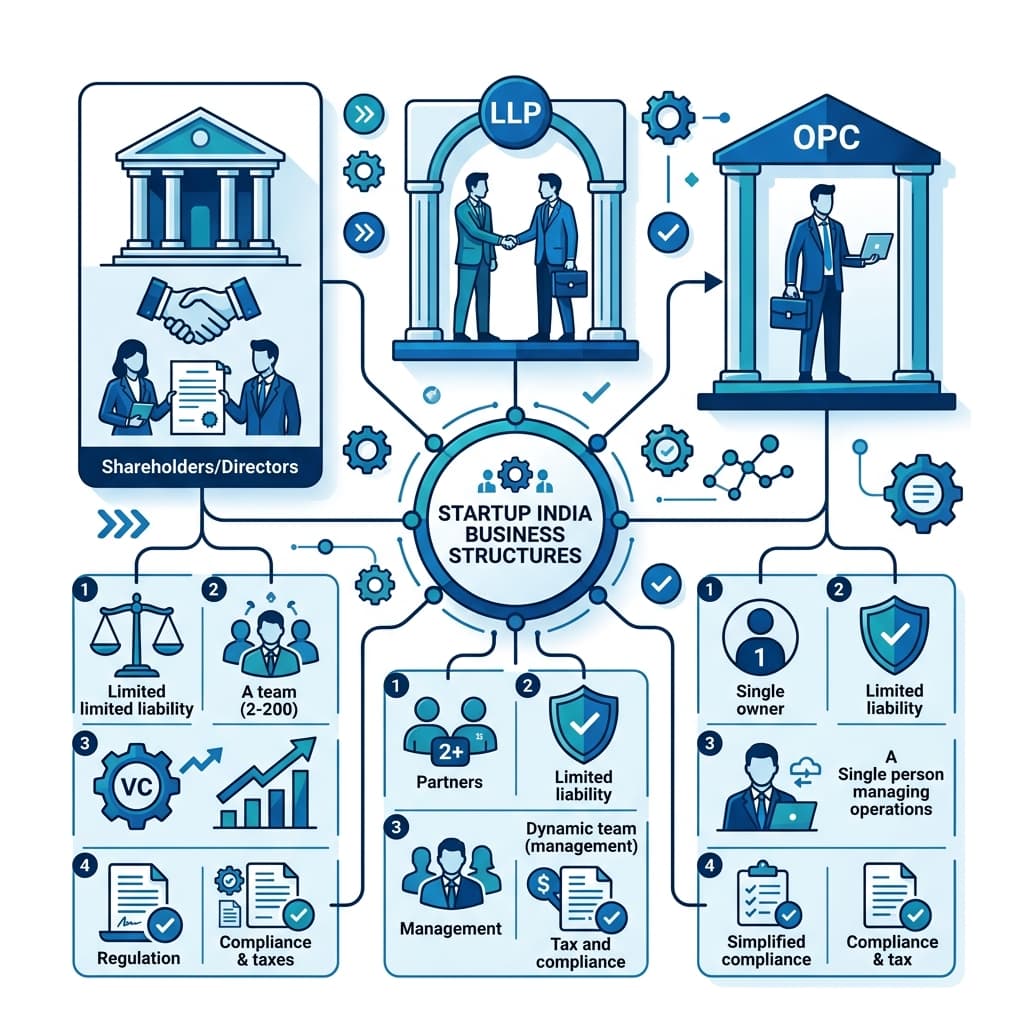
How Much Does It Cost to Register a Company in India?
Government fees, professional fees and hidden costs of registering a Private Limited Company, LLP or OPC.

Start Your Business Journey
in Under 15 Minutes.
Get a free 15-minute consultation with a senior CA. Clear answers on entity types, timelines, and costs - with zero sales pressure.