
Producer Company Registration
Form a company owned by primary producers or farmers to collectively engage in production, harvesting, and marketing activities.
Starter
Get your Producer Company legally incorporated
- Minimum 10 primary producer members onboarded
- DIN (Director Identification Number) for all directors
- DSC (Digital Signature Certificate) for directors
- MOA & AOA drafted with primary produce objects
- SPICe+ form preparation and filing with MCA
- Certificate of Incorporation (Producer Company)
- PAN and TAN allotment
Professional
Incorporate and unlock government grant eligibility
- Everything in Starter
- NABARD / SFAC FPO scheme application support
- Business Plan preparation for FPO scheme eligibility
- Bank account opening assistance
- GST Registration
Growth
Full FPO setup with compliance and equity grant support
- Everything in Professional
- Full FPO scheme documentation package
- Equity grant application support (up to ₹18 lakh)
- Credit Guarantee Fund application guidance
- Annual compliance setup — AOC-4, MGT-7, statutory audit coordination
- First-year compliance advisory
What is a Producer Company?
A Producer Company is a corporate entity formed by primary producers (farmers, artisans, etc.) to collectively undertake production, harvesting, procurement, grading, pooling, handling, marketing, selling, and export of primary produce.
Ideal For
Whether you're launching your first venture or scaling an established business, a Producer Company offers the flexibility and credibility to grow with confidence.
Crop Farmers — Wheat, Rice & Vegetables
Groups of 10 or more farmers cultivating staple or horticultural crops can pool their produce under a Producer Company to access government procurement, FCI empanelment, and direct sales to FMCG companies — eliminating the mandi middleman and realising significantly higher farm-gate prices.
Dairy Producers and Milk Cooperatives
Dairy farmers who want a structured alternative to informal milk cooperatives or dependence on a single aggregator can incorporate a Producer Company to collectively own chilling infrastructure, negotiate with dairy brands, and access NDDB and NABARD dairy development schemes.
Fishermen and Aquaculture Communities
Coastal and inland fishing communities can form a Producer Company to collectively own cold storage, processing facilities, and boats — and access PMMSY (Pradhan Mantri Matsya Sampada Yojana) government grants that are available exclusively to formally registered producer organisations.
Organic and Speciality Produce Farmers
Farmers producing certified organic, GI-tagged, or speciality crops (spices, medicinal herbs, specialty rice varieties) can use a Producer Company structure to collectively market under a unified brand, access premium export channels, and meet the traceability requirements of modern retail and export buyers.
Weavers, Artisans and Handicraft Producers
Under the Companies Act 2013, weavers, potters, and artisans who are 'engaged in any activity connected with or relatable to primary produce' can form a Producer Company. This gives traditional craft communities access to government schemes, collective branding rights, and institutional credit unavailable to informal SHGs.
Agri-Entrepreneurs and FPO Promoters
Agri-professionals, NGOs, or development organisations promoting and managing FPOs on behalf of farmer communities can use the Producer Company structure to create a scalable, governable, and grant-eligible entity — providing the institutional backbone needed for serious agri-business ventures.
Why Choose a
Producer Company?
Liability Protection
Protect your personal assets from business liabilities.
Investor & Funding Ready
Built to attract investors and raise capital with confidence.
Separate Legal Entity
Operate as an independent business with lasting legal identity.
Better Tax & Business Benefits
Unlock tax advantages and support long-term business growth.
Strong Business Credibility
Build trust with customers, banks, and business partners.
Why 1,000+ Founders Trust StartBusiness
From documentation to MCA approvals, our experts manage every step of your incorporation—so you can focus on building your business instead of paperwork.
Day Turnaround
Estimated incorporation timeline.
Dedicated CA
A single expert from start to finish.
Pre-Filing Review
Every application is reviewed before submission.
Hidden Charges
Clear pricing with government fees at actuals.
Compliance Kit
Everything you need for your Producer Company.
Compare Your Registration Options
See how StartBusiness compares to DIY registration and traditional CA firms.
Documents for Producer Company Registration
Member KYC, producer certificates, and incorporation documents.
Directors / Owners
- PAN and Aadhaar of members
- Land ownership documents
- Producer membership proof
- Address proof of registered office
- Bank account details
- Member consent letters
Registered Office / Business Address
- Rent agreement/ownership deed
- Utility bills (not older than 2 months)
- NOC from property owner
- Property tax receipt
- Municipality trade license
- Office photographs
What You Get:
Full-Service Producer Company Setup
You provide your documents. We handle everything else — every form, every filing, every follow-up with government portals — until your business is live.
Documents We Prepare for You
- DSC (Digital Signature Certificate) for all designated directors
- DIN (Director Identification Number) for all directors
- MOA & AOA drafted specifically with primary produce objects as required under Companies Act 2013
- Membership and share certificate documents for all member-shareholders
- Statutory registers setup — register of members, register of directors
- SPICe+ form — fully prepared and filed with MCA
Registrations We File
- Name approval on MCA portal (RUN form)
- Certificate of Incorporation (Producer Company under Part IXA)
- PAN (Permanent Account Number) allotment
- TAN (Tax Deduction Account Number) allotment
- FPO scheme registration guidance with NABARD / SFAC / NCDC
- GST Registration (Professional and Growth plans)
Your Registration, Step by Step
A clear timeline from document upload to certificate — no guesswork, no waiting in the dark.
Typical total: 20-25 working days
Step 1
Member Verification
Verify producer status of all members
Step 2
Name Reservation
Apply for company name with 'Producer Company Limited' suffix
Step 3
Documentation
Prepare MOA, AOA as per Producer Company provisions
Step 4
Filing
File incorporation documents with MCA
Step 5
Registration
Obtain Certificate of Incorporation

Not Sure Where to Begin?
Let's Talk.
Get a free 15-minute consultation with a senior CA. Clear answers on entity types, timelines, and costs — with zero sales pressure.
Talk to an ExpertFrequently Asked Questions
Got questions? Find quick, expert answers to everything you need to know before getting started
A Producer Company is a type of company registered under Part IXA of the Companies Act 2013, specifically designed for primary producers — farmers, fishermen, dairy producers, weavers, and artisans. It combines the democratic governance principles of a cooperative with the legal structure and transparency of a company. A minimum of 10 primary producer individuals (or 2 producer institutions) are required to form a Producer Company. All members must be engaged in activities connected to primary produce, and the company's objects must be limited to activities related to primary produce — such as production, harvesting, processing, procurement, grading, pooling, marketing, and sale.
While both are member-owned organisations for primary producers, Producer Companies are registered under the Companies Act 2013 and regulated by the Ministry of Corporate Affairs — giving them far greater legal enforceability, national portability, and access to corporate banking and private equity. Cooperative Societies are registered under state-level Cooperative Acts, making their operations geographically restricted and subject to heavy state government interference in management. Producer Companies follow MCA compliance (ROC filings, statutory audit under Companies Act), maintain limited liability for members, and are eligible for FPO scheme grants from NABARD, SFAC, and NCDC in a way that is cleaner and more accessible than many cooperative routes.
Yes. Producer Companies are the primary vehicle through which the Government of India's 10,000 FPO scheme disburses financial support. Eligible Producer Companies can receive an equity grant of up to ₹18 lakh (matched against member equity contributions) and access credit guarantee cover of up to ₹2 crore through the Credit Guarantee Fund for FPOs. Additional support is available through NABARD's refinancing schemes, SFAC's venture capital fund for agri-businesses, state government input subsidies, and central schemes like PM-AASHA and PM-KISAN linkages. Being incorporated as a Producer Company (rather than an informal group) is a prerequisite for most of these programmes.
Profits in a Producer Company can be distributed to members in two ways: as dividends on shares (capped to prevent excessive returns to capital) and as a 'patronage bonus' proportional to the volume of business each member conducted with the company during the year. This patronage bonus model ensures that active members — those who contributed more produce or availed more inputs — benefit proportionally more, aligning incentives for genuine participation. The distribution of profits must be approved at the AGM after the statutory audit, and the board is required to maintain a general reserve before any distribution is declared.
A minimum of 10 individual primary producers are required to incorporate a Producer Company. Alternatively, 2 or more producer institutions (such as other registered Producer Companies or cooperatives) can form a Producer Company without the 10-person individual minimum. There is no upper limit on membership — large FPOs often have thousands of member-farmers. Each member receives shares in proportion to their contribution, and voting rights follow the one-member-one-vote principle for individual members (regardless of shareholding), which is a key governance safeguard distinguishing Producer Companies from ordinary private limited companies.
Producer Companies must comply with the following each financial year: (1) Statutory Audit — mandatory every year by a qualified Chartered Accountant; (2) Annual General Meeting — must be held within 90 days of the close of the financial year; (3) Form AOC-4 — filing of financial statements with the ROC within 60 days of the AGM; (4) Form MGT-7 — filing of the annual return with the ROC within 60 days of the AGM; (5) Board meetings — minimum 4 board meetings per year as required under the Companies Act. Producer Companies receiving FPO scheme support additionally have annual reporting obligations to their implementing agency (NABARD, SFAC, or NCDC), including fund utilisation certificates and member data reports. Non-compliance can attract ROC penalties and suspension of government grant benefits.

“StartBusiness made our LLP registration incredibly simple. They handled all legal requirements and paperwork efficiently. Highly recommended for any new founders.”
Mr. Hemant Patil
Apaha Institute Of Construction Project Management LLP
“StartBusiness made our LLP registration incredibly simple. They handled all legal requirements and paperwork efficiently. Highly recommended for any new founders.”
Mr. Hemant Patil
Apaha Institute Of Construction Project Management LLP
Blogs & Guides
Explore practical guides, compliance checklists, and expert tax insights written by CAs to help you make smarter business decisions.
GST Registration Turnover Limit in India: Thresholds, Eligibility & Rules
Do you need GST registration? Learn the ₹20 lakh & ₹40 lakh turnover limits and when registration is mandatory.
Presumptive Taxation in India: Sections 44AD, 44ADA & 44AE
Confused about presumptive taxation? Learn Section 44AD, 44ADA & 44AE with eligibility and tax details.
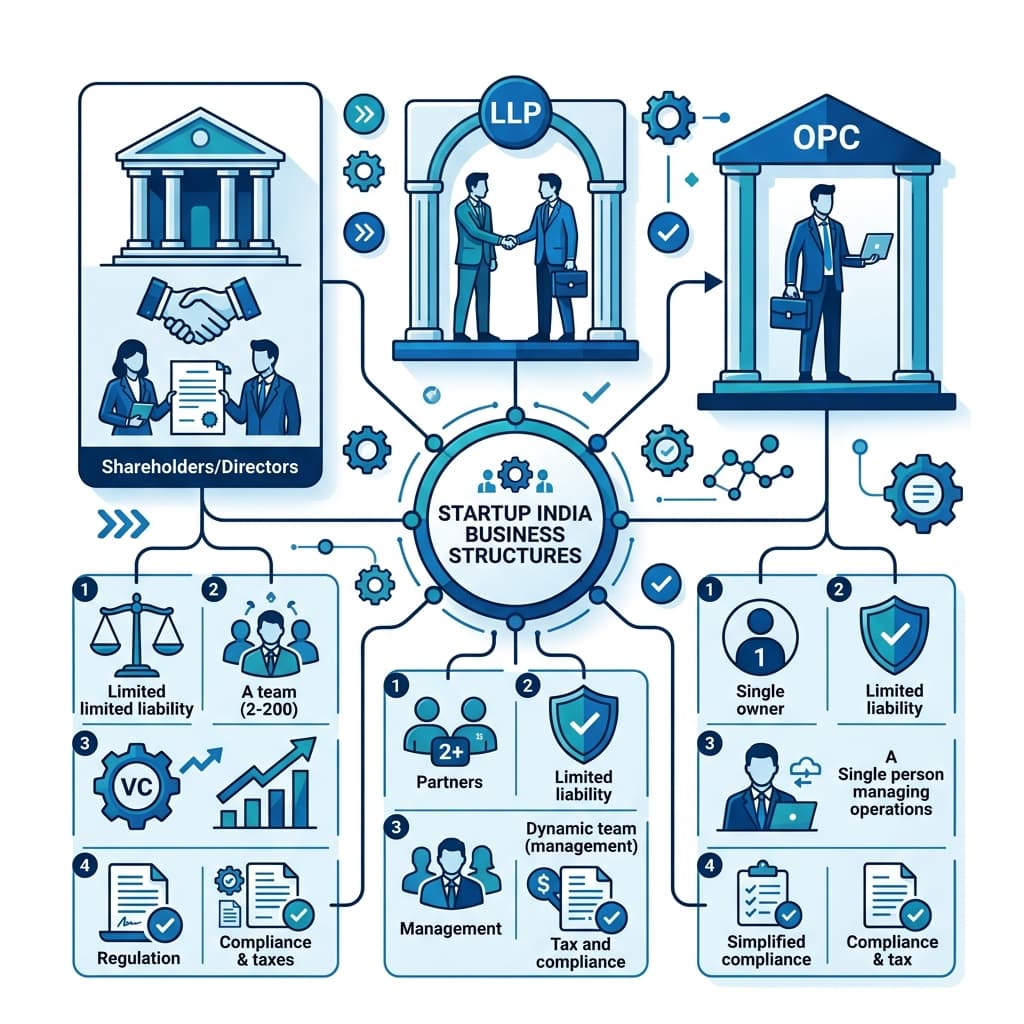
How Much Does It Cost to Register a Company in India?
Government fees, professional fees and hidden costs of registering a Private Limited Company, LLP or OPC.
Official sources: Ministry of Corporate Affairs (MCA) · Income Tax Department