

Key takeaways
- Checked and verified against current regulatory guidelines by practising CAs/CSs.
- Covers key requirements, step-by-step registration procedures, and statutory compliance timelines.
- Includes actionable insights tailored for Indian founders and business owners.
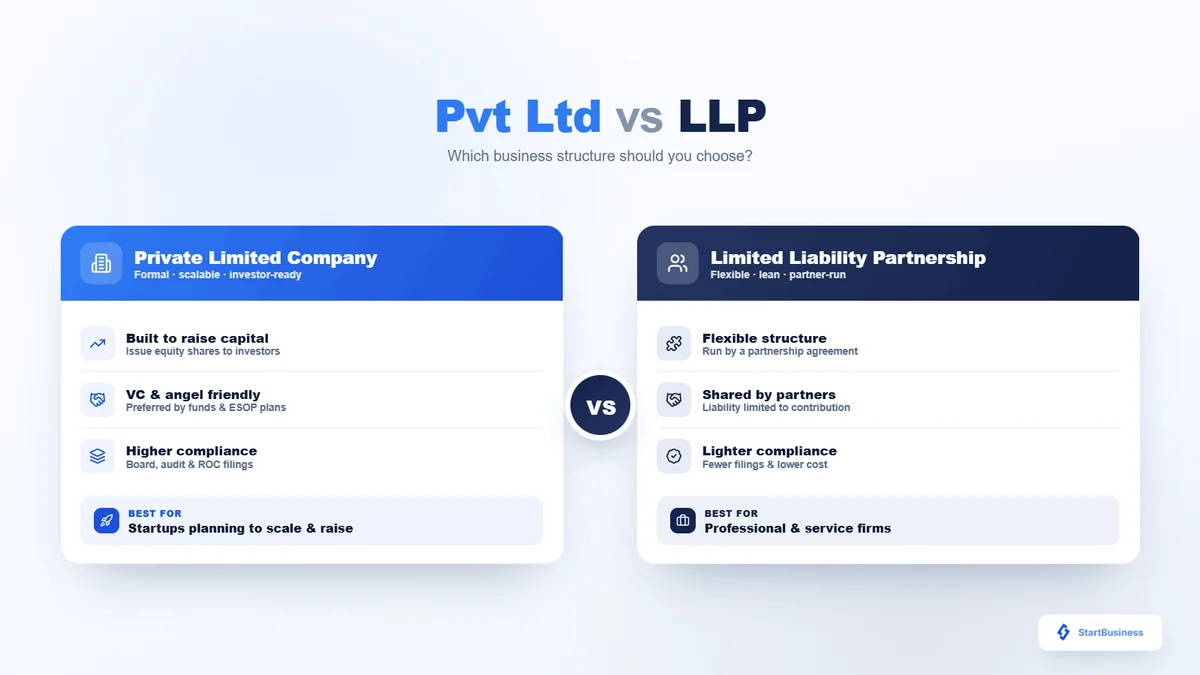
Pvt Ltd vs LLP Which Should You Choose?
In India, choosing between a Private Limited Company and an LLP depends on three things: whether you need funding, how much compliance you can manage, and how fast you plan to grow.
If you are building a startup, want to raise capital from investors, or plan to scale with a team — register a Private Limited Company. It is the only structure that lets you issue equity shares to investors, offer ESOPs to employees, and access institutional credit.
If you are a freelancer, consultant, or running a small professional services firm — an LLP is the smarter, leaner choice. It costs less to maintain, has lower annual compliance, and lets partners split profits without double taxation. You can register with LLP Registration in India.
Verdict: Pvt Ltd for startups and growth-stage businesses. LLP for professionals, small businesses, and self-funded ventures. The structure you choose on Day 1 shapes everything from investor conversations to your annual tax bill — get it right the first time or talk to our experts before you register.
Not Sure which to Pick? Most founders get this wrong
— Get a free 30-minute consultation - talk to our experts
Choosing the wrong structure means re-registration fees, compliance headaches, and rejected investor term sheets later. Fix it before you start.
What is a Private Limited Company?
A Private Limited Company is incorporated under the Companies Act, 2013, regulated by the Ministry of Corporate Affairs. It has a separate legal identity, limited liability for shareholders, and can raise funding by issuing shares. For full details, visit Private Limited Company Registration in India.
Key features at a glance:
• Minimum 2 directors and 2 shareholders (can be the same persons)
• Separate legal entity — can own property, sue, and be sued
• Can issue shares to investors, including foreign investors under FDI
• Eligible for Startup India recognition and DPIIT tax benefits
• Mandatory statutory audit regardless of turnover
What is an LLP?
A Limited Liability Partnership is governed by the LLP Act, 2008. It combines the flexibility of a partnership with a corporate structure partners have limited liability, and the LLP exists as a separate legal entity. See LLP Registration in India for step-by-step details.
Key features at a glance:
• Minimum 2 designated partners; no upper limit on total partners
• Partners' personal assets protected from business liabilities
• No mandatory audit if turnover is below Rs. 40 lakh and contribution below Rs. 25 lakh
• No board meetings, no requirement for a Company Secretary
• Cannot issue equity shares — not suitable for investor funding.
Private Limited Company vs LLP - Key Differences at a Glance
A direct comparison across the factors that matter most when choosing your business structure:
| Feature | Private Limited Company | LLP |
|---|---|---|
| Ownership | Min. 2, Max. 200 shareholders | Min. 2 designated partners, no upper limit |
| Liability | Limited to share capital | Limited to contribution amount |
| Taxation | 22–30% corporate tax + dividend tax on distribution | Flat 30% on profit; no dividend distribution tax |
| Compliance | High — board meetings, ROC filings, statutory audit | Low — minimal filings, audit only above threshold |
| Funding | Can raise equity from angels, VCs, institutions | Cannot issue shares; no equity funding |
| Transferability | Shares freely transferable (per Articles) | Transfer needs partner consent |
| Ideal For | Startups, funded businesses, scaling companies | Professionals, small businesses, freelancers |
Pvt Ltd vs LLP: Which is Better for Small Business in India?
For most small businesses in India, an LLP wins on practicality. The annual cost of running a Pvt Ltd — auditor fees, company secretary retainer, MCA filings — typically runs Rs. 25,000–60,000 per year even if the business makes no profit. An LLP cuts that to Rs. 5,000–15,000 for most small operations.
Beyond cost, LLPs offer flexibility that small business owners value. Profit-sharing ratios, decision-making authority, and capital contributions are all defined in the LLP agreement — no Articles of Association, no board resolutions, no shareholder meetings.
The one scenario where small business owners should still choose Pvt Ltd: if they plan to apply for government tenders, MSME loans above a certain threshold, or need a structure that signals scale to clients. A Pvt Ltd carries more perceived credibility in B2B contexts.
LLP vs Private Limited Company for Startups in India
For startups in India, the answer is almost always Private Limited Company — and the reason comes down to one word: equity.
Angel investors, venture capital firms, accelerators like Y Combinator and Sequoia's Surge — they all invest in exchange for equity (ownership shares). An LLP cannot issue shares. That means if you plan to raise even a single external rupee from an investor, an LLP is structurally incompatible with your funding plan.
There is also the DPIIT startup recognition angle. While both Pvt Ltd and LLP can apply for DPIIT recognition, the income tax exemption under Section 80-IAC — the famous 3-year tax holiday — applies only to eligible Private Limited Companies. In practice, most investors require Pvt Ltd before they engage seriously.
If you are early-stage and bootstrapped with no immediate funding plans, LLP is fine for now. But converting an LLP to Pvt Ltd later requires a fresh incorporation process, transfer of assets, and potential tax implications. Starting as Pvt Ltd from Day 1 is cleaner. Private Limited Company Registration in India.
Difference Between LLP and Private Limited Company with Examples
Example 1: SaaS Startup Seeking Funding
Rohan and Meera build a B2B SaaS product. They get interest from an angel investor who wants a 10% stake for Rs. 20 lakh. They must be a Private Limited Company — equity cannot be issued in an LLP. They register Pvt Ltd, issue shares, and close the round cleanly.
Example 2: Law Firm with Three Partners
Three advocates in Pune want to practice together with shared overhead and split profits 40/35/25. They register an LLP. No audit needed in Year 1 (turnover under threshold), annual filing is simple, and the LLP agreement governs everything. Cost of compliance: under Rs. 10,000 per year.
Example 3: Freelance UX Designer Going Solo-to-Two
A freelancer bringing in Rs. 30 lakh annually wants a business identity and a co-founder. An LLP gives them a formal structure, limited liability, and a professional entity for client contracts — without the overhead of a Pvt Ltd they do not yet need.
LLP vs Pvt Ltd Tax Benefits in India
Tax is where LLP has a genuine structural advantage — specifically around profit distribution.
LLP Tax Structure
• Taxed at flat 30% on net profit at the firm level
• Partners receive their profit share tax-free — no dividend distribution tax
• Surcharge: 12% if income exceeds Rs. 1 crore
• No Minimum Alternate Tax (MAT) for LLPs
Private Limited Company Tax Structure
• Corporate tax: 22% (existing companies) or 15% (new manufacturing, Section 115BAB)
• Dividends paid to shareholders taxed again at their individual slab rate
• MAT at 15% applies if tax payable falls below that threshold
• Retained profits (not distributed) avoid dividend tax useful for reinvestment.
Bottom line: If you plan to take profits out regularly, an LLP's no-dividend-tax structure saves money. If you plan to reinvest profits into growth, a Pvt Ltd's lower corporate tax rate under the new regime is competitive. Run the numbers for your specific withdrawal plan before deciding.
Which is Better - LLP or Pvt Ltd in India?
The short answer: it depends on what your business is and where it is going.
Pvt Ltd is better if you need investor funding, want to scale, or operate in sectors where corporate credibility matters — tech, e-commerce, manufacturing, exports.
LLP is better if you are a professional services provider, a freelancer, or a small team that wants to operate lean with low compliance overhead and flexible profit-sharing.
There is no universally correct answer. The right structure is the one that matches your funding model, compliance appetite, and growth plan. If you are unsure, talk to our experts before you file.
LLP vs Pvt Ltd Compliance Comparison in India
Compliance is one of the biggest practical differences between the two structures — and it directly affects your annual cost of running the business.
| Compliance Requirement | Private Limited Company | LLP |
|---|---|---|
| Statutory Audit | Mandatory every year | Only if turnover > Rs. 40 lakh or contribution > Rs. 25 lakh |
| Annual Filings | Form AOC-4, MGT-7 (MCA) | Form 8 and Form 11 (MCA) |
| Board Meetings | Minimum 4 per year | Not required |
| Company Secretary | Required above threshold | Not required |
| Annual Cost (approx.) | Rs. 25,000–60,000/year | Rs. 5,000–15,000/year |
If keeping your annual overhead low is a priority, the LLP compliance structure is significantly lighter. If you are raising money or building a scalable company, the Pvt Ltd compliance burden is a cost of doing business and investors expect it.
Advantages of Private Limited Company
• Can raise equity funding from angels, VCs, and institutional investors
• Issues ESOPs to attract and retain talent
• Higher credibility with banks, enterprise clients, and partners
• Perpetual succession — company survives ownership changes
• Eligible for Startup India tax benefits under Section 80-IAC
• Easier international expansion and foreign direct investment (FDI)
Advantages of LLP
• Lower compliance cost — no mandatory audit below turnover threshold
• No mandatory board meetings or Company Secretary requirement
• Partners receive profit shares without dividend tax
• Flexible profit-sharing and governance via LLP agreement
• Simpler winding up process compared to a company
• Ideal for professional service firms: CA, legal, architecture, consulting
Disadvantages of Both Structures
Private Limited Company
• High annual compliance: ROC filings, statutory audit, board meetings
• Requires auditor and often a Company Secretary — adds fixed costs
• Dividend distribution triggers additional tax in shareholders' hands
• Winding up is complex, time-consuming, and regulated.
LLP
• Cannot raise equity — structurally incompatible with investor funding
• Lower perceived credibility in investor and enterprise B2B contexts
• DPIIT tax benefits are technically available but rarely leveraged for LLPs
• Late filing penalties are disproportionately high relative to its compliance simplicity.
Which Business Structure is Best for You in India?
Choose a Private Limited Company if:
• You plan to raise funding from investors at any point
• You want ESOPs or a formal equity structure for co-founders
• Your clients are corporates or MNCs who require Pvt Ltd vendors
• You want DPIIT startup recognition and the 3-year tax exemption
• You plan to expand internationally or take on foreign investment
Choose an LLP if:
• You are a professional services firm: law, CA, architecture, consulting
• You are bootstrapped with no equity funding plans
• You want to keep annual compliance costs under Rs. 15,000
• You are a freelancer or micro-business formalising operations
• Flexibility in profit-sharing matters more than investor readiness
Is LLP Better Than Private Limited Company for Freelancers?
For most freelancers in India, yes an LLP is the better fit. Freelancers typically do not need external funding, do not plan to issue equity, and want to minimise administrative overhead.
An LLP gives a freelancer a professional business identity for invoicing, limited liability protection (personal savings are not at risk if a client sues), and a clean structure to bring in a partner later. The compliance is manageable — especially if annual turnover stays under Rs. 40 lakh.
The exception: if you are a freelancer building toward a product or a funded company, start as Pvt Ltd now and save the conversion hassle later. But for pure service-based freelancing, an LLP is leaner and more cost-effective.
Can an LLP Be Converted into a Private Limited Company?
Yes, conversion is possible under the Companies Act, 2013. The process involves applying to the Registrar of Companies (ROC), meeting minimum share capital requirements, and converting the LLP agreement into a Memorandum and Articles of Association.
In practice, the conversion is not a simple formality. It requires valuations, new registrations (GST, PAN, bank accounts), and can take 2–4 months. There are also potential tax implications on asset transfer between the two entities.
If there is any reasonable chance you will need investor funding within 2–3 years, it is significantly cheaper and faster to register as a Private Limited Company from the start. Talk to our experts before you decide.
Which Structure Saves More Tax in India LLP or Pvt Ltd?
It depends on how you withdraw money from the business. If you take profits out regularly as distributions, an LLP saves tax — partner withdrawals are not subject to dividend distribution tax. A Pvt Ltd paying dividends gets taxed at the corporate level and again at the shareholder level.
If you reinvest most profits back into the business, a Pvt Ltd under the new tax regime (22% flat corporate tax) can be more efficient. The effective rate is lower than an LLP's 30% — and since you are not distributing profits, double taxation is not triggered.
For most small businesses withdrawing all profits each year: LLP saves more tax. For growth-stage companies reinvesting profits: Pvt Ltd is often more efficient. Run a projection with your CA using your actual withdrawal plan.
Real-World Use Cases
E-commerce / D2C brand: Register as Pvt Ltd. You will need investor capital, and marketplaces like Flipkart and Amazon prefer corporate vendors for high-value accounts.
CA or law firm: LLP is the industry standard. Regulated bodies like ICAI and BCI recognise LLP practice structures. Compliance is low; profit-sharing is flexible.
B2B SaaS startup: Pvt Ltd without question. Enterprise clients sign contracts with corporate entities; your term sheet from any investor will require it.
Architecture practice: LLP works well. Partners share project revenues, liability is capped, and no mandatory audit below threshold keeps costs low.
Export business: Pvt Ltd. Banks offer better credit lines, export incentive schemes are more accessible, and foreign buyers prefer dealing with incorporated entities.
Already decided? Start your registration today. We handle the paperwork, filings, and follow-ups so you can focus on your business.
— Register your company in 3 easy steps
Frequently Asked Questions
Which is better, LLP or Pvt Ltd in India?
Pvt Ltd is better for startups seeking investment, scale, or DPIIT recognition. LLP is better for professionals, small businesses, and self-funded ventures that want lower compliance costs and simpler profit distribution.
Is LLP income taxable?
Yes. LLP profits are taxed at a flat 30% at the firm level. Partners do not pay additional tax on their profit share — unlike Pvt Ltd dividends, which are taxed again in the shareholder's hands.
What are common LLP mistakes?
Missing annual return deadlines (penalties are steep), drafting a vague LLP agreement that creates disputes, and choosing LLP when the business actually needs equity funding. Also: not tracking contribution limits that trigger mandatory audit.
What are 5 disadvantages of partnership?
(1) Unlimited liability in traditional partnerships. (2) No separate legal entity in general partnerships. (3) Partner disputes can dissolve the firm. (4) No mechanism to raise equity capital. (5) Death or exit of a key partner disrupts operations. LLP resolves points 1 and 2 but not the rest.
What is the golden rule of partnership?
Define everything in writing before you start — profit ratios, decision authority, exit terms, and what happens when partners disagree. Most partnership breakdowns are caused by ambiguity in the agreement, not malice.
How do you take profits from an LLP?
Partners withdraw profits per the LLP agreement — typically at year-end or agreed intervals. These are profit distributions, not salary or dividends. Partners pay income tax on their share at their individual slab rates.
What are the 4 types of partnerships?
(1) General Partnership — all partners have unlimited liability. (2) Limited Partnership — some partners are sleeping investors with limited liability. (3) LLP — all partners have limited liability; separate legal entities. (4) Partnership at Will — no fixed term; dissolves when any partner exits.
Still have questions?
— Contact our team - we help you register the right structure, the first time.
We handle business incorporation and deed drafting end-to-end, tailored to your needs.

Practising from Deccan Gymkhana, Pune since 2017. Has handled 1,000+ incorporations and ongoing compliance for founders across Maharashtra, from single-partner proprietorships to funded private limited companies.