
Key takeaways
- Checked and verified against current regulatory guidelines by practising CAs/CSs.
- Covers key requirements, step-by-step registration procedures, and statutory compliance timelines.
- Includes actionable insights tailored for Indian founders and business owners.
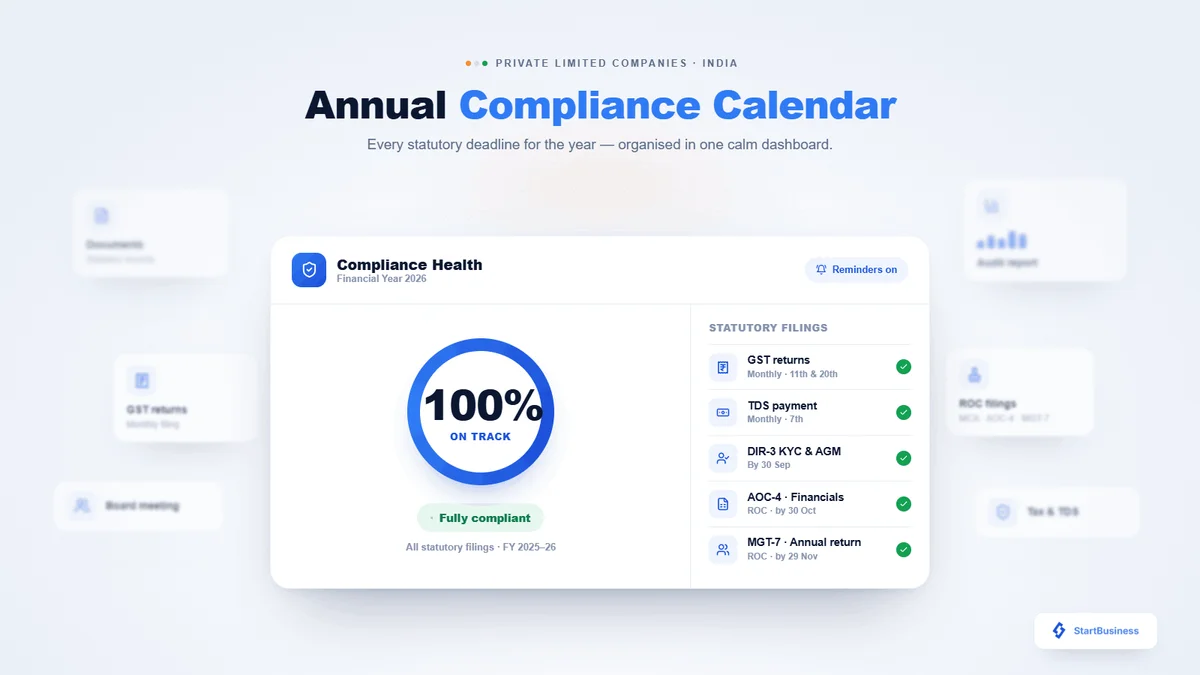
Running a Private Limited Company in India comes with a continuous stream of statutory obligations. Miss a single due date and you risk financial penalties, director disqualification, or company strike-off by the Registrar of Companies (ROC).
The Companies Act, 2013 lays out dozens of filings spread across the year — from monthly GST returns to annual ROC forms. If you are still deciding whether a Private Ltd is the right structure, read our guide on choosing the best business structure for startups first. If you are already incorporated and want a quick overview of all obligations before diving into calendar dates, our Private Limited Company Compliance Checklist is a good companion read.
This article is a different tool. It focuses on when and how often to file — a year-round planning calendar so nothing slips through the gap.
What Is Annual Compliance for a Private Limited Company?
If you are planning to start a Private Limited Company in India, you can register your company online here - Private Limited Company Registration
Annual compliance refers to the mandatory legal filings, disclosures, and procedural obligations that every Private Limited Company incorporated in India must fulfil each financial year under the Companies Act, 2013.
Compliance is not optional. Every Pvt Ltd — regardless of turnover, business activity, or whether it is operational — must meet these obligations. If you have not yet incorporated, read our complete guide on how to register a Private Limited Company in India before worrying about compliance calendars.
If you are comparing structures, our detailed breakdown of a
Private Limited Company vs LLP covers how compliance obligations differ between the two forms — relevant if you are reconsidering your structure.
Who mandates these obligations?
• Ministry of Corporate Affairs (MCA) — ROC filings, director KYC, annual returns
• Income Tax Department (CBDT) — ITR-6 and TDS compliance
• GST Council / CBIC — GST returns and annual reconciliation
• EPFO & ESIC — Monthly PF and ESIC contributions
• MSME Samadhan Portal — Half-yearly MSME-1 disclosure
Annual Compliance Calendar for Private Limited Companies (2026)
The table below covers every major statutory filing for FY 2025–26. Dates follow the standard regulatory calendar; always check MCA and CBDT notifications for any extensions announced during the year.
| Compliance | Form / Return | Due Date (FY 2025–26) | Frequency | Applicability |
|---|---|---|---|---|
| Board Meeting — Q1 | Minutes | By April 30, 2025 | Quarterly | All companies |
| Board Meeting — Q2 | Minutes | By July 31, 2025 | Quarterly | All companies |
| Board Meeting — Q3 | Minutes | By October 31, 2025 | Quarterly | All companies |
| Board Meeting — Q4 | Minutes | By January 31, 2026 | Quarterly | All companies |
| TDS Deposit | Challan 281 | 7th of following month (Mar: Apr 30) | Monthly | TDS deductors |
| PF Contribution | ECR Challan (EPFO) | 15th of following month | Monthly | PF-registered companies |
| ESIC Contribution | ESIC Challan | 15th of following month | Monthly | ESIC-registered companies |
| GST — GSTR-1 | GSTR-1 | 11th of following month | Monthly | Turnover > ₹5 Cr |
| GST — GSTR-3B | GSTR-3B | 20th of following month | Monthly | All GST-registered |
| TDS Return Q1 (Apr–Jun) | Form 24Q / 26Q | July 31, 2025 | Quarterly | All TDS deductors |
| TDS Return Q2 (Jul–Sep) | Form 24Q / 26Q | October 31, 2025 | Quarterly | All TDS deductors |
| TDS Return Q3 (Oct–Dec) | Form 24Q / 26Q | January 31, 2026 | Quarterly | All TDS deductors |
| TDS Return Q4 (Jan–Mar) | Form 24Q / 26Q | May 31, 2026 | Quarterly | All TDS deductors |
| MSME-1 (Oct–Mar period) | MSME Form-1 | April 30, 2025 | Half-yearly | Companies with MSME dues > 45 days |
| MSME-1 (Apr–Sep period) | MSME Form-1 | October 31, 2025 | Half-yearly | Companies with MSME dues > 45 days |
| DPT-3 (Deposits Return) | DPT-3 | June 30, 2025 | Annual | All companies with loans/deposits |
| DIR-3 KYC | DIR-3 KYC / Web | September 30, 2025 | Annual | All directors with DIN |
| Statutory Audit | Audit Report | By September 30, 2025 | Annual | All companies |
| AGM | Board Resolution / Notice | By September 30, 2025 | Annual | All companies |
| ADT-1 (Auditor filing) | ADT-1 | Within 15 days of AGM (~Oct 15) | Annual | All companies |
| AOC-4 (Financial Statements) | AOC-4 / AOC-4 XBRL | Within 30 days of AGM (~Oct 29) | Annual | All companies |
| Income Tax Return | ITR-6 | Oct 31, 2025 (audit); Jul 31 otherwise | Annual | All companies |
| MGT-7 (Annual Return) | MGT-7 / MGT-7A | Within 60 days of AGM (~Nov 28) | Annual | All companies |
| GSTR-9 Annual Return | GSTR-9 | December 31, 2025 | Annual | Turnover > ₹2 Cr |
Note: AGM must be held within 6 months of the financial year end — by September 30, 2025 for FY 2024–25. The first AGM after incorporation can be held within 18 months.
Monthly Compliance Requirements
Monthly obligations run every single month without exception. A single missed TDS deposit or GSTR-3B triggers interest and blocks e-way bill generation — both of which compound quickly.
| Task | Form / Action | Due Date | Consequence of Delay |
|---|---|---|---|
| Deposit TDS collected | Challan 281 | 7th of following month (March: April 30) | Interest @ 1.5%/month + ₹200/day late fee |
| GSTR-1 (outward supplies) | GSTR-1 | 11th of following month | e-Way bill generation blocked; ₹50/day late fee |
| GSTR-3B (tax payment) | GSTR-3B | 20th of following month | Interest @ 18% p.a. on liability; ₹50/day late fee |
| PF Contributions | ECR Challan (EPFO) | 15th of following month | Damages @ 5–25% of arrears |
| ESIC Contributions | ESIC Challan | 15th of following month | Interest + prosecution under ESIC Act |
| Professional Tax (applicable states) | PT Challan | Varies by state (typically monthly) | Penalty under respective State PT Act |
Quarterly Compliance Requirements
Quarterly filings require preparation in advance. TDS returns in particular need reconciliation of all deductions for the entire quarter — last-minute filing increases the chance of errors that attract notices.
| Quarter | Period | TDS Return Due Date | Board Meeting Deadline |
|---|---|---|---|
| Q1 | April – June 2025 | July 31, 2025 | April 30, 2025 (max 120 days from last meeting) |
| Q2 | July – September 2025 | October 31, 2025 | July 31, 2025 |
| Q3 | October – December 2025 | January 31, 2026 | October 31, 2025 |
| Q4 | January – March 2026 | May 31, 2026 | January 31, 2026 |
A minimum of 4 Board Meetings must be held each year with no more than 120 days between consecutive meetings. Companies with only 2 directors may hold at least 1 meeting per half-year.
Half-Yearly Compliance Requirements
MSME Form-1: Disclosure of Outstanding Payments to MSME Vendors
Every Private Limited Company that has received goods or services from registered MSME suppliers and has dues outstanding for more than 45 days must file MSME Form-1 twice a year.
| Half-Year | Period Covered | Due Date | Penalty for Default |
|---|---|---|---|
| First Half | October – March | April 30 each year | ₹25,000 – ₹3,00,000; officer in default liable personally |
| Second Half | April – September | October 31 each year | Same as above |
This is among the most overlooked filings. The obligation arises from dues outstanding at any point during the half-year — not just at the end date. Even if payment has since cleared, the filing is still required if the 45-day threshold was breached.
Annual Compliance Requirements — Filing by Filing
AOC-4: Filing of Financial Statements
AOC-4 is filed to submit the company's audited financial statements — Balance Sheet, Profit & Loss Account, Cash Flow Statement, and Auditor's Report — with the ROC.
• Purpose: Disclose financial health to regulators and the public registry
• Due date: Within 30 days of AGM — effectively October 29 if AGM held on September 30
• Penalty: ₹100 per day of default with no upper cap
• XBRL variant: Required for companies with paid-up capital ≥ ₹5 Cr or turnover ≥ ₹100 Cr
• Related: Our ROC Compliance Checklist for Private Limited Companies covers AOC-4 document preparation in detail
MGT-7 / MGT-7A: Annual Return
MGT-7 discloses the company's shareholding pattern, director details, changes in management, and related-party disclosures for the financial year.
• Purpose: Annual corporate governance and shareholding disclosure to the ROC
• Due date: Within 60 days of AGM — effectively November 28 if AGM held September 30
• MGT-7A: For small companies and One Person Companies (OPCs)
• Penalty: ₹100 per day of default; CS certification mandatory for larger companies
• Related: See our ROC Compliance Checklist for MGT-7 document and certification requirements
DIR-3 KYC: Annual Director KYC
Every individual holding a DIN must verify their KYC annually. Failure deactivates the DIN — a director with a deactivated DIN cannot sign any board resolution or MCA document.
• Due date: September 30 of each year — no extensions typically granted
• Web-based KYC: Available where no personal details have changed
• Penalty: ₹5,000 fee to reactivate a deactivated DIN
• Risk: Deactivation affects all companies the director is associated with
DPT-3: Return of Deposits / Exempted Deposits
DPT-3 discloses all money received by the company that is not classified as a 'deposit' — director loans, shareholder loans, inter-company borrowings, and similar instruments.
• Due date: June 30 of each year (data as of March 31)
• Penalty: ₹5,000–₹25,000 on the company; ₹1,000/day for continuing default
• Scope: Mandatory even for companies claiming exemption under deposit rules
• Tip: If the company has zero qualifying transactions, consult your CS on whether a nil filing is advisable
Income Tax Return (ITR-6)
All companies registered under the Companies Act must file ITR-6 annually, reporting taxable income, deductions, tax liability, and TDS credits.
• Due date (if statutory audit required): October 31 of the assessment year
• Due date (if audit not required): July 31
• Penalty: ₹5,000 if filed by December 31; ₹10,000 if filed after
• Interest: Under Sections 234A, 234B, and 234C for late or short payment
• Audit threshold: Turnover > ₹1 Cr (₹10 Cr if all cash receipts/payments are digital)
ADT-1: Auditor Appointment
Following each AGM, ADT-1 informs the ROC of the appointment or re-appointment of the statutory auditor. Auditors are typically appointed for a 5-year block.
• Due date: Within 15 days of AGM
• Penalty: ₹300 per day on the company and officer in default
Consequences of Non-Compliance
The penalties below are not one-time fines — most compound daily. A 60-day delay on MGT-7 alone costs ₹6,000 just in daily penalties, before additional ROC fees.
| Default | Penalty / Consequence | Who Bears It |
|---|---|---|
| Late AOC-4 or MGT-7 | ₹100 per day — no upper cap | Company + Directors |
| Late ADT-1 | ₹300 per day | Company + Officer in default |
| DIR-3 KYC missed | ₹5,000 reactivation fee; DIN deactivated until paid | Each defaulting Director |
| DPT-3 not filed | ₹5,000–₹25,000 + ₹1,000/day continuing | Company + Officer in default |
| MSME-1 not filed | ₹25,000–₹3,00,000 | Company + Directors |
| TDS not deposited on time | Interest @ 1.5%/month + ₹200/day up to TDS amount | Company |
| GSTR-3B / GSTR-1 late | ₹50/day late fee + 18% p.a. interest on outstanding | Company |
| Director disqualification (Sec 164) | Cannot be director in any company for 5 years | Director personally |
| Company strike-off (Sec 248) | Removed from register; revival only via NCLT | Company |
| ROC prosecution | Criminal prosecution for wilful non-filing | Directors personally |
10 Common Compliance Mistakes Made by Private Limited Companies
These are the mistakes behind most of the penalty notices, DIN deactivations, and strike-off proceedings seen in practice.
1. Filing AOC-4 and MGT-7 'just a few days late' — The ₹100/day penalty has no ceiling. Three years of consistent late filings can result in lakhs in additional fees and director disqualification.
2. Skipping DIR-3 KYC because 'nothing changed' — KYC is annual regardless. DIN deactivation locks the director out of signing resolutions across all companies they serve.
3. Not filing MSME-1 because payment was eventually made — The obligation arises from dues outstanding for over 45 days at any point during the half-year, not just at the period end.
4. Ignoring DPT-3 on the assumption 'we have no deposits' — Director loans, shareholder advances, and inter-company borrowings must be disclosed even when exempt from deposit regulations.
5. Missing Board Meetings or holding them too close together — The 120-day maximum gap between meetings is frequently breached when companies schedule Q4 late. Penalties apply to each director.
6. Letting the AGM slip past September 30 — An extension application to the ROC is available for genuine reasons but is rarely filed. Most companies simply miss the date and absorb the penalties.
7. Assuming the auditor will drive all ROC compliance — AOC-4, MGT-7, and DPT-3 require both a CA and a Company Secretary. Delays from either professional cascade into missed deadlines.
8. Not maintaining statutory registers — Registers of members, directors, contracts, charges, and loans are mandatory under the Companies Act. Absence invites ROC inspection consequences.
9. Skipping TDS on vendor payments — Many early-stage startups omit TDS on professional fees, rent, and contractor payments. This triggers expense disallowance under Section 40(a)(ia) and Section 201 interest.
10. Treating a dormant company as exempt — Every registered Private Limited Company must file annual returns and financial statements even with zero transactions. 'Inactive' is not a filing exemption under the Companies Act.
How StartBusiness Helps Private Limited Companies Stay Compliant
At StartBusiness, compliance management is a core service backed by company secretaries, chartered accountants, and legal professionals who monitor regulatory changes in real time.
| Service | What StartBusiness Handles | Learn More |
|---|---|---|
| Annual ROC Compliance | AOC-4, MGT-7, ADT-1, DPT-3, DIR-3 KYC — prepared, reviewed, and filed on time | ROC Compliance Checklist |
| Company Registration | End-to-end Pvt Ltd incorporation with MCA, DSC, DIN, MOA/AOA drafting | Register Your Company |
| GST Registration & Filing | GST registration, monthly GSTR-1 and GSTR-3B, GSTR-9 annual reconciliation | Contact StartBusiness |
| Startup India Registration | DPIIT recognition, certificate, and tax benefit documentation | Startup India Guide |
| MSME-1 Half-Yearly Filing | Vendor MSME status check and timely Form-1 submission twice a year | Included in annual compliance |
| TDS Compliance | Monthly TDS deposits, Form 16/16A, and quarterly return filing | Contact StartBusiness |
| Director KYC | DIR-3 KYC for all directors before September 30 each year | Included in annual compliance |
| Compliance Calendar Reminders | Proactive deadline alerts for every statutory obligation throughout the year | Compliance Checklist |
Frequently Asked Questions
1. What are the mandatory annual compliances for a Private Limited Company?
Every Private Limited Company must file AOC-4, MGT-7, ADT-1, DIR-3 KYC, DPT-3, and ITR-6 annually. Monthly obligations include GST returns and TDS deposits; quarterly obligations include Board Meetings and TDS returns. The Companies Act, 2013 also mandates a minimum of 4 Board Meetings per year and an AGM within 6 months of the financial year end. For a full document-level breakdown, see our Private Limited Company Compliance Checklist.
2. What is the due date for filing AOC-4 and MGT-7?
AOC-4 must be filed within 30 days of the Annual General Meeting (AGM). MGT-7 must be filed within 60 days of the AGM. Since the AGM must be held by September 30, AOC-4 is typically due October 29 and MGT-7 is due November 28. Delay on either form attracts ₹100 per day of default with no ceiling.
3. What happens if a company fails to file annual returns?
Late filing attracts ₹100 per day of default plus additional ROC fees. Failure to file for 3 consecutive years triggers director disqualification under Section 164(2) — directors cannot serve on any company's board for 5 years. The ROC may also initiate strike-off proceedings under Section 248, removing the company from the register. Revival is possible only through the NCLT at significant cost.
4. Is DIR-3 KYC mandatory every year?
Yes. Every director holding a DIN must file DIR-3 KYC by September 30 each year. Where no personal details have changed, a simplified web-based KYC replaces the full form. Failure to file by the deadline results in DIN deactivation; a ₹5,000 fee applies to reactivate it. A deactivated DIN prevents the director from appearing in any MCA filing across all companies.
5. Can a Private Limited Company be struck off due to non-compliance?
Yes. Under Section 248 of the Companies Act, 2013, the ROC can remove a company from the register if it fails to file financial statements or annual returns for 2 or more consecutive years, or if there is reasonable cause to believe it is not carrying on business. Restoration requires an NCLT petition. Prevention through timely filing is significantly simpler and cheaper. See our guide on how to register a Private Limited Company if you need to understand the full lifecycle from incorporation onwards.
Conclusion:
The obligations facing a Private Limited Company are substantial but entirely manageable when mapped to a calendar and assigned well before due dates. If you are still weighing whether a Pvt Ltd is the right structure, read our comparison of business structures for startups or our Private Limited vs LLP guide before committing.
For companies already incorporated, the cost of non-compliance — in penalties, directorial disqualification, and potential strike-off — vastly exceeds the cost of staying current. A single year of missed filings can translate into lakhs in additional fees and months of remediation.
If you need a compliance partner who tracks every deadline on your behalf, StartBusiness offers end-to-end annual compliance management — including ROC filings, GST management, director KYC, and more. If you are interested in Startup India registration for DPIIT recognition and tax benefits, that service is also available.
We handle business incorporation and deed drafting end-to-end, tailored to your needs.

Practising from Deccan Gymkhana, Pune since 2017. Has handled 1,000+ incorporations and ongoing compliance for founders across Maharashtra, from single-partner proprietorships to funded private limited companies.