
Key takeaways
- Checked and verified against current regulatory guidelines by practising CAs/CSs.
- Covers key requirements, step-by-step registration procedures, and statutory compliance timelines.
- Includes actionable insights tailored for Indian founders and business owners.
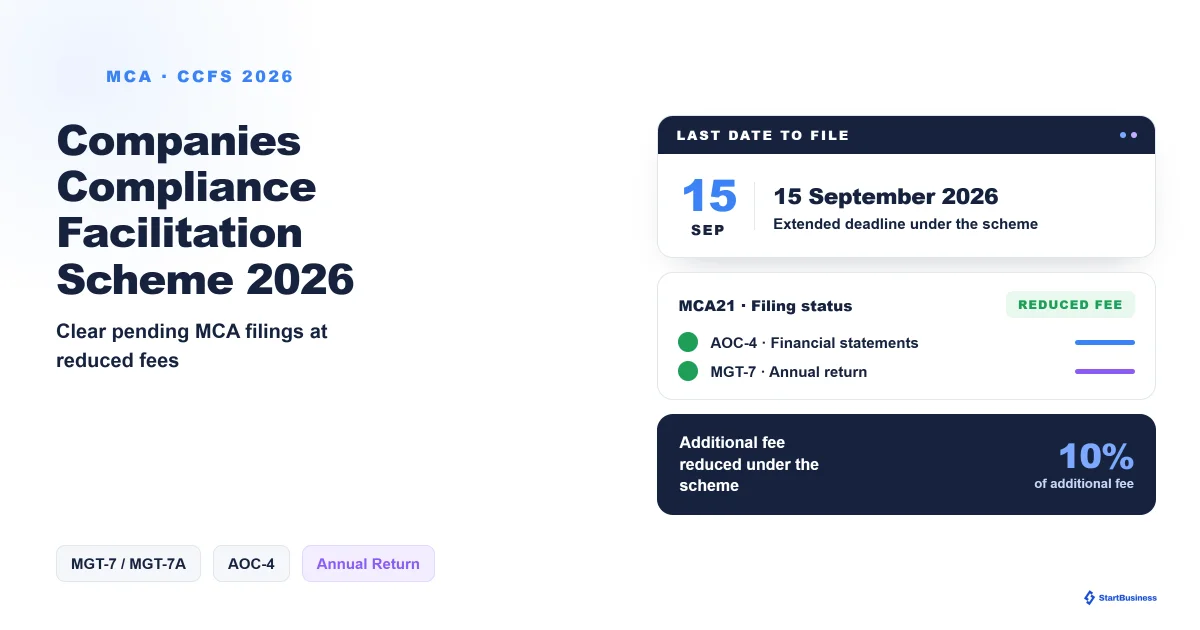
The Ministry of Corporate Affairs (MCA) has extended the Companies Compliance Facilitation Scheme, 2026 (CCFS-2026) twice since its launch, and the scheme is now set to close on 15 September 2026. If your company has pending Annual Return or Financial Statement filings, this is the current window to complete them at a reduced additional fee.
This article explains, based on the official MCA circulars, who the scheme applies to, what it actually reduces, which forms are covered, and the practical steps to file before the deadline.
Quick Answer: CCFS 2026 at a Glance
| Detail | Information |
|---|---|
| Scheme | Companies Compliance Facilitation Scheme, 2026 (CCFS-2026) |
| Authority | Ministry of Corporate Affairs, General Circular No. 01/2026 dated 24 February 2026 |
| Purpose | One-time relief allowing eligible companies to complete pending statutory filings at a reduced additional fee |
| Current deadline | 15 September 2026 (per General Circular No. 04/2026 dated 31 August 2026) |
| Who can use it | Companies with eligible pending filings that do not fall under the scheme's exclusions (see below) |
| Relief available | Reduced additional fee on eligible filings; concessional fee for dormant status (Form MSC-1) or strike-off (Form STK-2) |
| Filing platform | MCA21 portal (mca.gov.in) — no separate scheme application required |
| Important caution | The fee reduction is separate from any penalty already adjudicated under Section 454; it does not automatically cancel those |
CCFS 2026: Latest Update
Updated as of 7 September 2026: The current deadline is 15 September 2026. Confirm the latest position on the MCA website before filing, since this is a time-sensitive scheme and further changes are possible.
Timeline so far:
● Notified: 24 February 2026, via General Circular No. 01/2026, for the period 15 April 2026 to 15 July 2026.
● First extension: to 31 August 2026, via General Circular No. 03/2026 dated 8 July 2026.
● Second extension: to 15 September 2026, via General Circular No. 04/2026 dated 31 August 2026.
MCA has stated that all other terms of the scheme remain unchanged across both extensions. If your company has eligible pending filings, the practical takeaway is simple: act before 15 September 2026, since a further extension is not guaranteed.
What Is the Companies Compliance Facilitation Scheme 2026?
CCFS 2026 is a one-time relief measure notified by the MCA under Section 460 read with Section 403 of the Companies Act, 2013, that allows companies with eligible pending filings to regularise them at a reduced additional fee instead of the full amount that would otherwise apply. It was introduced via General Circular No. 01/2026 dated 24 February 2026.
Under Section 403, delayed filing of forms such as AOC-4 or MGT-7 normally attracts an additional fee of ₹100 per day, with no upper cap. CCFS 2026 gives companies a limited window to clear this backlog at a lower cost, helps MCA update its registry with current company data, and gives inactive companies an affordable route to formally close down instead of remaining in continuing default.
No separate application is required. A company simply files its pending forms on the MCA21 portal during the scheme period and pays the applicable concessional fee at that point.
Who Can Benefit From CCFS 2026?
Eligibility under CCFS 2026 is based on the company's filing status, not on its category. Companies that meet the conditions specified under the scheme may use the applicable relief for eligible pending filings — this is not automatically extended to a company simply because it is an MSME, startup, OPC, or private limited company.
Based on the official circular, a company is within scope if it has eligible pending statutory filings and has not already progressed to one of the exclusions listed in the next section. In practice, this includes companies of many kinds — private limited companies, OPCs, and small or closely-held businesses among them — that have one or more years of pending Annual Return (MGT-7/MGT-7A) or Financial Statement (AOC-4) filings and have not been issued a final strike-off notice or already applied for strike-off or dormant status.
To check whether your company's filings are actually up to date before assuming eligibility, see our Private Limited Company compliance checklist.
Who Is Not Eligible?
The following exclusions are confirmed in the MCA's CCFS-2026 notification:
| Company / Situation | Eligible? |
|---|---|
| Company already issued a final strike-off notice under Section 248 | No |
| Company that already applied for strike-off (Form STK-2) before the scheme | No |
| Company that already applied for dormant status before the scheme | No |
| Amalgamated or dissolved companies | No |
| Vanishing companies | No |
Which MCA Forms Are Covered Under CCFS 2026?
CCFS 2026 applies to a defined set of forms — not every MCA filing. Forms under the earlier Companies Act, 1956 are included because many companies still carry unfiled legacy returns from that period; they are labelled below for clarity.
| Form | Purpose | Covered? |
|---|---|---|
| MGT-7 / MGT-7A | Annual Return | Yes |
| AOC-4 (incl. XBRL, NBFC, CFS variants) | Financial Statements | Yes |
| ADT-1 | Auditor appointment intimation | Yes |
| FC-3 / FC-4 | Foreign company annual filings | Yes |
| Form 20B, 21A (legacy, Companies Act 1956) | Old annual return forms | Yes |
| Form 23AC / 23ACA, incl. XBRL (legacy) | Old financial statement forms | Yes |
| Form 66, Form 23B (legacy) | Old compliance certificate / auditor forms | Yes |
| Any form not listed above (e.g., INC-20A, charge forms) | Various | Not confirmed — verify with MCA before assuming coverage |
What Benefits Does CCFS 2026 Provide?
The scheme offers three separate routes, depending on whether a company plans to stay active, go dormant, or close down.
1. Complete Pending Annual Filings
● Pay the normal government filing fee, plus a reduced additional fee, instead of the full additional fee under Section 403.
2. Apply for Dormant Status (Section 455)
● File Form MSC-1 at a concessional fee, for companies that are inactive but intend to remain registered.
3. Strike Off the Company
● File Form STK-2 at a concessional fee, for companies that are defunct and want a formal, lower-cost exit from the register.
Important: this is fee relief, not a blanket penalty waiver. It reduces what you pay to file. It does not automatically cancel a penalty that an adjudicating officer has already imposed, or reverse a director disqualification already in effect. See the next section for how the two interact.
CCFS 2026 Additional Fee: What Will You Pay?
Under Section 403 of the Companies Act, 2013, delayed filing of forms such as AOC-4 or MGT-7 normally attracts an additional fee of ₹100 per day, with no cap. Under CCFS 2026, a company filing an eligible form within the scheme period pays the normal government filing fee in full, plus a reduced additional fee — a small fraction of what the standard Section 403 additional fee would otherwise be — instead of the uncapped daily amount.
The exact reduced percentage should be confirmed against the specific form and the current MCA fee schedule at the time of filing, since fee mechanics can be form-specific. Treat any percentage figure you see quoted elsewhere as indicative rather than guaranteed, and verify it on the MCA21 portal before making payment.
Fee Relief vs. Penalty: The Distinction That Matters
The reduced additional fee under CCFS 2026 is separate from any penalty that may arise under Section 454 for the same default. Where an adjudicating officer has already issued a notice or passed an order imposing a penalty for a pending default, filing under the scheme reduces the filing fee for that form, but does not by itself reverse a penalty that has already been imposed. Companies with an active adjudication notice or order should confirm their specific position with a company secretary or the MCA before assuming the scheme resolves it.
CCFS 2026 vs Normal MCA Filing
| Particular | Normal MCA Filing | CCFS 2026 |
|---|---|---|
| Additional fee (Section 403) | Full ₹100/day, uncapped | Reduced additional fee on eligible forms |
| Dormant status (MSC-1) fee | Full normal filing fee | Concessional fee under the scheme |
| Strike-off (STK-2) fee | Full normal filing fee | Concessional fee under the scheme |
| Separate application | Not applicable | Not required — file directly on MCA21 |
| Time-bound | Available year-round | Only until 15 September 2026 (current deadline) |
How to File Pending Forms Under CCFS 2026
1. Identify every pending MCA form for the company, across all outstanding financial years.
2. Check eligibility — confirm the company has not received a final strike-off notice and has not already applied for strike-off or dormant status.
3. Prepare the required financial statements, board resolutions, and supporting documents for each pending filing.
4. Complete the relevant MCA form(s) with current, accurate company and director data.
5. Calculate the applicable government fee and the reduced additional fee (or MSC-1/STK-2 fee) for each filing on the MCA21 portal.
6. Upload the completed forms and attachments on the MCA21 portal.
7. Make the payment and complete Digital Signature Certificate (DSC) authentication as required.
8. Note the Service Request Number (SRN) and track the filing status until it is approved.
9. Where an adjudication notice or order already exists for a past default, follow up separately with the relevant ROC office or a professional to confirm how that specific default is treated.
Documents and Information You May Need
● Company CIN
● Valid Digital Signature Certificate (DSC) of the authorised director
● Director details, including DIN, for all current directors
● Audited financial statements for each pending year
● Board resolutions approving the relevant filings
● Records of any filings already made, to avoid duplication
● Shareholding details for the pending years, for MGT-7/MGT-7A
What Happens If You Miss the 15 September 2026 Deadline?
After the deadline, pending filings revert to the normal fee structure — the full, uncapped additional fee under Section 403 applies again, and the scheme's concessional MSC-1/STK-2 fees are no longer available. Companies still in default also lose the scheme's fee relief for any adjudication action the ROC may take on that default going forward.
This article focuses on the CCFS-2026 consequences specifically. For the fuller picture of standard ROC penalties, director disqualification, and strike-off rules that apply to Indian companies generally — inside or outside this scheme — see our ROC compliance checklist for a Private Limited Company.
Common CCFS 2026 Filing Mistakes
● Assuming eligibility based on company type (MSME, startup, OPC) rather than actual filing and exclusion status.
● Assuming every overdue MCA form is covered — only the forms listed in the circular qualify.
● Treating the reduced additional fee as a penalty waiver when an adjudication notice or order already exists.
● Relying on an earlier scheme deadline instead of the current, extended date.
● Filing only some pending years and assuming the company is now fully compliant.
● Waiting until the last few days of the scheme window, when portal load and last-minute errors are more likely.
● Not retaining the SRN and filing acknowledgement after submission.
Need Help With Pending MCA Compliance?
If your company has pending MCA filings and you are unsure whether CCFS 2026 applies, which forms are eligible, or how an existing adjudication notice affects your position, StartBusiness can review your compliance status and handle the filing process.
Get Free Compliance Consultation
For the broader annual filing calendar once your company is current, see our annual compliance calendar for private limited companies, and if your company has grown since incorporation, check whether it now qualifies for lighter compliance under MCA's new small company rules.
Frequently Asked Questions
1. What is the last date for CCFS 2026?
The current deadline is 15 September 2026, as per General Circular No. 04/2026 dated 31 August 2026. The scheme originally closed on 15 July 2026 and was extended once to 31 August 2026 before this latest extension. Confirm the position on the MCA website before filing, as further extensions are possible but not guaranteed.
2. Who is eligible for CCFS 2026?
Companies with eligible pending statutory filings that have not already received a final strike-off notice, applied for strike-off, or applied for dormant status before the scheme opened are generally within scope. Eligibility depends on filing and exclusion status, not on being an MSME, startup, or OPC by category.
3. What forms are covered under CCFS 2026?
The scheme covers MGT-7/MGT-7A, AOC-4 (including XBRL, NBFC, and CFS variants), ADT-1, and FC-3/FC-4 under the Companies Act, 2013, plus specified legacy forms under the Companies Act, 1956 (Form 20B, 21A, 23AC/23ACA, 66, and 23B). Forms outside this list are not confirmed as covered.
4. Does CCFS 2026 waive MCA penalties?
No. CCFS 2026 reduces the additional filing fee under Section 403. It does not automatically waive a penalty already imposed by an adjudicating officer under Section 454. Where a notice or order already exists for a past default, that liability generally continues separately from the reduced filing fee.
5. Is there a separate application for CCFS 2026?
No. Unlike some earlier MCA relief schemes, CCFS 2026 does not require a separate application. Companies file their pending forms directly on the MCA21 portal during the scheme period and pay the applicable concessional fee at the time of filing.
6. Can a company file multiple pending forms under CCFS 2026?
Yes. A company with several years of pending filings can file each eligible form separately during the scheme period, with the concessional fee applying to each eligible filing. There is no indication in the notification that relief is limited to a single form per company.
7. What happens if I miss the CCFS 2026 deadline?
After 15 September 2026, the scheme's reduced fees are no longer available, and pending filings attract the full additional fee under Section 403 again. Companies in continuing default also remain exposed to standard ROC enforcement action, without the scheme's fee relief.
We handle business incorporation and deed drafting end-to-end, tailored to your needs.

Practising from Deccan Gymkhana, Pune since 2017. Has handled 1,000+ incorporations and ongoing compliance for founders across Maharashtra, from single-partner proprietorships to funded private limited companies.