
Key takeaways
- Checked and verified against current regulatory guidelines by practising CAs/CSs.
- Covers key requirements, step-by-step registration procedures, and statutory compliance timelines.
- Includes actionable insights tailored for Indian founders and business owners.
Quick Answer:
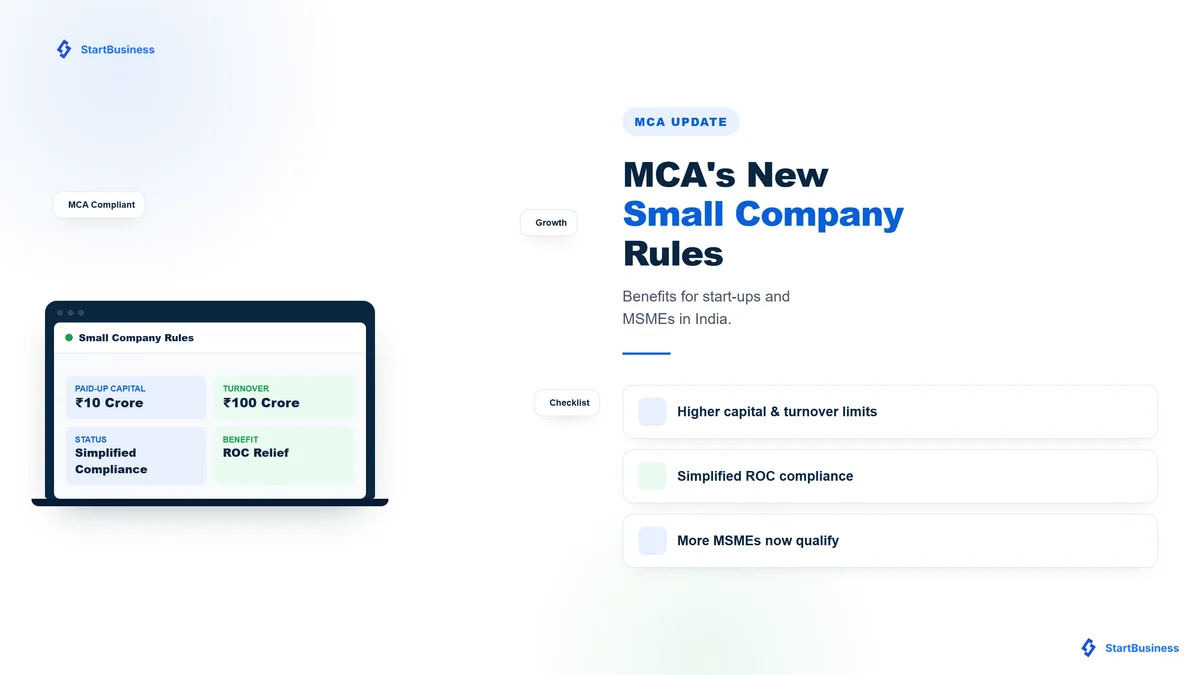
Under MCA's revised small company rules 2025 (Notification G.S.R. 880(E), effective 1 December 2025 and applicable through the current filing cycle), a private company with paid-up capital up to ₹10 crore and turnover up to ₹100 crore now qualifies as a "small company" under Section 2(85) of the Companies Act, 2013. Meeting both limits together — not just one — is what determines eligibility. Qualifying companies unlock lighter ROC compliance, fewer board meetings, simplified annual returns, and reduced penalty exposure, which is why this update matters directly to startups and MSMEs planning their 2025 compliance calendar.
If you run a startup or an MSME registered as a private limited company in India, this update directly affects how much time and money you'll spend on compliance in 2025. The Ministry of Corporate Affairs has more than doubled the financial thresholds that decide whether a company is treated as "small" — and small companies get real relief: fewer board meetings, simpler annual filings, and lower penalties if something slips.
This matters because many growing startups and MSMEs previously crossed the old eligibility limits as they scaled and lost access to these compliance relaxations.
As they scaled — and lost access to these relaxations right when they needed them least. The revised small company criteria for 2025 bring many of these growing companies back into the small company bracket. If you're at the stage of company registration or have just completed your Private Limited Company Registration in India, understanding the current small company limit in India now will shape your compliance planning for the next few years.
Key Takeaways
● Paid-up capital limit raised from ₹4 crore to ₹10 crore.
● Turnover limit raised from ₹40 crore to ₹100 crore.
● Both conditions must be satisfied simultaneously — meeting only one is not enough.
● Small companies get relief on board meetings, cash flow statements, annual return format, and penalties — not a blanket exemption from compliance.
● Holding companies, subsidiaries,This matters because many growing startups and MSMEs previously crossed the old eligibility limits as they scaled and lost access to these compliance relaxations.
Section 8 companies, and companies under special Acts are excluded regardless of size.
What Are the New Small Company Rules Under MCA?
The Ministry of Corporate Affairs amended Rule 2(1)(t) of the Companies (Specification of Definition Details) Rules, 2014, through the Companies (Specification of Definition Details) Amendment Rules, 2025. The change substitutes the rule that sets the financial thresholds referenced in Section 2(85) of the Companies Act, 2013 — and it's this rule that now defines the small company eligibility criteria for 2025.
Before this amendment, a company had to keep its paid-up capital under ₹4 crore and turnover under ₹40 crore to qualify as a Small Company. These thresholds had remained unchanged since 2021 and no longer reflected the scale at which many Indian startups and MSMEs operate. The revised limits expand eligibility and extend compliance relief to a much larger number of growing businesses.
The revised limits address exactly this gap. Here's the comparison:
| Criteria | Earlier Limit | New Limit (effective 1 Dec 2025) |
|---|---|---|
| Paid-up share capital | Up to ₹4 crore | Up to ₹10 crore |
| Turnover (preceding FY) | Up to ₹40 crore | Up to ₹100 crore |
| Governing provision | Rule 2(1)(t), 2014 Rules (pre-amendment) | Rule 2(1)(t), as substituted by G.S.R. 880(E) |
How Does MCA Define a Small Company Under Companies Act 2013?
Section 2(85) of the Companies Act, 2013 defines a small company as a private company (not a public company) that meets the prescribed paid-up capital and turnover thresholds set out in the rules. However, size alone doesn't guarantee eligibility. The Act specifically excludes certain categories, regardless of how small their capital or turnover is:
● Holding companies
● Subsidiary companies
● Companies registered under Section 8 (non-profit companies)
● Companies or bodies corporate governed by any special Act
If your company falls into any of these categories, it cannot claim small company status no matter how modest its financials are — a distinction founders sometimes miss when self-assessing eligibility.
What Are the Benefits of Small Company Status Under MCA Rules?
Small company status isn't just a label — it comes with specific, practical relaxations under the Companies Act, and it's a direct form of MCA compliance relief for startups navigating limited time and budget:
● Fewer board meetings: only two per calendar year, with a minimum gap of 90 days, instead of the standard four.
● Simplified annual return: eligible to file an abridged annual return in Form MGT-7A.
● No mandatory cash flow statement as part of the financial statements.
● Annual return can be signed by the company secretary alone, or by a single director if there's no CS.
● Lower monetary penalties for certain defaults compared to other private companies.
Together, these changes reduce the number of filings, board resolutions, and professional hours a qualifying company needs each year — which is precisely where early-stage and growth-stage companies tend to lose disproportionate time relative to their size.
If you're newly incorporated or planning to register, it's also worth reviewing Startup India registration benefits alongside small company status — the two schemes are separate but can be layered for maximum compliance and tax relief.
Is your company eligible for small company benefits? StartBusiness experts can help you review your compliance structure and identify possible compliance savings — Get Free Compliance Consultation.
What Is the Difference Between a Small Company and a Private Limited Company?
This distinction trips up a lot of founders, so it's worth stating plainly: a Private Limited Company is a legal structure you choose when you incorporate. A Small Company is a compliance classification your company may or may not fall into afterward, based on its size. Every small company is a private limited company, but not every private limited company qualifies as a small company — small company meaning, in India, is entirely about capital and turnover, not about how the company was formed.
In other words, incorporating as a private limited company is Step 1. Whether you subsequently get treated as a "small company" for compliance purposes is a separate, ongoing question decided each financial year by your capital and turnover — which is exactly why the revised small company criteria 2025 matter even to companies that registered years ago.
| Feature | Private Limited Company | Small Company |
|---|---|---|
| Meaning | Type of company structure | Compliance category |
| Governing provision | Section 2(68) | Section 2(85) |
| Board meetings | Normally 4 meetings | Minimum 2 meetings |
| Annual return | MGT-7 | MGT-7A |
| Cash flow statement | Required | Not required |
Who Will Benefit Most From MCA Small Company Rules?
The revised thresholds don't help every company equally. Some categories of business are far more likely to actually feel the difference in their day-to-day compliance load:
● Startups — early and growth-stage startups scaling toward Series A/B often crossed the old ₹40 crore turnover limit well before they had in-house compliance capacity. The higher ceiling extends their runway under simplified rules.
● SaaS companies — subscription revenue can look large on paper relative to headcount and operational complexity; SaaS businesses frequently exceed old turnover limits while still operating like a lean team.
● Manufacturing MSMEs — capital-intensive manufacturing units often carry higher paid-up capital for plant and machinery; the ₹10 crore capital ceiling now accommodates far more manufacturing MSMEs than before.
● Service companies — consulting, IT services, and agency-model businesses with high billing volumes but modest fixed assets typically qualify comfortably under both revised limits.
● Family-owned private companies — many closely-held businesses that grew organically over years, without formal governance infrastructure, now retain small company relaxations at a larger operating size.
Why Are MCA Small Company Rules Important for Startups?
For an early-stage founder, compliance isn't just a legal formality — it's a direct cost line that competes with product, hiring, and runway. A founder juggling four board meetings a year, full-format annual returns, and cash flow statement preparation is spending professional fees and internal time on paperwork that a larger company can absorb far more easily.
How Will These Rules Help MSMEs Reduce Compliance Costs?
Consider a small manufacturing company with ₹8 crore in paid-up capital and ₹70 crore in annual turnover. Under the old thresholds, it would have been treated as a regular private company — four board meetings a year, a full annual return, mandatory cash flow statements, and higher penalty exposure for procedural lapses.
Under the revised limits, the same company now qualifies as a Small Company and can take advantage of the simplified compliance framework available under the Companies Act. This reduces professional fees, administrative effort, and the time spent on routine compliance, allowing the business to focus more resources on working capital, expansion, or new equipment rather than regulatory paperwork.
For businesses that want this handled rather than managed in-house, professional accounting and compliance support for businesses can help translate the revised thresholds into an actual reduced filing calendar rather than leaving it as a theoretical benefit.
What Compliance Requirements Still Apply to Small Companies in India?
Small company status reduces compliance — it doesn't remove it. Founders sometimes assume qualifying as "small" means minimal filing obligations across the board, which isn't accurate. These Companies Act compliance requirements still apply:
● Annual return filing with the Registrar of Companies (in the abridged MGT-7A format)
● Preparation and filing of financial statements (excluding the cash flow statement)
● At least two board meetings a year, properly documented
● Statutory audit, as applicable under the Act
● Income tax return filing and other direct tax obligations
● GST compliance, if the company is GST-registered, including timely GST registration and return filing requirements.
For a full picture of what remains mandatory, it's worth reviewing ROC compliance requirements for companies and the Private Limited Company Compliance Checklist rather than assuming small company status is a blanket exemption.
How Do I Check If My Company Qualifies as a Small Company ?
Before changing your compliance calendar, confirm eligibility against the current rules:
● Check paid-up capital — confirm it does not exceed ₹10 crore.
● Check turnover — confirm the preceding financial year's turnover does not exceed ₹100 crore.
● Check company type — only private companies (not public companies) can qualify.
● Verify exclusions — rule out holding, subsidiary, Section 8, and special-Act companies.
● Consult a CA or CS before changing your filing approach, especially in a transition year.
What Should Start ups Do After Becoming Eligible as a Small Company?
Qualifying as a small company is only useful if you actually act on it. Reasonable next steps include:
● Review your current compliance structure against the new relaxations and identify which filings can be simplified.
● Update internal records and board calendars to reflect the reduced meeting frequency.
● Re-negotiate or reduce recurring professional fees tied to full-format compliance you no longer need.
● Redirect the time and cost saved into growth priorities — hiring, product, or market expansion.
If you haven't yet incorporated, this is also a good moment to plan your company structure with the small company limit in India in mind from day one. Private limited company remains the default choice for funded start ups, but for professional service firms and smaller partnerships, LLP registration in India is worth comparing before you commit to a structure.
Government Reference
MCA Notification G.S.R. 880(E) dated 1 December 2025 amended Rule 2(1)(t) of the Companies (Specification of Definition Details) Rules, 2014.
Frequently Asked Questions
What Is the New Small Company Limit Under MCA Rules?
Under MCA's revised rules, a private company qualifies as a small company if its paid-up capital does not exceed ₹10 crore and its turnover does not exceed ₹100 crore, per Section 2(85) of the Companies Act, 2013. Both conditions apply together — meeting only the capital limit or only the turnover limit is not sufficient for eligibility.
What are the benefits of small company status in India?
Small companies can hold just two board meetings a year instead of four, skip the cash flow statement in their financial statements, file an abridged annual return (Form MGT-7A), and face lower penalties for certain defaults compared to regular private companies.
Does a small company get exemption from ROC compliance?
No. Small companies receive compliance relaxations but must still file annual returns, financial statements, undergo statutory audit where applicable, and meet other ROC requirements.
Can startups become small companies under MCA rules?
Yes. Eligible private companies meeting the prescribed financial thresholds and not falling within excluded categories can claim Small Company status.
How can I check if my company qualifies as a small company?
Review your latest paid-up capital, preceding financial year's turnover and company type. If you're unsure, consult a CA or CS before relying on Small Company status.
We handle business incorporation and deed drafting end-to-end, tailored to your needs.

Practising from Deccan Gymkhana, Pune since 2017. Has handled 1,000+ incorporations and ongoing compliance for founders across Maharashtra, from single-partner proprietorships to funded private limited companies.