
Key takeaways
- Checked and verified against current regulatory guidelines by practising CAs/CSs.
- Covers key requirements, step-by-step registration procedures, and statutory compliance timelines.
- Includes actionable insights tailored for Indian founders and business owners.
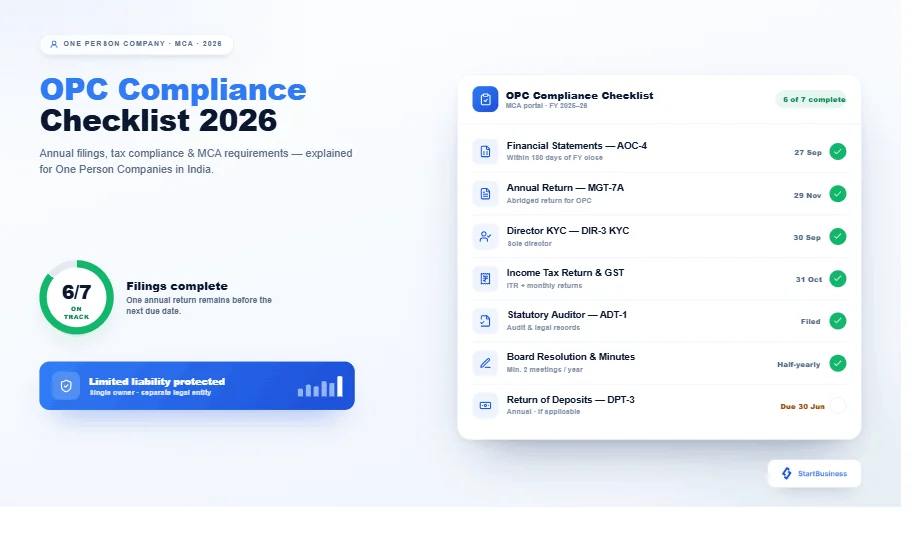
Starting a One Person Company (OPC) in India offers entrepreneurs the flexibility of limited liability with a simplified structure. However, compliance remains critical to avoid penalties and ensure smooth operations. This guide covers the key compliance requirements for OPCs in 2026.
A One Person Company (OPC) lets a single entrepreneur run a registered company with limited liability and a separate legal identity—without needing a co-founder, partner, or second director. Since its introduction under the Companies Act, 2013, it has become one of the most popular structures for solo founders, freelancers, and small business owners in India who want corporate credibility without the complexity of a multi-member company.
But the single-owner convenience comes with a catch many founders underestimate: an OPC is still a company under the Companies Act, and it carries almost the same core compliance burden as a private limited company. A missed filing isn't a minor paperwork slip it triggers penalties that accrue daily with no upper cap, and repeated default can disqualify the director and lead to the company being struck off the register.
This guide walks through every OPC compliance requirement post-incorporation, annual, and tax with the exact forms, deadlines, and the common mistakes that quietly rack up penalties. If you're still at the formation stage, begin with OPC registration.
Read also>> Private Limited Company Compliance Checklist
What Is a One Person Company (OPC)?
A One Person Company is a company incorporated with a single member who is also its sole shareholder. Defined under Section 2(62) of the Companies Act, 2013, it gives an individual the corporate benefits of a private limited company while requiring only one person to own it. At incorporation, the member must name a nominee who will take over the company in the event of the member's death or incapacity, ensuring business continuity.
An OPC can have a single director, or multiple directors (up to 15), but only one member. This flexibility is what makes it attractive to solo entrepreneurs who want a clean corporate structure they fully control.
Benefits of the OPC Structure
• Limited liability: the owner's personal assets are shielded from business debts and liabilities.
• Separate legal entity: the OPC can own property, enter contracts, sue, and be sued in its own name.
• Single-owner control: full decision-making authority with no partners or board friction.
• Stronger credibility: a registered company is taken more seriously by banks, clients, and vendors than a sole proprietorship.
• No mandatory AGM: OPCs are exempt from holding an Annual General Meeting, simplifying governance.
No forced conversion: since the 2021 amendment, an OPC can keep operating regardless of how high its turnover or capital grows.
Read also>> ROC Compliance Checklist
Post-Incorporation Compliances for OPC
| Post-Incorporation Compliances Form | Purpose | Timeline |
|---|---|---|
| INC-20A | Commencement Certificate | Within 180 days of incorporation |
| Stamp Duty | On Share Certificates | Within 30 days of issue |
| Board Meetings | If more than 1 director | Two Meetings per year, 90 days gap |
| AGM | Annual General Meeting | Not applicable |
| DIR-8 | Director declaration of non-disqualification | Annually |
| AOC-4 | Filing of Financials | Within 180 days from FY end |
| MGT-7A | Annual Return | Within 180 days from FY end |
| DIR-3 KYC | KYC of Director | By September 30th annually |
| ADT-1 | Auditor Appointment | Valid for 5 years |
| MSME-I | Half-yearly Return | Apr–Sep (by Oct 31), Oct–Mar (by Apr 30) |
| DPT-3 | Return of Deposits | By June 30 annually |
Do OPCs Still Have to Convert After Crossing a Turnover Limit?
No and this is a frequent point of confusion. Earlier, an OPC had to compulsorily convert into a private limited company if its paid-up capital exceeded ₹50 lakh or its average annual turnover crossed ₹2 crore. The Companies (Incorporation) Second Amendment Rules, 2021 (effective 1 April 2021) removed that mandatory conversion entirely. Today an OPC can keep operating no matter how large it grows.
Conversion is now purely voluntary and can be done at any time by passing a special resolution, increasing the number of members and directors to at least two, altering the MOA and AOA, and filing Form INC-6 with the ROC. The earlier two-year waiting period for voluntary conversion was also removed.
Common Mistakes OPC Owners Make
Missing Deadlines
The most common and costly error. Because an OPC holds no AGM, many founders never set a reference date to track—and quietly drift into default. Map the AOC-4, MGT-7A, and ITR deadlines at the start of each financial year.
Filing the Wrong Form
Using MGT-7 instead of the OPC-specific MGT-7A leads to rejection and penalties while the error is fixed. Always use the abridged MGT-7A for an OPC.
Assuming a Dormant OPC Is Exempt
A zero-revenue or inactive OPC still has to file AOC-4, MGT-7A, and ITR-6, and still needs a statutory audit. "No business this year" is not a valid reason to skip filings.
Neglecting Records and Disclosures
Skipping the minutes book, statutory registers, or director disclosures (MBP-1, DIR-8) creates problems at filing time and during due diligence. Keep records current throughout the year, not just at deadline.
Conclusion
OPCs benefit from reduced compliance compared to private limited companies, but MCA, income tax, and GST filings are still mandatory. Maintaining a compliance calendar and partnering with a professional can help avoid penalties and ensure smooth operations.
Frequently Asked Questions
What are the annual compliance requirements for OPC in India?
Every OPC must file Form AOC-4 (financial statements), Form MGT-7A (annual return), and ITR-6 (income tax return) each year. It must also undergo a statutory audit, file Form ADT-1 for auditor appointment, and complete director DIR-3 KYC—regardless of turnover.
Is audit mandatory for a One Person Company?
Yes. Statutory audit by a Chartered Accountant is mandatory for every OPC from its first financial year. There is no turnover-based exemption, and the audit is required even if the company had no income.
What is the due date for OPC ROC filing?
Form AOC-4 is due within 180 days of the financial year end (around 27 September for a March year-end). Form MGT-7A is due within 60 days of the date the financial statements are signed.
Can an OPC operate without a company secretary?
Yes. A company secretary is not mandatory for an OPC unless it crosses the paid-up capital threshold that triggers the requirement. Most OPCs operate without one, though many engage a CA or CS to manage filings.
What happens if OPC compliance is not filed on time?
Late filing of AOC-4 and MGT-7A attracts ₹100 per day per form with no maximum cap. Continued non-compliance can deactivate the director's DIN, disqualify the director, and lead to the company being struck off.
Is GST mandatory for an OPC?
No, not by default. GST registration is required only if the OPC's turnover crosses the prescribed threshold or it makes inter-state taxable supplies. Below that, GST registration is optional.
How is an OPC different from a private limited company in compliance?
The core annual filings and audit are similar, but an OPC is exempt from holding an AGM, files the simplified MGT-7A instead of MGT-7, and has relaxed board meeting rules when it has a single director.
We handle business incorporation and deed drafting end-to-end, tailored to your needs.

Practising from Deccan Gymkhana, Pune since 2017. Has handled 1,000+ incorporations and ongoing compliance for founders across Maharashtra, from single-partner proprietorships to funded private limited companies.