
Key takeaways
- Checked and verified against current regulatory guidelines by practising CAs/CSs.
- Covers key requirements, step-by-step registration procedures, and statutory compliance timelines.
- Includes actionable insights tailored for Indian founders and business owners.
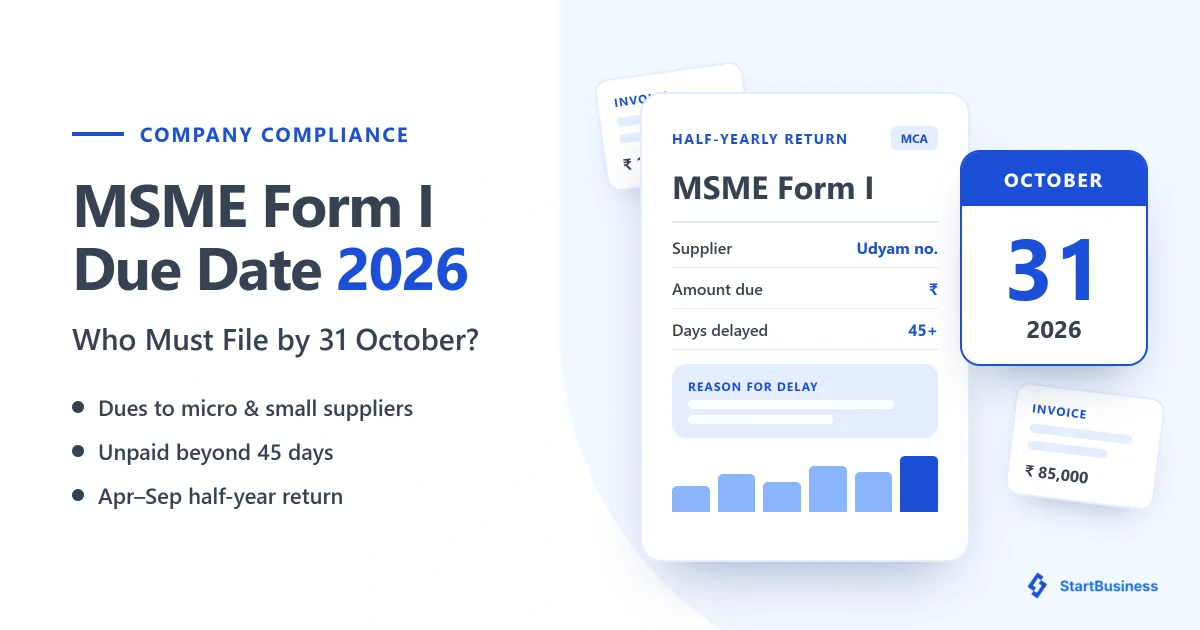
MSME Form I for the half-year 1 April to 30 September 2026 is due on 31 October 2026. It is a half-yearly return filed with the Registrar of Companies (ROC) about payments a company owes to its micro and small enterprise (MSE) suppliers. Only companies that have payments to such suppliers pending for more than 45 days from acceptance of the goods or services are required to file. Having MSME vendors alone does not create a filing obligation.
What Is MSME Form I?
MSME Form I is the return through which the Ministry of Corporate Affairs (MCA) collects information on delayed payments to micro and small suppliers. Section 405 of the Companies Act, 2013 allows the Central Government to order companies to furnish information. Using that power, MCA issued the Specified Companies (Furnishing of information about payment to micro and small enterprise suppliers) Order, 2019 (S.O. 368(E), 22 January 2019).
On 15 July 2024, MCA amended the Order through S.O. 2751(E) . The amendment did two things: it added a proviso stating which companies must file, and it replaced the form with a more detailed version.
MSME Form I is not Udyam registration. Udyam registration is the supplier’s own registration as a micro, small or medium enterprise. MSME Form I is a buyer company’s return about what it owes or paid to such suppliers. A company that is itself Udyam-registered may still have to file Form I as a buyer.
For a view of how this filing fits with your other obligations, see our private limited company compliance guide.
MSME Form I Due Date in 2026
The April–September 2026 return is due on 31 October 2026. Paragraph 3 of the 2019 Order sets two half-yearly deadlines.
| Reporting period | Due date | Filing condition | Source |
|---|---|---|---|
| 1 Apr – 30 Sep 2026 | 31 October 2026 | Payments to an MSE supplier pending more than 45 days from acceptance | Para 3 of the 2019 Order, with proviso inserted by S.O. 2751(E) |
| 1 Oct 2026 – 31 Mar 2027 | 30 April 2027 | Same condition | Para 3 of the 2019 Order |
31 October 2026 falls on a Saturday, so plan to file by Friday 30 October or earlier in the week, in case of portal load or a signatory being unavailable.
The filing deadline and the 45-day rule are different things. The due date tells you when to file. The 45-day condition decides whether you need to file at all. To see this return alongside your other dates, use our annual compliance calendar for private limited companies.
Who Must File MSME Form I?
The proviso inserted in July 2024 says that only those specified companies “having payments pending” to any micro or small enterprise for more than 45 days from the date of acceptance or deemed acceptance must furnish MSME Form I. Work through three questions:
1. Is the buyer a company? The Order is made under the Companies Act, so it applies to companies. The form accepts a CIN or a Foreign Company Registration Number. LLPs, partnership firms and proprietorships are not covered by this Order.
2. Is the supplier a micro or small enterprise? Payments to medium enterprises are not part of this return.
3. Does the company have a payment to that supplier pending for more than 45 days from acceptance or deemed acceptance? If not, the Order does not require the company to file. There is no separate requirement to file a “nil” return.
When does the 45-day count start?
From the date the buyer accepts the goods or services, or the date of deemed acceptance. Under the MSMED Act’s definition of “appointed day”, deemed acceptance applies where the buyer raises no written objection within 15 days of delivery; the day of delivery is then treated as the day of acceptance.
Do not confuse the 45-day trigger with the MSMED Act payment deadline
Section 15 of the MSMED Act, 2006 requires the buyer to pay by the date agreed in writing, which cannot exceed 45 days from acceptance or deemed acceptance. Where there is no written agreement, payment is due before the “appointed day”, which is the day after 15 days from acceptance (DC-MSME FAQ).
So a payment made on day 30 with no written agreement is already late under Section 15, and interest is payable. It does not, by itself, meet the Form I condition, which is tied to 45 days.
Which MSME Suppliers Qualify for Reporting?
Only micro and small enterprises are reported. From 1 April 2025, enterprises are classified under Notification S.O. 1364(E) dated 21 March 2025, which amended S.O. 2119(E) of 2020:
| Category | Investment in plant and machinery or equipment | Turnover | Part of Form I? |
|---|---|---|---|
| Micro | Up to ₹2.5 crore | Up to ₹10 crore | Yes |
| Small | Up to ₹25 crore | Up to ₹100 crore | Yes |
| Medium | Up to ₹125 crore | Up to ₹500 crore | No |
Section 7 of the MSMED Act, as substituted by the MSMED (Amendment) Act, 2026, lets the Central Government notify these thresholds. The S.O. 1364(E) limits above continue to apply until a new notification replaces them.
The Ministry of MSME’s classification notice and the Udyam Registration portal are the official references.
For each vendor, keep on file:
• A copy of the supplier’s Udyam registration certificate
• The category shown on it (micro, small or medium) for the period you are reporting
• The supplier’s PAN, which the form asks for
The supplier’s Udyam registration date, compared with the contract and invoice dates. In Silpi Industries v. Kerala State Road Transport Corporation (2021), the Supreme Court held that a supplier must be registered at the relevant time, not afterwards, to claim the benefit of Section 18 of the MSMED Act.
A supplier’s category can change from year to year, so check it for the period you are reporting rather than relying on an old certificate. For how Udyam registration and the classification limits work, see our MSME (Udyam) registration guide.
What If the Company Has Already Paid the Overdue Invoice?
Two questions need to be kept apart: whether the company must file at all, and what it must report once it files.
What to report once filing. The revised form has separate columns for amounts paid within 45 days, paid after 45 days, outstanding for 45 days or less, and outstanding for more than 45 days. Its note asks companies to report amounts outstanding for more than 45 days or “liquidated after 45 days” of acceptance. So, once a company is filing, late payments made during the half-year belong in the return.
Whether a settled late invoice, on its own, triggers filing. This is not settled. The proviso uses the words “having payments pending”, while the form’s note covers amounts already liquidated. One reading is that a payment that was pending beyond 45 days at any time during the half-year meets the condition, even if paid before 30 September. Some professional commentary takes this view (Mondaq/Nexdigm). Another reading looks only at dues still pending. MCA has not, to our knowledge, issued a clarification. Decide your position with your CA or CS and keep a note of the reasoning.
| Situation in Apr–Sep 2026 | Filing condition met? | If the company files |
|---|---|---|
| Invoice still unpaid more than 45 days after acceptance on 30 September | Yes | Report under “outstanding for more than 45 days”, with reason |
| Invoice paid on day 60, nothing else overdue on 30 September | Unsettled — confirm with CA/CS | Report under “paid after 45 days”, with reason |
| All invoices paid within 45 days | No | Report under “paid within 45 days” only if filing for another reason |
| Invoice unpaid but within 45 days on 30 September | No | Report under “outstanding for 45 days or less” only if filing for another reason |
| Amount disputed with the supplier | If the buyer objected in writing within 15 days of delivery, the day of acceptance is the day the supplier removes the objection, and the 45 days count from then. An objection raised later, or not in writing, does not shift the date. | Report from the correct acceptance date; state the dispute as the reason |
Documents and Information Required for MSME Form I
The table lists what the form asks for, and the records you need to prepare it.
| Information | In the form? | Prepare from |
|---|---|---|
| CIN or FCRN, company name, registered office address, email, company PAN | Yes | MCA master data |
| Type of return (half-yearly) and period start and end dates | Yes | 01/04/2026 to 30/09/2026 |
| Supplier name and PAN | Yes | Vendor master |
| Number and amount: paid within 45 days, paid after 45 days | Yes | Payment ledger |
| Number and amount: outstanding up to 45 days, outstanding over 45 days | Yes | Payables ageing |
| Payment mode, including TReDS (Trade Receivables Discounting System) | Yes | Payment records |
| Reason for delay in payment or amount outstanding | Yes | Finance and procurement |
| Declaration and digital signature | Yes | Authorised signatory’s DSC |
| Udyam certificate copy and category | Keep on file | Supplier |
| Invoice, delivery and acceptance dates; written payment terms | Keep on file | Purchase records, GRNs, contracts |
MSME Return Filing Procedure on the MCA Portal
1. Log in to the MCA portal and open MSME Form I. Read MCA’s instruction kit for MSME Form I before you start.
2. Run an invoice-level ageing of payables to micro and small suppliers for 1 April to 30 September 2026, counted from the acceptance or deemed-acceptance date.
3. Enter the company details and select the half-yearly return for the period 01/04/2026 to 30/09/2026.
4. Fill in the supplier-wise table. The form offers an Excel template that can be downloaded and imported, which helps when there are many suppliers.
5. Give a reason for each delayed or overdue amount. Attachments are optional.
6. Complete the declaration and sign with the Digital Signature Certificate (DSC) of an authorised signatory. The form allows a director, managing director, manager, company secretary, CFO, CEO or authorised representative.
7. Submit and save the Service Request Number (SRN) acknowledgement with your working papers.
MSME Form I Late Filing Penalty and Consequences
The penalty for MSME Form I comes from Section 405(4) of the Companies Act, 2013, not from the MSMED Act. It applies if a company fails to comply with the Order, or furnishes information that is incorrect or incomplete in any material respect. The company and every officer in default are each liable to:
• a penalty of ₹20,000, and
• for a continuing failure, a further ₹1,000 for each day after the first, up to a maximum of ₹3 lakh.
Penalties under the Companies Act are imposed by the ROC as adjudicating officer under Section 454. Check the MCA portal for any additional fee shown at the time of filing.
Two separate consequences come from the MSMED Act, not from Form I:
• Interest owed to the supplier. Under Section 16 of the MSMED Act, a buyer that pays late owes compound interest, with monthly rests, at three times the bank rate notified by the RBI. This is payable to the supplier, not to MCA.
No tax deduction for that interest. Section 23 of the MSMED Act says this interest is not allowed as a deduction when computing income.
Common MSME Form I Filing Mistakes
• Treating MSME Form I and Udyam registration as the same thing
• Including medium enterprises, or leaving out a supplier without checking its current category
• Counting 45 days from the invoice date instead of the acceptance or deemed-acceptance date
• Leaving out amounts paid after 45 days once the company is filing
• Reporting totals that do not match the ledger
• Using old penalty figures or an outdated version of the form
• Not keeping the Udyam evidence, ageing working and SRN
MSME Form I Pre-Filing Checklist
• Vendor master tagged micro, small or medium, with Udyam certificates on file
• Acceptance or deemed-acceptance date captured for every MSE invoice
• Ageing run for 1 April to 30 September 2026
• Filing decision recorded, including the position on settled late invoices
• Amounts split into the four form columns
• Reason written for each delayed or overdue amount
• Totals reconciled to the ledger
• Authorised signatory’s DSC valid
• Filed on or before 31 October 2026; SRN saved
Frequently Asked Questions
What is the due date for MSME Form I in 2026?
The return for April to September 2026 is due on 31 October 2026. The return for October 2026 to March 2027 is due on 30 April 2027. Both dates are set by paragraph 3 of the 2019 MCA Order.
Who is required to file MSME Form I?
A company with payments to a micro or small enterprise supplier pending for more than 45 days from acceptance or deemed acceptance. LLPs, firms and proprietorships are not covered, and payments to medium enterprises are not part of the return.
Is MSME Form I required if there are no outstanding payments?
If no payment to a micro or small supplier is pending beyond 45 days, the Order does not require a return, and there is no nil filing. Whether an invoice paid late but settled within the half-year triggers filing is unsettled; confirm with your CA or CS.
What happens if a company files MSME Form I late?
Under Section 405(4) of the Companies Act, the company and each officer in default face a ₹20,000 penalty, plus ₹1,000 per day of continuing failure, up to ₹3 lakh each. The same section covers incorrect or incomplete information.
Is MSME Form I the same as Udyam registration?
No. Udyam registration is a supplier registering itself as an MSME. MSME Form I is a buyer company’s return about payments to its micro and small suppliers.
Does a company need to report an invoice paid after 45 days?
If the company is filing, yes. The form has a column for amounts paid after 45 days and asks for the reason for delay. Whether such an invoice alone makes filing compulsory is not settled, so confirm your position with a CA or CS.
We handle business incorporation and deed drafting end-to-end, tailored to your needs.

Practising from Deccan Gymkhana, Pune since 2017. Has handled 1,000+ incorporations and ongoing compliance for founders across Maharashtra, from single-partner proprietorships to funded private limited companies.