
Key takeaways
- Checked and verified against current regulatory guidelines by practising CAs/CSs.
- Covers key requirements, step-by-step registration procedures, and statutory compliance timelines.
- Includes actionable insights tailored for Indian founders and business owners.
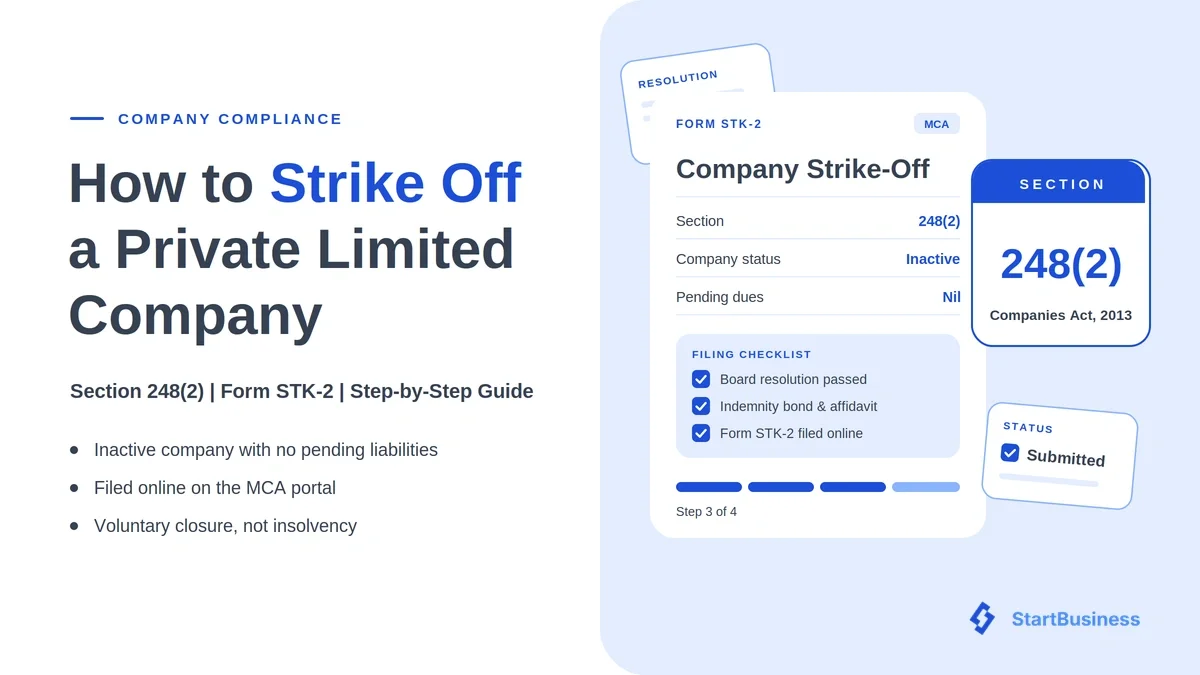
To voluntarily strike off a Private Limited Company in India under Section 248(2) of the Companies Act, 2013, the company must apply for removal of its name from the Register of Companies maintained by the Registrar of Companies (ROC) through the MCA portal using Form STK-2, subject to the prescribed eligibility conditions and requirements.
Voluntary strike-off is a legal exit route in which a company asks the Registrar to remove its name from the register, after which the company is dissolved. It is meant for inactive companies that never started business, or have carried on no business for two financial years, and have no liabilities left. This guide explains how to strike off a private limited company: eligibility, the pre-filing checklist, documents, the Form STK-2 process, fees, timelines and what happens afterwards.
What Is Strike-Off of a Private Limited Company?
Strike-off means the Registrar removes a company’s name from the Register of Companies, and the company is dissolved and ceases to exist as a legal entity. It is different from winding up, which is a liquidator-led process for companies that still have assets or liabilities to settle.
There are two routes. Voluntary strike-off under Section 248(2) is started by the company itself by filing Form STK-2 with the Registrar. ROC-initiated strike-off under Section 248(1) is started by the Registrar after issuing a notice to a company that appears to be defunct, often because it has stopped filing returns. Closing an inactive company voluntarily lets its directors and members control the timing and the paperwork, instead of waiting for the Registrar to act.
Who Is Eligible for Voluntary Strike-Off?
A Private Limited Company can apply for voluntary strike-off only if it meets the conditions in Section 248(2), the Companies (Removal of Names of Companies from the Register of Companies) Rules, 2016, and is not barred by Section 249. Being inactive alone does not make a company eligible.
| Condition | What the law requires | Practical note |
|---|---|---|
| Ground for removal | The company has not commenced business within one year of incorporation, or has not carried on business or operations for the immediately preceding two financial years and has not applied for dormant-company status under Section 455. | Bank statements and ledgers should show no business activity for the period claimed. |
| Liabilities | All liabilities must be extinguished before the application (Section 248(2)). | Supported by the statement of accounts and director undertakings. |
| Member approval | A special resolution, or consent of members holding at least 75% of the paid-up share capital. | A special resolution must also be filed in Form MGT-14. |
| Section 249 restrictions | Law column: Under Section 249, a company cannot apply if, at any time in the previous three months, it changed its name or shifted its registered office from one state to another, made a disposal for value of property or rights held for disposal for gain in the normal course of trading, or engaged in any activity other than what is necessary for the application, closing its affairs or meeting statutory requirements. It also cannot apply if it has a compromise or arrangement application pending before the NCLT, or if it is being wound up under the Companies Act or the IBC. | Check the dates of any recent name, office or asset changes, and confirm that no NCLT scheme or winding-up proceeding is pending.. |
| Excluded categories and pending action | Rule 3 excludes listed companies, companies delisted for non-compliance, vanishing companies, companies under inspection or investigation, companies with pending Section 206/207 notices or inquiries, companies facing pending prosecution, companies with a pending compounding application, companies with outstanding or defaulted public deposits, companies with charges pending satisfaction, and Section 8 companies. | Seek professional review if any notice or proceeding exists. |
| Regulated companies | Where the company is regulated under a special Act, approval of the relevant regulator is needed. | Applies, for example, to certain financial-sector entities. |
What Should Be Completed Before Applying for Company Strike-Off?
Before filing Form STK-2, a company should confirm its MCA status, clear overdue filings, settle all liabilities and obtain approvals, because an incomplete application is the most common reason for queries and rejection. The checks below are in a practical order.
• Check company status and MCA master data. Confirm the company is shown as active, and that director, address and share capital details are current. Mismatches can trigger queries.
• File pending ROC annual filings. Under Rule 4(1) of the Companies (Removal of Names of Companies from the Register of Companies) Rules, 2016, Form STK-2 cannot be filed until the company has filed its overdue financial statements (AOC-4) and annual returns (MGT-7, or MGT-7A for small companies and OPCs) up to the end of the financial year in which it ceased business operations. These overdue filings must be completed first, with the applicable additional fee.
• Our ROC compliance checklist for Private Limited Companies explains these forms, and the annual compliance calendar for Private Limited Companies shows when each falls due.
• Clear liabilities and review the balance sheet. Settle creditors, loans and statutory dues (GST, TDS, income tax, PF/ESI where applicable), file final GST, TDS and income tax returns, and apply for cancellation of GST registration. Section 248(2) requires liabilities to be extinguished, and the application is supported by sworn statements from every director.
• Deal with bank balances and assets. Distribute or dispose of remaining assets properly, and close the bank account once balances are settled. Disposing of property for value in the normal course of trading within three months before applying can trigger the Section 249 restriction, so plan the timing of any asset sale.
• Satisfy registered charges. Any charge registered with the ROC (for example, a bank loan) must be satisfied and recorded as satisfied in Form CHG-4 before the application, because companies with charges pending satisfaction cannot be struck off under Rule 3.
• Review litigation, inspections and investigations. Pending proceedings can bar strike-off, and the application requires a statement on pending litigation signed by every director.
• Obtain approvals. Hold the board meeting and obtain shareholder approval (see Step 3).
• Prepare the statement of accounts last. It must be made up to a date not more than 30 days before the application, so prepare it close to the filing date.
If the company has several years of overdue filings or disputed liabilities, professional help with ROC compliance services can save time before the strike-off application is made.
Documents Required for Form STK-2 Filing
The core documents for Form STK-2 are the application itself, director indemnity bonds and affidavits, a certified statement of accounts and proof of member approval. The exact attachment list can change, so verify it against the latest MCA STK-2 instruction kit before filing.
| Document / form | Purpose | Prepared / signed by | Important requirements |
|---|---|---|---|
| Form STK-2 | Application to the Registrar for removal of the company’s name under Section 248(2). | Company; signed by an authorised director and certified by a practising CA, CS or Cost Accountant. | Filed on the MCA portal with a ₹10,000 government fee and the attachments below. |
| Board resolution | Authorises the strike-off application and the director who will file it. | Board of directors. | Certified true copy is typically attached. |
| Special resolution or members’ consent | Records approval of strike-off by members. | Members. | Special resolution, or consent of members holding at least 75% of paid-up capital. A special resolution is filed in MGT-14 within 30 days. |
| Form STK-3 (Indemnity Bond) | Director undertaking to indemnify against any claim arising after the company’s name is removed. | Every director. | Notarised, on stamp paper as per the applicable state rules. |
| Form STK-4 (Affidavit) | Sworn declaration by directors about the company’s status and liabilities. | Every director. | Notarised, on stamp paper as per state rules. |
| Form STK-8 (Statement of Accounts) | Shows the company’s assets and liabilities. | Company; certified by a practising Chartered Accountant. | Made up to a date not more than 30 days before the application. |
| Statement on pending litigation | Discloses any pending legal proceedings. | Signed by every director. | Required even if the answer is nil. |
| Other declarations, NOCs or proofs | Regulator approval, proof of closed bank account, tax records and similar. | Depends on the company. | Not universally mandatory. Include only what applies or what the instruction kit requires. |
How to Strike Off a Private Limited Company in India: Step-by-Step Process
The strike-off process has seven stages: check eligibility, clear compliance and liabilities, obtain approvals, prepare documents, file Form STK-2, respond to processing queries, and wait for the public notice and final gazette notification.
Step 1: Check the Company’s Eligibility
Start by confirming that the company fits one of the two statutory grounds: no business within one year of incorporation, or no business or operations for the previous two financial years without a dormant-status application. Then confirm it is not an excluded category and has no Section 249 restriction, such as a recent name change or a transfer of the registered office between states. If any condition is doubtful, resolve it before spending time on documents.
Step 2: Clear Pending ROC Compliance and Outstanding Liabilities
File all overdue AOC-4 and MGT-7 or MGT-7A returns up to the end of the financial year in which the company ceased business (mandatory under Rule 4(1)), pay the applicable additional fees, and settle creditors, loans and statutory dues. Liabilities must be extinguished because the Registrar removes the company’s name on the footing that nobody is left with an unpaid claim against it. Satisfy any registered charges and close the bank account once all payments are complete.
Step 3: Obtain Board and Shareholder Approval
1. Hold a board meeting to approve the strike-off proposal, authorise a director to file Form STK-2, and fix the date of the general meeting.
2. Pass a special resolution at a general meeting (requiring at least 21 days’ notice unless shorter notice is validly consented to), or obtain written consent from members holding at least 75% of the paid-up share capital.
3. If a special resolution is passed, file Form MGT-14 within 30 days. STK-2 asks for the details of this filing, so complete it first.
Step 4: Prepare the Required Documents
Each director signs a Form STK-3 indemnity bond and a Form STK-4 affidavit, both notarised on stamp paper. A practising Chartered Accountant certifies the Form STK-8 statement of accounts, which shows the company’s assets and liabilities as of a date not more than 30 days before filing. Add the signed statement on pending litigation, the resolutions, and any regulator approvals or other supporting proofs that apply.
Step 5: File Form STK-2 on the MCA Portal
1. Log in to the MCA portal using the company’s registered user credentials and a valid Digital Signature Certificate (DSC), and open the Form STK-2 e-form following the portal’s on-screen workflow and the current instruction kit.
2. Fill in the company, director and resolution details, and attach the documents listed above in the formats the form accepts.
3. Have the form digitally signed by the authorised director and certified by a practising CA, CS or Cost Accountant.
4. Pay the government fee of ₹10,000 and submit. Keep the Service Request Number (SRN) to track the application.
Because Rule 4(4) restricts resubmission of a defective application, accuracy at the first filing matters more than speed.
Step 6: Application Processing by C-PACE
The Centre for Processing Accelerated Corporate Exit (C-PACE) is the MCA unit that processes strike-off applications centrally, instead of the company’s local ROC. It scrutinises the form and attachments against MCA records. If it finds gaps, such as a missing attachment, an unresolved filing default or a date mismatch, it raises a query or returns the form for resubmission, and the company must respond within the allowed time.
Step 7: Publication of Notice and Final Strike-Off
Once satisfied, the Registrar issues a public notice of the proposed removal in Form STK-6. The notice is placed on the MCA website, published in the Official Gazette and in newspapers, and sent to authorities such as the Income Tax and GST departments. Objections can be filed within 30 days.
If no sufficient cause is shown against it, the Registrar publishes a final notice (Form STK-7) in the Official Gazette under Section 248(5). On that publication, the company is dissolved and its name is struck off the register.
Condition: Pending filings and ROC action
What the law requires: Overdue AOC-4 and MGT-7/MGT-7A must be filed up to the end of the financial year in which business ceased (Rule 4(1)). If the ROC has already initiated action under Section 248(1), all pending returns must be filed first. Once the ROC has issued the Section 248(5) notice for publication in such action, STK-2 can no longer be filed.
Practical note: Check the MCA filing history and any ROC notices before preparing documents.
Strike-Off Fees: Government Fee and Other Costs
The government fee for filing Form STK-2 is ₹10,000. Total cost is higher because professional fees, notarisation, certification and any overdue-filing fees are separate.
| Cost component | Amount | Notes |
|---|---|---|
| Government fee for Form STK-2 | ₹10,000 | Paid on the MCA portal at filing. Confirm the figure on the MCA fee schedule on the day you file. |
| Professional fees | Varies | Depends on complexity and the scope of work, such as drafting, CA/CS certification and filing. |
| Notary, stamp paper and CA certification | Varies | STK-3 and STK-4 are notarised on stamp paper, and STK-8 is certified by a Chartered Accountant. |
| Pending ROC filings and accounting | Varies | Overdue AOC-4 and MGT-7 attract additional fees, currently ₹100 per day per form, and may need accounts to be prepared or audited. |
A note on CCFS-2026. The Companies Compliance Facilitation Scheme, 2026 was a time-bound scheme that offered concessional fees for strike-off. It began on 15 April 2026 and was extended by MCA twice, first to 31 August and then to 15 September 2026, when it closed. As of the latest check, no further extension had been notified, so a reduced STK-2 fee should not be assumed. Confirm any fresh MCA circular before relying on it, and see our CCFS-2026 guide for the scheme’s background.
How Long Does the Strike-Off Process Take?
No official guaranteed timeline exists. In practice, strike-off usually takes several months from the first board meeting, and longer if queries, objections or backlog filings arise.
| Stage | What affects the time | Indicative position |
|---|---|---|
| Document preparation | Availability of directors for notarisation, CA certification and member approvals. | Days to a few weeks. |
| Clearing pending compliance | Number of overdue years, accounts to be prepared, creditors to settle. | Highly variable. |
| Filing and C-PACE processing | Completeness of the application and any queries or resubmissions. | Not fixed by MCA. |
| Public notice period | A 30-day window for objections after the notice is published. | 30 days. |
| Final gazette notification | Registrar’s publication of the final notice (Form STK-7). | Follows the notice period. |
Treat any duration quoted online as an estimate, not a commitment. Delays most often come from queries, objections and incomplete documents.
Common Reasons for Delay or Rejection of Company Strike-Off Applications
Strike-off applications are most often delayed or rejected because of missing attachments, unresolved filing defaults or unextinguished liabilities. The main causes are:
• Incomplete or incorrect STK-2 attachments, including wrong forms, unsigned or un-notarised bonds and affidavits, or mismatched dates.
• Pending ROC filings for years before the company stopped operating.
• Outstanding liabilities, including unpaid statutory dues or open registered charges.
• Incorrect statement of accounts, such as one older than 30 days, uncertified, or inconsistent with the filed balance sheets.
• Missing shareholder approvals, or a special resolution that was never filed in Form MGT-14.
• Undisclosed litigation or a statement that does not match public records.
• Statutory restrictions, such as a recent name change, registered office shift, asset disposal or an excluded company category.
• Missing approvals, such as regulator consent where the company is regulated under a special Act.
Cases involving liabilities, litigation or statutory restrictions are better reviewed by a Chartered Accountant or Company Secretary before filing.
What Happens After the Company Is Struck Off?
After the final notice is published in the Official Gazette, the company stands dissolved and can no longer carry on business, sign contracts or operate bank accounts. MCA records show its status as struck off.
Dissolution does not erase every liability. Under Section 248(7), the liability of every director, manager, officer and member continues and can be enforced as if the company had not been dissolved. Strike-off is therefore not a shield against future claims, tax demands or investigations relating to the company’s past.
A struck-off company can be revived. Under Section 252(1), a person aggrieved by the Registrar’s order can appeal to the National Company Law Tribunal (NCLT) within three years of the order. Separately, under Section 252(3), the company, a member, a creditor or a workman can apply to the NCLT within 20 years of publication of the dissolution notice, and the NCLT may restore the company’s name if it considers it just to do so. Directors should keep the company’s books, resolutions, filed forms and tax records safe for years after dissolution. Founders who later start a new venture will need a fresh incorporation, such as Private Limited Company registration.
Frequently Asked Questions
1. How can I strike off a Private Limited Company in India?
An eligible company can apply for voluntary strike-off under Section 248(2). It must clear liabilities, pass a special resolution or obtain 75% member consent, prepare STK-3, STK-4 and STK-8, and file Form STK-2 on the MCA portal with the ₹10,000 fee. After C-PACE scrutiny and a public notice, the Registrar publishes the final notice dissolving the company.
2. What is Form STK-2 and why is it required?
Form STK-2 is the MCA e-form a company uses to apply to the Registrar for removal of its name from the register under Section 248(2). It is required because the Registrar acts only on a complete application with prescribed attachments, director undertakings and professional certification. Without a valid STK-2, a company cannot be voluntarily struck off.
3. Can I strike off a company with pending ROC filings?
No. Under Rule 4(1), a company must first file its overdue financial statements (AOC-4) and annual returns (MGT-7/MGT-7A) up to the end of the financial year in which it ceased business operations, with the applicable additional fees. Only then can Form STK-2 be filed. If the ROC has already initiated strike-off action under Section 248(1), all pending returns must be filed before STK-2. A professional should review your specific position.
4. What is the government fee for striking off a Private Limited Company?
The government fee for Form STK-2 is ₹10,000, payable on the MCA portal when the form is filed. The reduced CCFS-2026 fee is no longer available because the scheme closed on 15 September 2026. Professional fees, notarisation, CA certification and late fees for pending filings are separate, so the total cost is higher than the filing fee alone.
5. How long does it take to strike off a Private Limited Company?
There is no fixed or guaranteed timeline. Preparing documents and clearing pending filings can take weeks, and MCA processing, the 30-day public notice and final gazette publication usually add several months. Queries, resubmissions or objections extend this further. Treat any quoted duration as an estimate rather than a commitment.
6. Can a company that never started business apply for strike-off?
Potentially yes. Not commencing business within one year of incorporation is a statutory ground for strike-off, but the company must still meet the other conditions: liabilities extinguished, required member approval, no Section 249 restriction or excluded status, and a complete STK-2 filing. If it has unfiled INC-20A or other defaults, seek professional review first.
Conclusion
Striking off a Private Limited Company works best when each stage is done in order. First, confirm the company is eligible under Section 248(2) and not barred by Section 249. Second, clear pending ROC filings and extinguish all liabilities. Third, prepare the board and member approvals, STK-3, STK-4, STK-8 and the litigation statement. Finally, file Form STK-2, respond to any C-PACE queries, and wait for the public notice and final dissolution notice. Strike-off is not a shortcut around unresolved liabilities, so unclear cases deserve professional review.
Planning to close your inactive Private Limited Company? StartBusiness can help you understand the applicable compliance requirements and next steps. Contact our team for professional guidance.
We handle business incorporation and deed drafting end-to-end, tailored to your needs.

Practising from Deccan Gymkhana, Pune since 2017. Has handled 1,000+ incorporations and ongoing compliance for founders across Maharashtra, from single-partner proprietorships to funded private limited companies.