

Key takeaways
- Checked and verified against current regulatory guidelines by practising CAs/CSs.
- Covers key requirements, step-by-step registration procedures, and statutory compliance timelines.
- Includes actionable insights tailored for Indian founders and business owners.
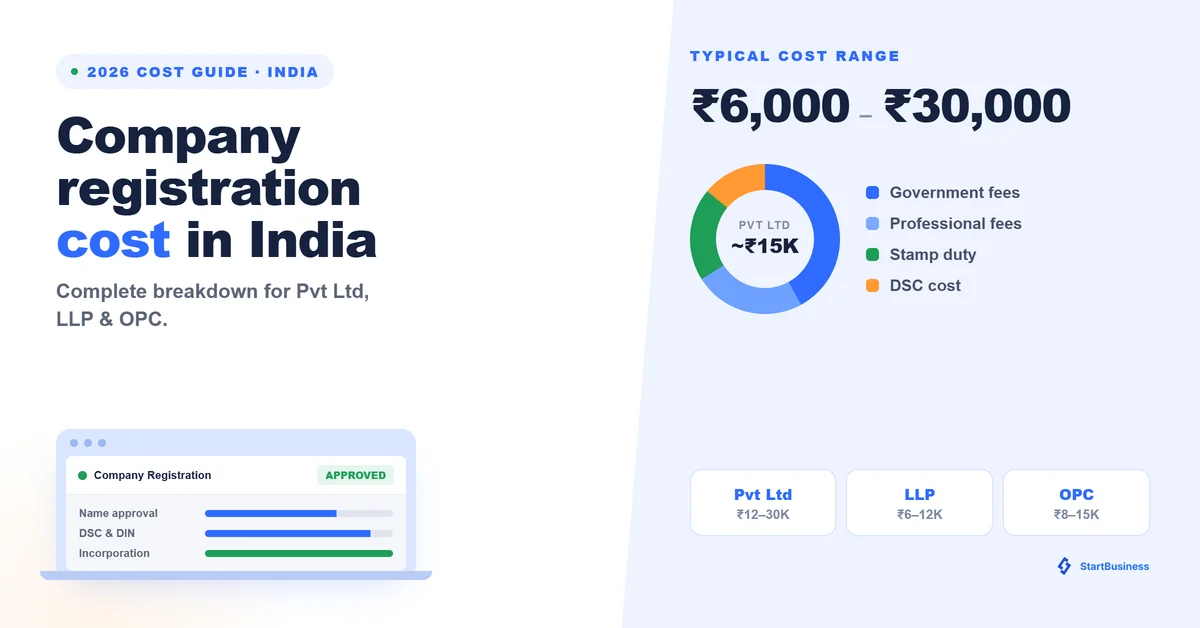
Registering a company in India in 2026 typically costs ₹6,000 to ₹30,000, depending on the structure, your state's stamp duty, and professional fees. A Private Limited Company usually costs ₹7,000–₹25,000 all-inclusive, an LLP ₹6,000–₹15,000, and a One Person Company (OPC) from around ₹6,500. Government filing fees are low—the biggest variables are stamp duty and CA/CS charges.
If you're planning to start a business, the first real question is simple: how much money do I actually need to register it? The honest answer is that it depends on three things—the entity type, the state you register in, and whether you hire a professional.
Online ads quoting "₹999 registration" rarely reflect the full cost, because they leave out stamp duty, Digital Signature Certificates, and professional fees. This guide breaks down every component clearly, with updated 2026 figures, so you can budget accurately and avoid surprises.
If you've already decided on a structure, you can jump straight to company registration. Otherwise, read on for the full cost picture.
Quick Cost Summary by Entity Type
Here's the all-inclusive cost range for the three most common structures in 2026 (government fees + stamp duty + DSC + typical professional charges):
| Entity Type | Typical All-Inclusive Cost (2026) | Best Suited For |
|---|---|---|
| Private Limited Company | ₹7,000 – ₹25,000 | Startups, funded ventures, businesses seeking investors |
| Limited Liability Partnership (LLP) | ₹6,000 – ₹15,000 | Service firms, professionals, small businesses |
| One Person Company (OPC) | ₹6,500 – ₹18,000 | Solo founders wanting limited liability |
Government vs Professional Cost Split
• Government/statutory costs: typically ₹2,000–₹8,000 (stamp duty is the main variable). SPICe+ filing is free for authorized capital up to ₹15 lakh, and PAN, TAN, and DIN are issued at little or no extra cost.
• Professional/CA fees: usually ₹3,000–₹15,000, depending on the firm and the scope of service.
Detailed Cost Breakdown: Every Component Explained
Company registration cost is the total of several individual components. Here's what each one is and what it costs in 2026.
1. Digital Signature Certificate (DSC)
A DSC is a Class-3 digital signature that every director and subscriber needs to sign the incorporation forms electronically. The MCA does not issue these—you buy them from licensed certifying authorities like eMudhra, Sify, or Capricorn.
2026 cost: ₹800–₹2,500 per person, depending on the vendor and validity (a 2-year DSC avoids early renewal costs).
2. Director Identification Number (DIN)
A DIN is a unique number every company director must hold. For new incorporations, DIN is allotted through the SPICe+ form itself.
2026 cost: included free in SPICe+ for up to 3 directors. A standalone DIN application (Form DIR-3) costs ₹500.
3. SPICe+ Filing Fee
SPICe+ (INC-32) is the integrated MCA web form that handles name reservation, incorporation, DIN, PAN, and TAN in a single application.
2026 cost: the MCA filing fee is zero for authorized capital up to ₹15 lakh, and increases incrementally above that threshold.
4. RUN (Name Approval)
RUN (Reserve Unique Name) reserves your company name before incorporation. You can also reserve the name inside SPICe+ Part A.
2026 cost: ₹1,000 per name application (₹1,000 again if you need to resubmit).
5. MoA & AoA Charges
The Memorandum of Association (MoA) and Articles of Association (AoA) are your company's foundational documents, filed electronically as e-MoA (INC-33) and e-AoA (INC-34). Stamp duty applies on these (covered below); drafting is usually bundled into professional fees.
2026 cost: ₹1,000–₹5,000 if drafted by a professional, often included in the package fee.
6. Stamp Duty (State-Wise Variation)
Stamp duty is a state government charge levied on the MoA and AoA, calculated on your declared authorized capital. It is the single most variable cost in company registration—rates differ sharply between states, so your registered office location directly affects your bill.
2026 cost: roughly ₹200 to ₹10,000+ for typical small-company capital, depending on the state. See the state-wise table below.
7. Professional / CA Fees
This is what you pay a Chartered Accountant, Company Secretary, or filing platform to prepare documents, file SPICe+, handle e-stamping, and respond to ROC queries. It varies the most of any component.
2026 cost: ₹3,000 for budget online platforms up to ₹15,000+ for full-service CA/CS firms.
PAN and TAN are auto-allotted during incorporation at a nominal processing charge (around ₹130–₹150 combined). For a deeper look at picking and registering a structure, see the company registration page.
State-Wise Stamp Duty for Company Registration (2026)
The figures below are approximate stamp duty on the MoA and AoA for a company with ₹1 lakh authorized capital. Stamp duty rises with authorized capital and is set by each state, so always confirm the current rate for your state before budgeting.
| State | Approx. Stamp Duty (₹1 lakh capital) | Relative Cost |
|---|---|---|
| Karnataka | ~₹1,000 (flat ₹500 MoA + ₹500 AoA) | Low |
| Delhi | ~₹150–₹360 (≈0.15% of capital) | Low |
| Maharashtra | ~₹1,200 (₹200 MoA + ₹1,000 AoA) | Moderate |
| Tamil Nadu | ~₹1,020 (≈1% of capital on MoA) | Moderate |
| Gujarat | Higher slab rates | Higher |
| Kerala / Punjab | Higher slab rates | Higher |
Note: Stamp duty is calculated on authorized capital and varies by state notification. Karnataka and Delhi are generally on the lower end; Gujarat, Kerala, and Punjab tend to be higher. DPIIT-recognised startups may qualify for waivers or rebates in some states.
Total Cost Scenarios: Three Real-World Cases
To make this concrete, here are three realistic budget scenarios for registering a Private Limited Company in 2026.
Scenario 1 — Low-Budget DIY Setup
You file SPICe+ yourself, buy your own DSCs, register in a low-stamp-duty state, and start with ₹1 lakh authorized capital. You pay only unavoidable government and stamp costs.
Estimated total: ₹5,000 – ₹9,000. Best for confident founders comfortable with MCA forms.
Scenario 2 — Standard Startup Setup
Two directors, ₹1 lakh capital, a mid-range professional or platform handling the filing end-to-end. This is what most founders actually pay.
Estimated total: ₹10,000 – ₹20,000. Balances cost with correct, hassle-free filing.
Scenario 3 — Premium Professional Setup
A full-service CA/CS firm, higher authorized capital, a higher-stamp-duty state, and added support like compliance setup and advisory.
Estimated total: ₹22,000 – ₹35,000+. Best for founders who want everything handled and structured correctly from day one.
Not sure which structure fits your budget and goals? The start a business guide walks through the decision.
Hidden Costs Entrepreneurs Often Miss
The incorporation fee is not the end of your spend. Budget for these too:
• INC-20A (Commencement of Business): a small government fee (~₹200–₹600) plus professional filing charges. Mandatory within 180 days, or you face a ₹50,000 penalty.
• Auditor appointment (ADT-1): the first auditor must be appointed within 30 days, with a small filing fee plus the auditor's charges.
• GST registration: free on the government portal, but a professional may charge ₹1,000–₹3,000 to handle it if you need it.
• PAN / TAN processing: nominal, auto-allotted, but worth knowing it isn't strictly zero.
• Annual ROC compliance: the biggest ongoing cost—statutory audit, AOC-4, MGT-7/7A, and ITR filing typically run ₹15,000–₹50,000+ per year.
Ongoing filings are a recurring budget line, not a one-time cost. You can read more on ROC filing to understand what's due each year.
Is It Worth Hiring a Professional for Company Registration?
Legally, you can file SPICe+ yourself. Whether you should depends on your comfort with MCA forms and your tolerance for resubmission risk.
Benefits of Hiring a CA/CS
• Correct first-time filing—name searches, MoA/AoA drafting, and e-stamping done right.
• Fewer rejections; government fees are non-refundable if your application is rejected for errors.
• Post-incorporation setup (INC-20A, auditor appointment, GST) handled in one go.
Risks of Going Fully DIY
• Name rejection or document mismatch leads to resubmission and lost fees.
• Incorrect stamp duty or capital details can delay your Certificate of Incorporation.
• Missing post-incorporation deadlines (like INC-20A) triggers heavy penalties.
When Should Founders Hire?
If you have multiple directors, higher authorized capital, foreign shareholding, or you simply want certainty, a professional is worth the ₹3,000–₹15,000. If you're a solo founder with a clean, simple structure and time to learn the portal, DIY can work.
A note on 2026 rules: the MCA published draft amendments in April 2026 proposing to raise the DIN cap from 3 to 5, treat MoA subscribers' consent as deemed consent, and make some integrated registrations optional. These were open for public comment until May 2026 and are proposed, not yet in force—so confirm the live rules before filing.
Read also>> How to Register a Private Limited Company in India
Conclusion:
Registering a company in India in 2026 is affordable and transparent once you understand the components. For most founders, the realistic all-inclusive cost is ₹7,000–₹25,000 for a Private Limited Company, less for an LLP. Government fees are low; the real variables are stamp duty and professional charges.
The smartest cost strategy: start with ₹1 lakh authorized capital, choose a low-stamp-duty state if you're location-flexible, and bundle incorporation with first-year compliance from a single provider.
Frequently Asked Questions
What is the minimum cost to register a company in India in 2026?
The bare-minimum unavoidable cost (DSC, name reservation, and stamp duty in a low-duty state, filing it yourself) is roughly ₹5,000–₹9,000 for a Private Limited Company. Adding professional fees brings most setups to ₹10,000–₹20,000.
Is LLP cheaper than a Private Limited Company in India?
Generally, yes. LLP registration usually costs less to set up (around ₹6,000–₹15,000) and has lower annual compliance costs, making it more economical for service firms and small businesses that don't need equity funding.
What is included in MCA registration fees?
MCA fees cover SPICe+ form filing, name reservation, and DIN allotment. SPICe+ filing is free for authorized capital up to ₹15 lakh. Stamp duty is a separate state charge, and PAN/TAN are auto-allotted at a nominal fee.
Do I need a CA to register a company in India?
No—you can legally file SPICe+ yourself. However, MCA filings require certification by a practicing professional (CA/CS/CMA) in many cases, and most founders hire one to avoid rejections and handle post-incorporation compliance.
How much does a DSC cost in India?
A Class-3 Digital Signature Certificate costs about ₹800–₹2,500 per director in 2026, depending on the certifying authority and validity period. A 2-year DSC is usually better value than a 1-year one.
Can I register a company in India myself without a professional?
Yes. SPICe+ is a self-service web form on the MCA V3 portal. DIY works best for simple, single-director structures. The trade-off is resubmission risk and non-refundable fees if you make filing errors.
We handle business incorporation and deed drafting end-to-end, tailored to your needs.

Practising from Deccan Gymkhana, Pune since 2017. Has handled 1,000+ incorporations and ongoing compliance for founders across Maharashtra, from single-partner proprietorships to funded private limited companies.