

Key takeaways
- Checked and verified against current regulatory guidelines by practising CAs/CSs.
- Covers key requirements, step-by-step registration procedures, and statutory compliance timelines.
- Includes actionable insights tailored for Indian founders and business owners.
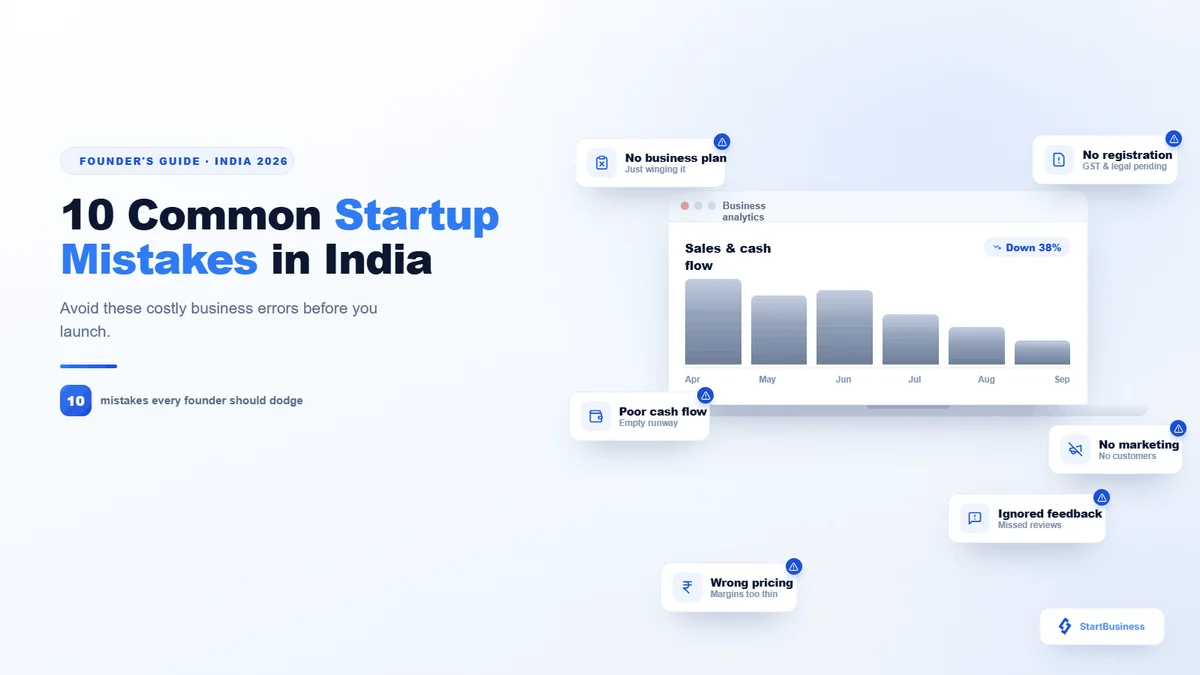
Every year, thousands of people in India start a new business with big dreams. But many of them fail not because their idea was bad, but because they made avoidable mistakes. Understanding the most common mistakes when starting a new business in India can be the difference between success and shutting down within a year. Before you take the leap, read our complete step-by-step business start guide for India to set a strong foundation. In this article, we cover the real, on-ground mistakes that trip up beginners from skipping legal paperwork to ignoring their customers.
Whether you are a student, a freelancer, or someone leaving a job to build something of your own this guide is written simply, so you can avoid failure before it happens.
Read More>> How to Register a Private Limited Company in India
Mistake 1: Skipping a Proper Business Plan
What Is This Mistake?
Many beginners start a business purely on excitement. They have an idea, they print some visiting cards, and they start. No written plan. No numbers. No strategy.
Why Does It Happen?
People think a business plan is only for big companies or bank loans. That is wrong. A business plan is your roadmap — even a simple one-page plan matters.
How to Avoid It
• Write down your product or service clearly
• Estimate your monthly costs and income
• Identify who your customers are and how you will reach them
• Set a 6-month goal and track it
Even a simple plan in a notebook is better than no plan at all.
Mistake 2: Not Registering the Business Legally
What Is This Mistake?
Many new business owners in India skip legal registration to "save time" or "start small." This creates major problems later — from GST issues to bank account troubles.
Why Does It Happen?
The registration process seems complicated. But it is actually faster and cheaper than most people think, especially with online options available today.
How to Avoid It
• Register as a Sole Proprietor, Partnership, LLP, or Private Limited Company — based on your business size
• Get a GST registration if your revenue crosses the threshold
• Open a separate business bank account from Day 1
Not sure which registration is right for you? Read our guide on business registration in India to understand your options simply.
Mistake 3: Underestimating Startup Costs
What Is This Mistake?
New entrepreneurs often plan for the visible costs — rent, stock, a logo — but forget the hidden ones. Then they run out of money in month 2 or 3.
Why Does It Happen?
Excitement makes people optimistic. They assume sales will come quickly. But most businesses take 3–6 months to generate steady income.
How to Avoid It
• Calculate your fixed monthly expenses (rent, salaries, internet, subscriptions)
• Add 30% as a buffer for unexpected costs
• Keep at least 6 months of operating expenses saved before you start
• Do not mix personal and business money
Mistake 4: Ignoring Market Research
What Is This Mistake?
Starting a business without checking if people actually want what you are selling. Many businesses launch a product and then discover — too late — there is no real demand.
Why Does It Happen?
It feels uncomfortable to test an idea before building it. Many entrepreneurs fear rejection, so they skip the research phase entirely.
How to Avoid It
• Talk to at least 20 potential customers before you invest money
• Check if competitors exist — if they do, that is actually a good sign (demand exists)
• Use free tools like Google Trends, Instagram polls, or Facebook groups to test interest
• Ask people: "Would you pay for this?" — not just "Do you like this idea?"
Mistake 5: Trying to Do Everything Alone
What Is This Mistake?
Many Indian founders — especially first-timers — refuse to delegate or ask for help. They handle design, accounts, marketing, delivery, and customer calls by themselves. This leads to burnout and poor quality work across the board.
Why Does It Happen?
Founders worry about cost. But the hidden cost of doing everything yourself is time — the one resource you cannot buy back.
How to Avoid It
• Identify your top 2 strengths and focus on those
• Outsource or hire for tasks like bookkeeping, social media, or logistics
• Use free tools like Canva, Zoho, or WhatsApp Business to save time on routine tasks
• Find a co-founder or mentor if possible — local startup communities and incubators can help
Mistake 6: No Clear Marketing Strategy
What Is This Mistake?
Building a product and then hoping people will find it. Marketing is treated as something to think about later — after launch. That is a common new business failure reason in India.
Why Does It Happen?
Many first-time founders are product-focused. They believe a good product sells itself. In a competitive market, it does not.
How to Avoid It
• Decide your marketing channel before launch — Instagram, WhatsApp, Google, local newspapers
• Create content consistently — even 3 posts a week on one platform beats silence
• Set a small paid ad budget (even ₹500/month on Meta Ads can work for local businesses)
• Ask your first 10 customers for referrals — word of mouth is still the strongest channel in India
Mistake 7: Ignoring Cash Flow
What Is This Mistake?
A business can be "profitable on paper" and still shut down because it runs out of cash. This is one of the most dangerous — and misunderstood — starting a business mistakes in India.
Why Does It Happen?
Founders confuse profit with cash. If a customer owes you ₹1 lakh but has not paid, you cannot pay your rent with that promise.
How to Avoid It
• Track all money coming in and going out every week — not just monthly
• Avoid giving long credit periods to customers, especially when you are new
• Follow up on unpaid invoices immediately
• Use simple free tools like Google Sheets or Vyapar app to manage cash flow
Mistake 8: Pricing Too Low (Or Too High) Without Research
What Is This Mistake?
New business owners in India often underprice their products because they fear rejection. This leaves money on the table and signals low quality to customers.
Why Does It Happen?
The instinct is to compete on price. But competing on value is far more powerful and sustainable.
How to Avoid It
• Research what competitors charge — do not price blindly
• Calculate your actual cost per unit or per service, then add a healthy margin
• Test 2–3 price points with real customers before fixing your pricing
• Remember: too low a price attracts the wrong customers — those who always want more discount
Mistake 9: No Customer Feedback Loop
What Is This Mistake?
After launch, many entrepreneurs stop listening to their customers. They build features no one asked for and miss the real problems people want solved.
How to Avoid It
• Ask every customer for honest feedback after a purchase
• Read every negative review — it is free product research
• Create a simple feedback form (Google Forms is free)
• Update your product or service based on patterns in feedback, not individual opinions
Mistake 10: Giving Up Too Early
What Is This Mistake?
Many first-time business owners expect results in 30–60 days. When sales are slow, they panic and quit — sometimes just 2–3 months before things would have turned around.
Why Does It Happen?
Social media shows overnight success stories. Real business growth is quieter and slower. The comparison kills patience.
How to Avoid It
• Set a realistic timeline — most Indian businesses take 6–18 months to stabilize
• Track small wins: first 10 customers, first repeat buyer, first referral
• Build a support system — a mentor, a peer group, or an online community
• Separate "this is hard" from "this is wrong" hard is normal, wrong needs to be fixed.
Frequently Asked Questions (FAQs)
What are the most common mistakes when starting a new business in India?
The most common mistakes include skipping a business plan, not registering legally, poor cash flow management, and lack of market research.
Why do most new businesses fail in India?
Most new businesses in India fail due to poor financial planning, no clear marketing strategy, and running out of cash in the early months.
Is it mandatory to register a small business in India?
Not always mandatory, but highly recommended. Registration protects you legally, helps open bank accounts, and is needed for GST compliance.
How much money should I save before starting a business in India?
Ideally, save at least 6 months of your expected monthly business expenses before you launch.
How do I avoid startup failure in India?
Do market research, create a simple business plan, register your business, control cash flow, and stay consistent with marketing from Day 1.
What is the biggest financial mistake new business owners make in India?
Mixing personal and business money, and underestimating startup costs especially the hidden costs in the first 3 months.
We handle business incorporation and deed drafting end-to-end, tailored to your needs.

Practising from Deccan Gymkhana, Pune since 2017. Has handled 1,000+ incorporations and ongoing compliance for founders across Maharashtra, from single-partner proprietorships to funded private limited companies.