

Key takeaways
- Checked and verified against current regulatory guidelines by practising CAs/CSs.
- Covers key requirements, step-by-step registration procedures, and statutory compliance timelines.
- Includes actionable insights tailored for Indian founders and business owners.
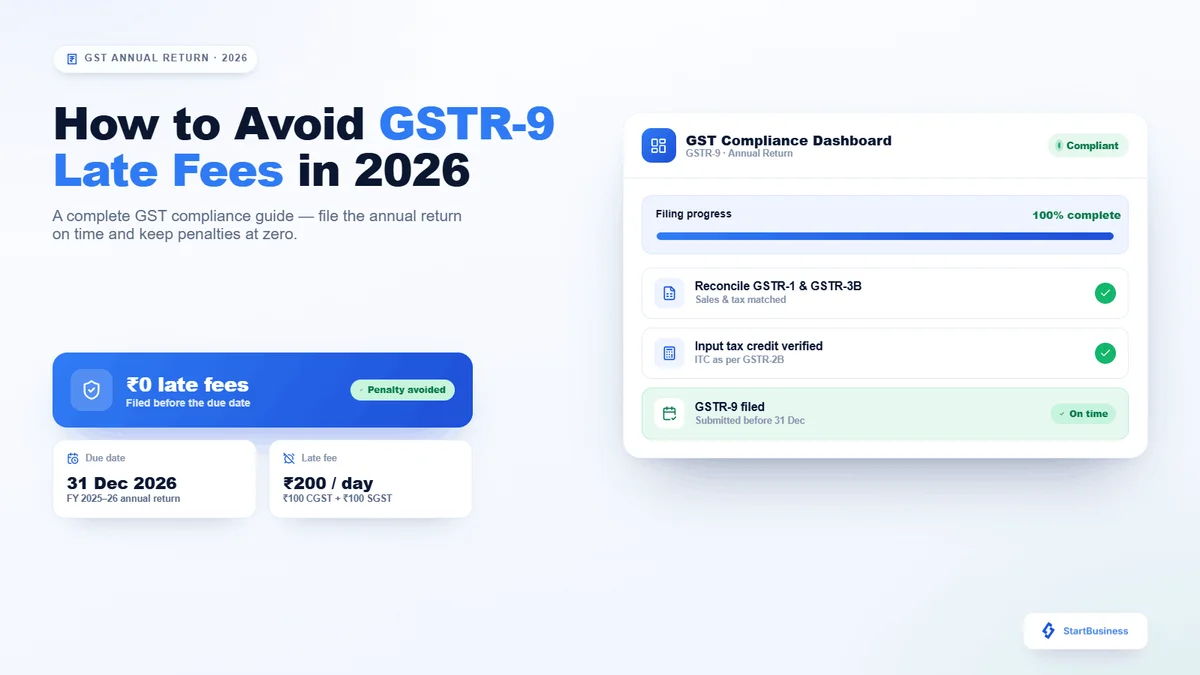
Every year, thousands of Indian businesses end up paying avoidable late fees just because they missed the GSTR-9 deadline or filed an incomplete return. In 2026, with GST enforcement tightening and compliance notices becoming more common, staying ahead of your annual return is more important than ever.
This guide is built specifically for business owners and finance teams who want a clear, actionable plan to avoid GST late filing penalties — without the jargon.
Read more>> Section 194C TDS
Why GSTR-9 Late Fees Happen
Most businesses don't miss their GSTR-9 deadline on purpose. The real culprits are usually:
• Lack of a structured year-end compliance calendar
• Reconciliation mismatches between GSTR-1, GSTR-3B, and purchase data
• Unclear understanding of who is actually required to file
• Waiting too long to gather invoices and input tax credit (ITC) data
• Assuming the deadline has been extended — without verifying
Under Section 47 of the CGST Act
Late Fee by Turnover Slab
| Annual Turnover | Total / Day | CGST / Day | SGST / Day | Maximum Cap |
|---|---|---|---|---|
| Up to ₹5 Crore | ₹50 | ₹25 | ₹25 | 0.04% of turnover |
| ₹5 Crore – ₹20 Crore | ₹100 | ₹50 | ₹50 | 0.04% of turnover |
| Above ₹20 Crore | ₹200 | ₹100 | ₹100 | 0.50% of turnover |
Note: There is NO late fee applicable on IGST component.
Payment Rules
| Rule | Detail |
|---|---|
| Payment mode | Cash only — via Electronic Cash Ledger |
| ITC offset allowed? | No — Electronic Credit Ledger cannot be used to pay late fees |
| IGST late fee | Nil — no late fee levied on IGST |
| Cap basis | Percentage of aggregate annual turnover for the relevant FY |
Compliance Risk
Why This Matters Beyond the Fee
Even at the lowest slab (₹50/day), a 60-day delay on a ₹4 crore turnover business hits a ₹3,000 cash outflow — payable only from the Cash Ledger, not ITC. More significantly, late filing of GSTR-9 is a direct non-compliance signal to the GST department and can trigger scrutiny notices, audit selection, or input tax credit mismatch proceedings.
If you need to understand the exact penalty amount based on your turnover, you can calculate your GSTR-9 late fee using our dedicated tool.
Late Fees vs. Penalties - Know the Difference
Many businesses confuse late fees with penalties under GST. They are separate consequences and can apply simultaneously. Here is a clear breakdown:
Late Fees (Section 47 of CGST Act) — These are automatic, system-computed charges for delayed filing of GSTR-9/9C. They accrue daily from the due date (31st December) until the return is filed. Late fees are paid through the Electronic Cash Ledger only and cannot be adjusted against ITC. The turnover-based slab rates (₹50/₹100/₹200 per day) and caps (0.04%/0.50%) apply as described above.
Penalties (Sections 122, 125, and 73/74 of CGST Act) — Penalties are separate from late fees and may be imposed where the annual return reveals discrepancies, misreporting, or non-compliance. The key penalty provisions relevant to GSTR-9/9C are:
1. Section 122(2) — Penalty for tax short-payment or wrong ITC: (a) For reasons other than fraud: ₹10,000 or 10% of the tax due, whichever is higher. (b) For fraud or wilful misstatement or suppression of facts: ₹10,000 or 100% of the tax due, whichever is higher.
2. Section 125 — General penalty for non-compliance: Where a contravention is not covered by any other specific penalty provision (Sections 122–124), the defaulter is liable to a general penalty of up to ₹25,000 (under each Act — CGST and SGST). This can apply to errors or incorrect declarations found in GSTR-9C during scrutiny, inspection, or assessment.
3. Sections 73 and 74 — Demand and recovery proceedings: If GSTR-9/9C filing reveals tax short-paid, unpaid, erroneously refunded, or ITC wrongly availed/utilised, the proper officer may initiate demand proceedings. Under Section 73 (non-fraud cases), penalty is 10% of the tax demand or ₹10,000, whichever is higher. Under Section 74 (fraud/suppression cases), penalty is equal to 100% of the tax demand. Note: Section 74A (applicable from FY 2024-25 onwards, as introduced via Finance Act 2024-25) replaces Sections 73 and 74 with a unified demand provision for all future periods. Sections 73 and 74 continue to apply for FY 2023-24 and earlier. Under Section 74A, penalty is 10% of the tax due (non-fraud) or graded at 15%/25%/50%/100% depending on the stage of payment and whether fraud is established.
4. Interest under Section 50: In addition to penalty, interest at 18% per annum applies on any tax short-paid or unpaid. Where ITC has been wrongly availed and utilised, the interest rate is 24% per annum.
5. Section 128A — Amnesty for waiver of interest and penalty (FY 2017-18 to 2019-20): Effective from 1st November 2024, Section 128A provides a conditional waiver of interest or penalty (or both) on demand notices issued under Section 73 for FY 2017-18, 2018-19, and 2019-20, provided the full tax demand is paid by 31st March 2025. This amnesty does not cover late fees, fraud cases under Section 74, or erroneous refunds. Applications must be filed using Form GST SPL-01 or SPL-02.
Key takeaway: Late fees (Section 47) and penalties (Sections 122/125/73/74) are independent consequences. Filing GSTR-9 late attracts late fees automatically; if the return also reveals discrepancies or misreporting, separate penalty proceedings under Sections 73/74 or 122/125 can be initiated by the proper officer. Interest under Section 50 applies on top of both. Filing accurately and on time is the only way to avoid all three.
Tips to Prevent GST Annual Return Penalty
Here are the most effective tips to prevent GST annual return penalties. These aren't generic suggestions — they're practical steps used by compliance-aware small businesses across India.
1. Mark Your Compliance Calendar Early
GSTR-9 is due on 31st December for the previous financial year. Block this date in your calendar at the start of the year and set reminders 60, 30, and 7 days before the deadline.
2. Reconcile Monthly, Not Annually
The biggest time-sink in GSTR-9 filing is resolving mismatches between your GST return filing records and your books. Running monthly reconciliations means your year-end data is already clean.
3. Register Correctly From the Start
Wrong registration category or late GST registration leads to filing gaps. Make sure your business is registered under the correct type — Regular, Composition, or QRMP — to determine your actual GSTR-9 obligation.
4. Don't Wait for Government Reminders
GST authorities send notices, not reminders. Build your own internal compliance workflow so you never rely on external triggers.
5. Use Professional Help for Complex Returns
If your annual turnover exceeds ₹5 crore, you also need to file GSTR-9C — a self-certified reconciliation statement between the annual return and audited financial statements. Note that GSTR-9C no longer requires certification from a practising CA or Cost Accountant. Consider engaging GST compliance services to handle this accurately.
GSTR-9 Filing Checklist for Small Businesses
Use this GSTR-9 filing checklist before you sit down to file. Ticking off each item means you're ready.
✅ Pre-Filing Checklist
- Turnover verified for the financial year (check if GSTR-9 is mandatory)
- All GSTR-1 returns filed and reconciled for the year
- All GSTR-3B returns filed no pending monthly returns
- Purchase register matched with auto-populated GSTR-2B data (and Invoice Management System, where applicable)
- ITC claimed vs. ITC available - gap analysed and justified
- HSN/SAC summary compiled for outward supplies
- B2B, B2C, export, and exempted supply totals verified
- Tax payment ledger (Cash and Credit) confirmed with GST portal balance
- Previous year's unadjusted ITC and reversals noted
- GSTR-9C applicability checked (mandatory above ₹5 crore turnover)
Preparing this data in advance ideally during Q4 of the financial year dramatically reduces last-minute errors and the risk of late filing.
GSTR-9 Compliance Checklist India
Beyond just filing on time, staying compliant with GSTR-9 in India involves maintaining ongoing accuracy throughout the year. Here's what that looks like in practice:
Year-Round Compliance Checklist
- File GSTR-1 by the 11th of every month (or quarterly under QRMP)
- File GSTR-3B by the 20th of every month
- Match your sales register with GSTR-1 data monthly
- Ensure vendors you’ve bought from have filed their GSTR-1 (affects your ITC in GSTR-2B); use the Invoice Management System (IMS) to accept, reject, or keep invoices pending
- Reverse ITC for invoices unpaid beyond 180 days (as per Rule 37 of CGST Rules); also check Rule 37A for ITC reversal on non-filing by supplier
- Maintain proper invoice-level records for all B2B purchases
- Keep records of any exempt, nil-rated, or non-GST supplies separately
- Monitor your annual turnover to determine if GSTR-9C applies to you (note: as per Circular No. 246/03/2025-GST, the late fee is calculated until the complete annual return — both GSTR-9 and GSTR-9C, where applicable — is filed; the fee is not levied separately for each form)
- Review your GST registration details annually — address, category, authorised signatory
Businesses that maintain this GSTR-9 compliance checklist throughout the year report significantly fewer errors at filing time.
Common Mistakes That Lead to Late Fees
Even well-intentioned businesses get caught out. Watch for these common filing mistakes:
• Filing GSTR-9 without clearing all pending GSTR-3B liabilities — the portal won't allow it
• Incorrect turnover reporting — Table 5 vs. Table 4 mismatches with books
• Not claiming eligible ITC that was missed during the year — Table 13 entries
• Ignoring auto-populated data and manually entering figures without reconciliation
• Missing HSN summary requirements — mandatory for outward supplies from FY 2021-22 onwards (6-digit HSN for turnover above ₹5 crore; 4-digit for B2B supplies for turnover up to ₹5 crore)
• Assuming nil filing is an option when you have any taxable supply
• Trusting unverified third-party data without cross-checking with the GST portal.
What If You Already Missed the Deadline?
If you've already crossed the GSTR-9 deadline, act immediately — the late fee accrues every single day. Here's what to do:
Step 1: Log in to your GST portal and check your exact filing status.
Step 2: Find out the exact late fee amount based on your turnover and days delayed. Use our GSTR-9 Late Fee Calculator to get an instant estimate.
Step 3: Ensure all your GSTR-1 and GSTR-3B returns for the year are filed — GSTR-9 cannot be submitted otherwise.
Step 4: Complete your data reconciliation and file GSTR-9 at the earliest to stop the late fee counter.
Step 5: Pay the applicable late fee through your Electronic Cash Ledger (Head: Fee) during the filing process. Note: The portal will not allow you to file the return without paying the full late fee — there is no partial payment, instalment, or waiver option. Late fee cannot be paid using ITC; it must be paid in cash only.
Delaying further only increases your liability. A missed deadline is recoverable — consistent non-filing is not.
How to Stay Compliant Year-Round
The businesses that never worry about GSTR-9 late fees share one habit: they treat compliance as a monthly task, not an annual scramble. Here's the mind-set shift that makes a difference:
• Assign a dedicated person or team for GST compliance even in small businesses
• Review your GSTR-2B every month and flag mismatches immediately
• Keep your accounting software synced with GST return data in real time
• Conduct a mid-year compliance review (around October) to catch issues early
• Stay updated on government notifications deadlines can change
• Use professional services for high-volume or complex GST situations.
For a smooth, penalty-free year, consider outsourcing your annual return to experts. Our team at StartBusiness handles everything from GST registration to year-end compliance filing so you can focus on your business, not the paperwork.
Stay Compliant Don't Let Late Fees Cost Your Business
GSTR-9 compliance doesn't have to be stressful. With the right checklist, a disciplined monthly routine, and expert support when you needed, can file on time - every time - and avoid GST late filing penalties entirely.
Need help with your GSTR-9 this year? Our GST compliance specialists handle the entire process from data reconciliation to final submission so nothing falls through the cracks.
Already behind? Don't wait. Calculate your GSTR-9 late fee now, then get in touch so we can help you file and minimise your exposure today.
Frequently Asked Questions (FAQs)
Can we file GSTR-9 without paying late fee?
No. If you file after the due date, the late fee is auto-calculated by the GST portal and must be paid in full before the return is accepted. There is no provision for partial payment, instalment, or waiver of late fee based on financial hardship. The system will not allow you to proceed with filing unless the entire late fee is discharged through the Electronic Cash Ledger.
What is the maximum late filing fee for GSTR-9?
From FY 2022-23 onwards (Notification No. 07/2023-Central Tax), the late fee is turnover-based: ₹50/day for turnover up to ₹5 crore (max 0.04% of turnover); ₹100/day for turnover between ₹5–₹20 crore (max 0.04%); and ₹200/day for turnover above ₹20 crore (max 0.50% of turnover). The maximum cap of 0.25% per Act (totalling 0.50%) applies only to the highest turnover bracket. Important: (a) There is no late fee on IGST — only CGST and SGST/UTGST. (b) As per Circular No. 246/03/2025-GST, the late fee is not levied separately for GSTR-9 and GSTR-9C; it is calculated as a single continuous obligation from the due date until the complete annual return (both GSTR-9 and GSTR-9C, where applicable) is filed. (c) Late fee must be paid in cash only through the Electronic Cash Ledger and cannot be set off against ITC.
Is there any exemption from filing GSTR-9?
Yes. As per CBIC Notification No. 15/2025-Central Tax, taxpayers with aggregate annual turnover up to ₹2 crore are permanently exempt from filing GSTR-9 (this is no longer a year-by-year exemption). Composition dealers file GSTR-9A instead (replaced by GSTR-4 from FY 2019-20 onwards).
Can the GST penalty be waived off?
There is no general or standing waiver provision for GSTR-9/9C late fees. However, the government has periodically issued amnesty schemes: (a) Notification No. 07/2023-Central Tax capped late fee at ₹20,000 for FY 2017-18 to 2021-22 if filed between April–June 2023 (later extended to August 2023). (b) Notification No. 08/2025-Central Tax (23 January 2025) waived excess late fee for delayed GSTR-9C filing for FY up to 2022-23, provided GSTR-9C was filed by 31st March 2025. For FY 2025-26, there is currently no active amnesty or waiver scheme — always check the latest CBIC notifications before filing.
What is the 5% penalty for GST?
Under Section 122(2) of the CGST Act, the penalty for tax short-payment or wrong ITC availment is: (a) for reasons other than fraud — ₹10,000 or 10% of the tax due, whichever is higher; (b) for fraud or wilful misstatement — ₹10,000 or 100% of the tax due, whichever is higher. There is no specific “5% penalty” provision in the CGST Act for GSTR-9/9C non-filing; this figure may arise from turnover-based penalty calculations in individual notices.
How to pay a late filing fee for GSTR-9?
The late fee is automatically computed by the GST portal when you open the GSTR-9 return. It must be paid through your Electronic Cash Ledger (Head: Fee) before submission — ITC cannot be used to pay late fees. For taxpayers who also need to file GSTR-9C: the system auto-calculates late fee up to the date of GSTR-9 filing and collects it at that stage; if GSTR-9C is filed later, the balance late fee for the additional days of delay is auto-populated and collected at the time of GSTR-9C filing (as per GSTN’s consolidated FAQs and Circular No. 246/03/2025-GST). From FY 2024-25 onwards, GSTR-9C also includes a new Table 17 that records the daily late fee amount.
What happens if GSTR-9 is not filed?
Late fees accrue daily. Continued non-filing can lead to GST notices, suspension of GSTIN, and denial of ITC to your buyers — affecting your business relationships. Additionally, from July 2025 onwards, GSTN restricts filing of GSTR-3B after the expiry of three years from its due date. Since GSTR-9 cannot be filed unless all GSTR-1 and GSTR-3B returns for the year are filed, prolonged non-compliance with monthly returns can permanently block your ability to file the annual return as well.
Can we file GSTR-9 without HSN summary?
From FY 2021-22 onwards, HSN summary for outward supplies in Table 17 of GSTR-9 is mandatory. Taxpayers with annual turnover above ₹5 crore must report HSN codes at 6-digit level. Taxpayers with turnover up to ₹5 crore must report at least 4-digit HSN for B2B supplies. Table 18 (inward supplies HSN summary) remains optional but is recommended for reconciliation purposes.
Who is liable to file GSTR-9 and GSTR-9C?
All regular GST-registered taxpayers with aggregate annual turnover exceeding ₹2 crore must file GSTR-9 (those below ₹2 crore are permanently exempt). GSTR-9C (self-certified reconciliation statement) is mandatory for those with annual turnover exceeding ₹5 crore in a financial year. Note: GSTR-9C is self-certified by the taxpayer and no longer requires CA/CMA certification.
We handle business incorporation and deed drafting end-to-end, tailored to your needs.

Practising from Deccan Gymkhana, Pune since 2017. Has handled 1,000+ incorporations and ongoing compliance for founders across Maharashtra, from single-partner proprietorships to funded private limited companies.