

Key takeaways
- Checked and verified against current regulatory guidelines by practising CAs/CSs.
- Covers key requirements, step-by-step registration procedures, and statutory compliance timelines.
- Includes actionable insights tailored for Indian founders and business owners.
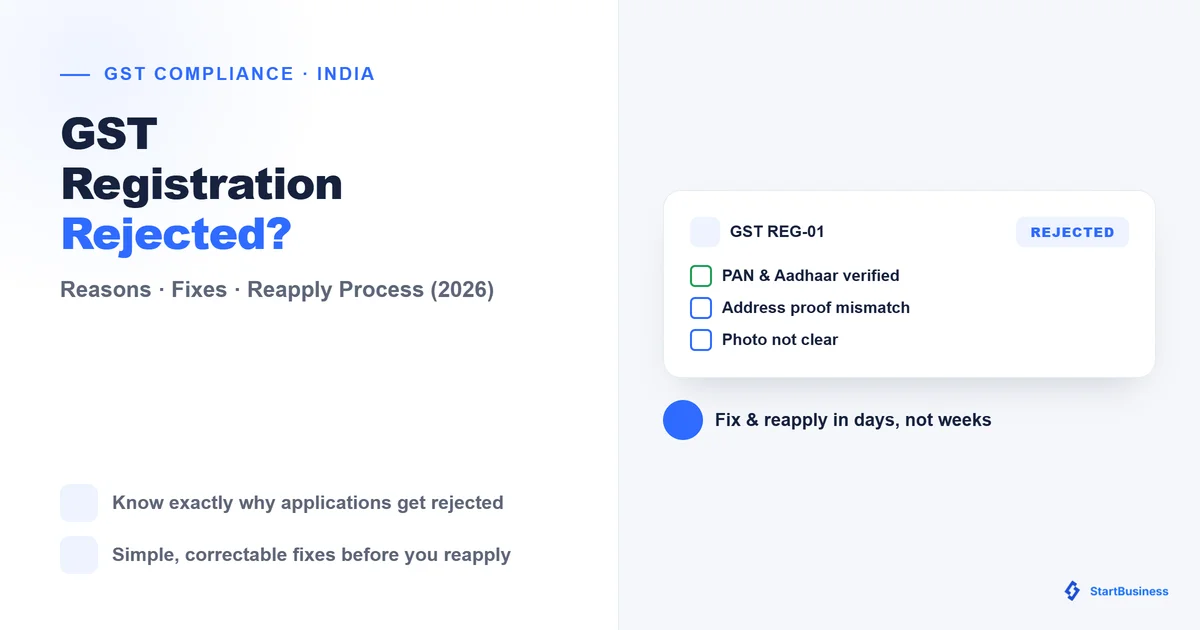
A rejection usually happens because of correctable issues such as document mismatch, incomplete information, or failure to respond to a GST clarification notice.
This guide focuses only on what happens after you apply for GST Registration — why applications get rejected, how to read the rejection or clarification notice, what a tax officer actually checks, and the exact steps to reapply without repeating the same mistake. It does not repeat the basic registration process, since that is covered in our GST Registration Turnover Limit guide.
Quick Answer: What Happens When GST Registration Is Rejected?
A rejected GST application cannot be reopened using the same ARN — the decision is final for that ARN. You must fix the flagged issue (usually a document mismatch, address proof problem, or an unanswered clarification notice) and submit a fresh Form REG-01 application. There is no reapplication fee and no mandatory waiting period, so you can reapply as soon as the underlying issue is corrected. If you believe the rejection order (Form REG-05) was unjustified or unreasoned, you also have two other routes — a grievance to the jurisdictional Zonal Principal Chief Commissioner under CBIC Instruction No. 04/2025-GST, or an appeal under Section 107 of the CGST Act in Form APL-01.
GST Registration Rejection At a Glance
| Question | Quick Answer |
|---|---|
| Can GST registration be rejected? | Yes — usually for document mismatch, address proof issues, or an unanswered clarification notice. |
| Can I apply again after rejection? | Yes, any number of times, with no fee and no mandatory waiting period. |
| Can the same ARN be reopened? | No. A rejected ARN is closed permanently; reapplication generates a new ARN. |
| Can I appeal a rejection? | Yes. Form REG-05 is an appealable order under Section 107 of the CGST Act — file Form APL-01 within 3 months. |
| What is the most common rejection reason? | Address proof issues — the utility bill, rent agreement or consent letter not matching the application. |
| How long does reapplication take? | Same review timeline as a first application — 7 working days under Rule 9, or 3 working days if the application qualifies for the Rule 9A fast track. |
| Is there a fee for reapplying? | No. GST registration and reapplication are both free of government fees. |
Key Takeaways
| Situation | What It Means | What To Do |
|---|---|---|
| Application shows 'Rejected' | Officer has formally refused registration in Form REG-05 | File a fresh REG-01 application; the old ARN cannot be reopened. If the order is unreasoned, consider a grievance or appeal instead |
| Status shows 'Pending for Clarification' | Officer wants more information, not a final rejection yet | Reply using Form REG-04 within 7 working days |
| No reply to clarification notice | Application gets rejected after the deadline | Track the ARN daily; set a reminder for the 7-day window |
| ARN never generated | Biometric authentication or document verification at the GST Suvidha Kendra was not completed | Complete GSK verification within 15 days of submitting Part B of REG-01 |
| Rejected for address proof | Most frequently cited ground in practice | Use any one valid document from the indicative list in REG-01 — you are not required to submit more than that |
| Rejected after physical verification | Officer visited and found a mismatch or no active business | Ensure signage, premises access, and documents match exactly before reapplying |
| Officer takes no action at all | Registration may be deemed granted under Rule 9(5) | Check the portal; if the statutory period has lapsed with no action, raise a grievance |
How GST Registration Approval Works
GST registration approval is essentially a document and identity verification exercise carried out by a jurisdictional GST officer. Once you submit Form REG-01 with PAN, Aadhaar, business address proof, and bank details, the officer has seven working days under Rule 9(1) of the CGST Rules, 2017 (or up to 30 days if the application is flagged for physical verification) to either approve the application, raise a clarification, or reject it.
Since 1 November 2025, there is also a faster parallel track. The CGST (Fourth Amendment) Rules, 2025, notified vide Notification No. 18/2025–Central Tax dated 31 October 2025, inserted Rule 9A and Rule 14A into the CGST Rules. Under Rule 9A, applications identified as low-risk by the portal's automated risk-assessment engine are granted registration electronically within three working days, without manual officer verification. Rule 14A is an optional simplified scheme for applicants whose monthly output tax liability on supplies to registered persons does not exceed ₹2.5 lakh, and REG-01 now carries a field asking whether you wish to opt for it.
For this article, what matters is the decision point — approval, clarification, or rejection. If you need to check whether your turnover crosses the mandatory registration threshold first, use our GST Calculator, which covers eligibility thresholds alongside GST amount calculations.
GST Registration Rejection Timeline: From Application to Rejection
| Stage | Timeline | What Happens |
|---|---|---|
| REG-01 Part A submission | Day 0 | PAN, mobile and email verified; TRN generated |
| Aadhaar / biometric authentication | Within 15 days of Part B submission | OTP-based Aadhaar authentication, or biometric authentication and document verification at a GST Suvidha Kendra if flagged. ARN is not generated until this is completed |
| Rule 9A automated grant | Within 3 working days | Where the portal's risk engine identifies the applicant as low-risk, registration is granted electronically without officer verification |
| Officer verification | Within 7 working days | Officer reviews documents; may approve, raise a clarification, or reject |
| REG-03 clarification (if required) | Within 7 working days of submission, or up to 30 days where flagged for physical verification | Officer requests additional information or corrected documents |
| REG-04 response | Within 7 working days of REG-03 | Applicant must reply with the requested clarification or documents |
| Approval or rejection | Within 7 working days of REG-04 | Officer approves the application or issues a rejection order (REG-05), recording reasons in writing |
| Deemed approval | On lapse of the above periods | If the officer takes no action within the prescribed period, registration is deemed granted under Rule 9(5) |
| Fresh application after rejection | Any time, no waiting period | Applicant files a new REG-01 with the flagged issue corrected; new ARN generated |
| Appeal against rejection | Within 3 months of the REG-05 order | Appeal to the Appellate Authority in Form APL-01 under Section 107 |
How to Check Why Your GST Registration Was Rejected
Log in to the GST Portal, go to Services > Registration > Track Application Status, and enter your ARN or SRN. The status will show one of: Pending for Processing, Pending for Clarification, Approved, or Rejected. If rejected, the exact reason is available as an attached order — download it from Services > User Services > View Notices and Orders.
1. Visit www.gst.gov.in and log in with your TRN (Temporary Reference Number) used during application.
2. Go to Services → Registration → Track Application Status.
3. Enter the ARN (Application Reference Number) received on your registered email/mobile.
4. Go to Services → User Services → View Notices and Orders to open the rejection order or clarification notice as a downloadable PDF.
5. Read the 'Reason for Rejection' field carefully — this is the officer's exact objection, not a generic message. Rule 9(4) requires the officer to record reasons in writing, so a vague or unreasoned order is itself a ground for challenge.
Did You Know? Most applicants only check the status as 'Approved/Rejected' and never open the actual rejection order PDF — which is where the specific reason is written. Always download and read the order itself.
Top Reasons GST Registration Gets Rejected
GST registration rejection almost always falls into one of three buckets: document issues, verification failures, or an unanswered clarification notice. Here are the most common specific reasons, based on patterns seen across applications.
| Reason | What It Looks Like | How to Fix Before Reapplying |
|---|---|---|
| Incorrect PAN | Name on PAN doesn't match the name entered in REG-01 | Re-check PAN card spelling; use the exact name as per PAN database |
| Aadhaar mismatch | Aadhaar e-KYC name/DOB doesn't match PAN records | Update Aadhaar via UIDAI or correct the application to match Aadhaar exactly |
| Biometric verification not completed | Applicant flagged for GSK visit did not attend within 15 days | Complete biometric authentication and document verification at the designated GST Suvidha Kendra within the 15-day window |
| Business address proof mismatch | Utility bill address differs from the address typed in the form | Use the address exactly as printed on the electricity bill or property tax receipt |
| Blurred or unclear documents | Scanned copies are illegible | Re-scan at 200 DPI minimum; avoid mobile camera photos with glare |
| Address document not in the list | Document uploaded is not among those in the indicative list appended to REG-01 | Upload any one document from that list — for owned premises, a property tax receipt, municipal khata copy, electricity bill or water bill is sufficient on its own |
| Rental agreement issues | Agreement uploaded without proof of the lessor's ownership | A registered rent agreement plus the lessor's ownership proof is enough. If the agreement is unregistered, add the lessor's ID proof. An unregistered agreement is valid and cannot be refused on that ground alone |
| No consent letter for shared premises | Business runs from a relative's or third party's premises without a consent letter | Attach a consent letter along with the consenter's ID proof and ownership proof of the premises |
| No rent agreement available at all | Premises occupied without any written agreement | Submit an affidavit on non-judicial stamp paper of minimum value, executed before a First-Class Judicial Magistrate, Executive Magistrate or Notary Public, along with an electricity bill in the applicant's name |
| Mobile/email mismatch or OTP failure | OTP sent to number/email not accessible at verification time | Ensure the mobile number and email in Aadhaar/PAN records are active and accessible |
| Wrong business constitution selected | Proprietorship shown as partnership or vice versa | Match constitution type exactly with PAN and supporting deed/certificate. For partnerships only the Partnership Deed is required; for societies and trusts only the Registration Certificate |
| Digital Signature Certificate (DSC) issues | DSC expired, not registered, or belongs to a different authorized signatory | Register a valid, current DSC for the authorized signatory before submission |
| Physical verification failed | Officer visited premises and found it locked, unused, or mismatched | Ensure signage, access, and business activity are visibly evident during the visit window |
| Fake or tampered documents | Forged rent agreement, fabricated consent letter, or edited utility bill | Never submit altered documents — this attracts penalty under Section 122 and prosecution under Section 132 of the CGST Act, not just rejection |
| Fake or tampered documents | Forged rent agreement, fabricated consent letter, or edited utility bill | Never submit altered documents - this attracts penalty under section 122 and prosecution under section 132 of the CGST Act, not just rejection |
Queries an Officer Should Not Be Raising
CBIC Instruction No. 03/2025-GST dated 17 April 2025 expressly restricts what officers may ask for. Under this instruction, officers must confine themselves to the indicative list of documents appended to Form REG-01 and must not demand additional or original documents. It also identifies specific presumptive queries as invalid grounds to delay or reject an application, including:
• Why the residential address of the authorised signatory is in a different state
• Whether the declared HSN code relates to restricted or notified goods
• Whether the business activity appears suitable for the declared premises
• Demands for landlord photographs, affidavits, or documents outside the REG-01 list
If your application was rejected on any of these grounds, reapplying is not your only option — see the grievance and appeal routes below.
How to Read a GST Clarification Notice
A clarification notice (Form REG-03) means the officer needs more information before deciding — it is not a rejection. You must respond using Form REG-04 within 7 working days from the date of the notice.
Open the notice PDF and read the specific query listed — it could be a request for a clearer document, an explanation of a mismatch, or proof of business activity. Answer only what is asked; attach the corrected or additional document directly against that query field in REG-04.
Difference Between Clarification Notice and Rejection Order
| Clarification Notice (REG-03) | Rejection Order (REG-05) |
|---|---|
| Application is still active | Application is closed for that ARN |
| You reply using Form REG-04 | You cannot reply — you must file fresh REG-01, or challenge the order |
| 7 working days to respond | 3 months to appeal in Form APL-01 under Section 107 |
| Same ARN continues | New ARN generated on reapplication |
| Usually issued for minor document gaps | Usually issued when clarification was ignored or objection is serious |
GST Application Rejected by Tax Officer
A GST application can be rejected by the jurisdictional tax officer where the reply to a clarification notice is unsatisfactory, or where no reply is received within the 7-working-day window. Rule 9 requires a REG-03 notice to be issued before rejection and requires the officer to record reasons in writing in Form REG-05 — so an outright rejection with no clarification stage, or one with no stated reasons, is not procedurally sound.
Common officer objections include address proof not matching the actual site visited, premises found locked or inactive during physical verification, or documents that appear inconsistent with each other (for example, a rent agreement dated after the application was filed).
To respond effectively: address the specific line item the officer flagged, attach one additional corroborating document beyond the minimum (an invoice, a photograph of the premises with signage, or a utility bill), and avoid resubmitting the same document without any change — that is the fastest way to a second rejection.
What Does a GST Officer Check Before Rejecting an Application?
Before rejecting an application, an officer typically checks these points in sequence:
• PAN verification — name and details match government PAN records exactly
• Aadhaar and biometric authentication — OTP-based e-KYC completed, or biometric verification done at a GST Suvidha Kendra where flagged
• Address verification — any one document from the indicative list in REG-01 establishes the declared place of business
• Document consistency — dates, names, and addresses match across all uploaded documents, with cross-verification permitted against public records such as electricity department or land registry websites
• Business existence — evidence the business is genuinely operating, where the case has been flagged on risk parameters
• Physical verification — if flagged, the site visit confirms the business is active at the declared address
• Clarification response — whether a REG-03 query was answered fully and within the 7-day window.
Example: A business owner submits a GST application with a rental agreement, but the electricity bill shows a different address. Since the two documents don't match, the officer raises an objection or clarification instead of approving the application.
After Rejection of GST Registration, What to Do
After a rejection you have three routes: reapply with the defect corrected, raise a grievance if the rejection contravened CBIC's own instructions, or file a statutory appeal. For ordinary document or data errors, reapplication is the fastest and most practical remedy.
1. Download and read the rejection order to identify the exact reason (not just the word 'Rejected').
2. Fix the specific document or data issue flagged — don't guess; match the objection line by line.
3. If the rejection happened after a clarification you didn't answer in time, note the deadline miss so it doesn't repeat.
4. Gather corrected documents: matching PAN/Aadhaar details, current address proof, valid consent letter or rent agreement.
5. File a brand-new Form REG-01 — the old ARN cannot be revived or reopened.
6. Track the new ARN from day one and respond to any clarification notice within 7 working days.
Route 2: Grievance Under Instruction No. 04/2025-GST
If your ARN was assigned to Central jurisdiction and you believe a query was raised in contravention of Instruction No. 03/2025-GST, or your application was rejected without valid grounds, CBIC Instruction No. 04/2025-GST dated 2 May 2025 allows you to approach the jurisdictional Zonal Principal Chief Commissioner or Chief Commissioner. Each CGST Zone is required to publicise a dedicated grievance email ID for this purpose.
Your grievance should carry your ARN, the jurisdiction (Centre or State), and a brief description of the issue. Where the grievance relates to State jurisdiction, the Central office forwards it to the concerned State authority with a copy to the GST Council Secretariat.
Route 3: Appeal Under Section 107
Form REG-05 is an appealable order. You can file an appeal to the Appellate Authority in Form GST APL-01 under Section 107 of the CGST Act, 2017 within 3 months of the date of the rejection order, extendable by one further month on sufficient cause. Since a registration rejection involves no tax demand, the 10% pre-deposit under Section 107(6) does not arise.
An appeal is worth considering where the rejection was unreasoned, where valid documents you had already submitted were ignored, or where the officer demanded documents outside the REG-01 list. For a straightforward document error, reapplication remains the faster route.
Note that the revocation mechanism under Section 30 is a separate remedy — it applies to registrations that were cancelled after being granted, not to rejected fresh applications.
Can You Reapply for GST Registration?
Yes. There is no restriction on the number of times you can apply for GST registration, no reapplication fee, and no mandatory waiting period after a rejection. You can file a new application the same day you fix the flagged issue.
The only real constraint is practical: if you reapply with the same unresolved defect, you will likely get rejected again, and repeated rejections from the same PAN or address can draw closer officer scrutiny on future attempts. Separately, if you are applying under the Rule 14A simplified scheme, you cannot hold more than one Rule 14A registration in the same State or Union Territory against the same PAN.
Step-by-Step Reapplication Process
1. Register fresh on the GST Portal with your PAN, mobile number, and email — a new TRN will be generated.
2. Fill Form REG-01 again, carefully matching every field to your PAN and Aadhaar records exactly as they appear in government databases.
3. Decide whether to opt for the Rule 14A simplified scheme in the field provided, if your monthly output tax liability on B2B supplies will stay within ₹2.5 lakh.
4. Upload corrected documents — sharper scans, a valid address proof from the indicative list, and a consent letter or rent agreement with the lessor's ownership proof where applicable.
5. Select the business constitution and HSN/SAC codes that accurately reflect your actual activity — don't copy the previous rejected form blindly.
6. Complete Aadhaar authentication (OTP-based), or attend the designated GST Suvidha Kendra for biometric authentication within 15 days if your application is flagged for it. The ARN is not generated until this step is done.
7. Submit and note the new ARN; check status every 2-3 days and respond to any REG-03 clarification within 7 working days.
Documents Accepted for GST Reapplication
| Document | Purpose |
|---|---|
| PAN Card | Primary identity proof; must match all other application details exactly |
| Aadhaar Card | Identity verification via OTP-based or biometric e-KYC |
| Electricity Bill | Address proof for the declared place of business |
| Property Tax Receipt / Municipal Khata | Alternate address proof where electricity bill is unavailable |
| Water Bill or similar State-prescribed document | Accepted as ownership proof in place of the above |
| Rent Agreement | Proof of right to operate from a rented premises, with the lessor's ownership proof |
| Consent Letter from Owner | Required when premises are occupied with the consent of a third party or family member, with the consenter's ID and ownership proof |
| Affidavit | Where no rent or lease agreement exists, executed on non-judicial stamp paper before a Magistrate or Notary |
| Bank Proof | Cancelled cheque or bank statement confirming account details |
| Business Proof | Partnership deed, incorporation certificate, or registration certificate as applicable |
If you're reapplying as part of a new business setup rather than fixing an existing entity, see our guide on Private Limited Company Registration for the constitution proof this table refers to.
Documents Checklist Before Reapplying
• PAN card matching the exact name used in the application
• Aadhaar card with a mobile number linked for OTP verification
• Any one address proof from the indicative list in REG-01 — electricity bill, property tax receipt, municipal khata copy or water bill
• Rent agreement with the lessor's ownership proof, or a consent letter with the consenter's ID and ownership proof, or an affidavit where no agreement exists
• Passport-size photograph of the proprietor/partners/directors
• Bank account proof — cancelled cheque or bank statement showing the entity/proprietor name
• Business constitution proof — partnership deed, incorporation certificate, or registration certificate as applicable
• Digital Signature Certificate for companies and LLPs (mandatory), where the authorized signatory is correctly mapped
Real Examples of GST Registration Rejection
Example 1: Address Proof Mismatch
Problem: The applicant's rent agreement listed a different address than the electricity bill uploaded as proof.
Why GST rejected it: The officer could not confirm a single, consistent business address, which is a mandatory check.
How to fix it: Use one current, matching address proof across all documents, or add a covering explanation with both documents reconciled.
Example 2: PAN/Aadhaar Mismatch
Problem: The applicant's name was entered as 'S. Kumar' in the form but appears as 'Suresh Kumar' on Aadhaar.
Why GST rejected it: Aadhaar e-KYC could not match the PAN database record, triggering an automatic flag.
How to fix it: Enter the name exactly as it appears on Aadhaar and PAN — no abbreviations or initials.
Example 3: Missing Consent Letter for Shared Premises
Problem: The business operated from a family member's premises, but no consent letter was attached.
Why GST rejected it: Address proof not in the applicant's name requires a consent letter, along with the consenter's ID and ownership proof, to be considered valid.
How to fix it: Attach a signed consent letter from the property owner along with their ID proof and ownership document.
Example 4: No Response to GST Clarification Notice
Problem: A REG-03 clarification notice was issued, but the applicant missed the 7-working-day deadline to reply.
Why GST rejected it: An unanswered clarification notice results in rejection once the window lapses.
How to fix it: Track the ARN daily after applying and reply via Form REG-04 well before the deadline.
Common Mistakes to Avoid
• Resubmitting the exact same rejected documents without correcting the flagged issue
• Ignoring a clarification notice until the 7-day window lapses, causing an avoidable rejection
• Missing the 15-day window for biometric authentication at the GST Suvidha Kendra, so the ARN is never generated
• Using an address proof document that is in a different name without an accompanying consent letter and ownership proof
• Selecting a business constitution that doesn't match supporting legal documents
• Uploading low-resolution or cropped scans that hide key details like the address or bill date
• Entering PAN/Aadhaar details with even a single character mismatch (spacing, initials, abbreviations)
• Assuming a rejection is final and not checking whether the order was reasoned or lawful.
Expert Tips
• Cross-check every field against your PAN and Aadhaar exactly before submitting — most rejections are data-entry mismatches, not policy issues.
• Keep your registered mobile number and email active and checked daily during the application window; OTP failures are a frequent, avoidable rejection cause.
• Know what an officer can and cannot ask for. Under Instruction No. 03/2025-GST, officers must stay within the indicative list of documents in REG-01 — if you are asked for something outside it, you can cite the instruction and ask for the legal basis.
• If your application is simply sitting with no action beyond the statutory period, check whether deemed approval under Rule 9(5) has kicked in before assuming it is stuck.
• If you're unsure why an application was rejected, consult a CA or company secretary before reapplying rather than resubmitting blind — a second rejection can slow you down further.
• Once registered, plan your ongoing compliance early — for instance, understanding the Difference Between GSTR-1 and GSTR-3B will help you file correctly from month one.
Conclusion
A GST registration rejection is usually a paperwork problem, not a legal dead end. Identify the exact reason from the rejection order, fix that specific issue, and file a fresh application — most businesses get approved on the second attempt within a week. And where the rejection itself was unreasoned or went beyond what CBIC permits an officer to ask, the grievance and appeal routes are open to you.
If you're also setting up your business structure at the same time, try our Business Structure Quiz to find the right fit, or How to Register a Private Limited Company if you're incorporating. And once your GSTIN is active, use our GSTR-9 Late Fee Calculator to stay ahead of annual return deadlines.
If your GST registration application has been rejected due to document errors, verification issues, or officer objections, StartBusiness experts can help you identify the issue, prepare correct documents, and submit a fresh application correctly.
Frequently Asked Questions
Why was my GST registration rejected?
GST registration is most commonly rejected due to document mismatches (PAN/Aadhaar name differences), unclear address proof, missing consent letter or ownership proof for shared premises, or failure to respond to a clarification notice within 7 working days. The exact reason is listed in the rejection order (Form REG-05), which you can download from the GST Portal under Services > User Services > View Notices and Orders. Rule 9(4) requires the officer to record reasons in writing, so always read this order rather than assuming the reason.
Can I apply again if GST registration is rejected?
Yes. You can reapply for GST registration any number of times with no fee and no mandatory cooling-off period. The old ARN cannot be reopened — each reapplication generates a new ARN and starts a fresh review. Make sure the specific issue that caused the earlier rejection is corrected before resubmitting.
Can I appeal against a GST registration rejection?
Yes. Form REG-05 is an appealable order. You can file an appeal in Form GST APL-01 to the Appellate Authority under Section 107 of the CGST Act, 2017 within 3 months of the order date, extendable by one month on sufficient cause. No pre-deposit applies, since a registration rejection carries no tax demand. Appeal is most useful where the order was unreasoned or where the officer demanded documents outside the REG-01 list.
How do I check why my GST application was rejected?
Log in to the GST Portal, go to Services → Registration → Track Application Status, enter your ARN, and then open the attached rejection order PDF under Services → User Services → View Notices and Orders. The order lists the officer's specific reason under 'Reason for Rejection.' Checking only the status label ('Rejected') without opening this document is the most common mistake applicants make.
How long should I wait before applying again?
There is no mandatory waiting period — you can file a fresh application the same day your rejection order is issued, provided you've corrected the flagged document or data issue. Reapplying immediately without fixing the underlying problem, however, usually results in a repeat rejection, so prioritize accuracy over speed.
How long does GST registration approval take now?
Under Rule 9(1), the officer must decide within 7 working days of submission, or within 30 days where the application is flagged for physical verification. Since 1 November 2025, Rule 9A allows applications identified as low-risk by the portal's risk engine to be granted electronically within 3 working days without officer intervention. If no action is taken within the prescribed period, registration is deemed granted under Rule 9(5).
Can GST registration be rejected twice?
Yes — there's no limit on how many times an application can be rejected or resubmitted. A second rejection usually means the original flagged issue wasn't actually fixed, or a new mismatch was introduced. Before reapplying a second time, compare the new rejection order against the first one line by line rather than resubmitting quickly.
Will a rejected GST application affect my PAN?
No. A rejected GST application does not affect your PAN, your income tax record, or your ability to apply again. It only closes that specific ARN. Repeated rejections from the same PAN or address may draw closer officer scrutiny on future applications, but there's no penalty or PAN-level restriction.
Can GST registration be rejected after physical verification?
Yes. If an officer visits the declared premises and finds it locked, unused, or inconsistent with the application (wrong signage, no visible business activity), the application can be rejected even after documents were initially accepted. Ensuring the premises are active and clearly signed during the verification window prevents this.
My unregistered rent agreement was rejected. Is that valid?
No. Under Instruction No. 03/2025-GST, an unregistered rent agreement is acceptable when submitted along with the lessor's ownership proof and the lessor's identity proof. Officers cannot insist on a registered or notarised agreement as a precondition. If this happened to you, you can raise a grievance under Instruction No. 04/2025-GST or appeal the order.
We handle business incorporation and deed drafting end-to-end, tailored to your needs.

Practising from Deccan Gymkhana, Pune since 2017. Has handled 1,000+ incorporations and ongoing compliance for founders across Maharashtra, from single-partner proprietorships to funded private limited companies.