

Key takeaways
- Checked and verified against current regulatory guidelines by practising CAs/CSs.
- Covers key requirements, step-by-step registration procedures, and statutory compliance timelines.
- Includes actionable insights tailored for Indian founders and business owners.
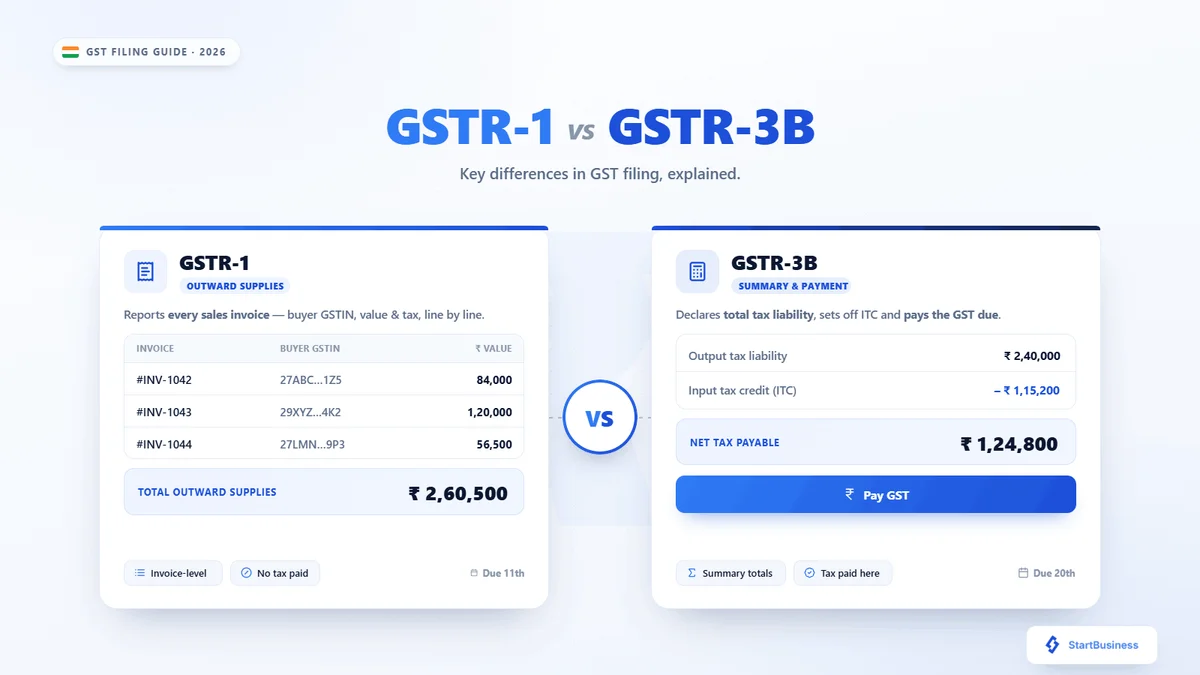
GSTR-1 is a GST return used to report outward supplies and detailed invoice data, while GSTR-3B is a summary return used to declare total tax liability and pay GST to the government. The main difference between GSTR-1 and GSTR-3B is that GSTR-1 contains invoice-level sales data, whereas GSTR-3B contains consolidated tax figures. GSTR-1 has no tax payment, but GSTR-3B requires tax payment at the time of filing.
If you have recently registered under GST or started a business in India, you have probably heard the terms GSTR-1 and GSTR-3B quite often. These are two of the most important GST returns every regular taxpayer must file — but they serve completely different purposes.
Many business owners confuse the two, skip one thinking the other is enough, or file incorrect data because they do not understand the difference between GSTR-1 and GSTR-3B. This guide explains both returns in plain language with practical examples, due dates, penalties, and reconciliation tips — everything you need to stay compliant.
For detailed help with GST registration, visit our GST Registration Guide.
Table of Contents
1. What is GSTR-1?...................................................................................................
2. What is GSTR-3B?................................................................................................
3. Difference Between GSTR-1 and GSTR-3B.......................................................
4. GSTR-1 vs GSTR-3B Comparison Table............................................................
5. Due Dates of GSTR-1 and GSTR-3B...................................................................
6. Penalty for Non-Filing of GSTR-1 and GSTR-3B...............................................
7. Which Businesses Need to File GSTR-1 and GSTR-3B?.................................
8. What Happens If GSTR-1 and GSTR-3B Do Not Match?..................................
9. Common Mistakes While Filing GSTR-1 and GSTR-3B...................................
10. How to Reconcile GSTR-1 and GSTR-3B.........................................................
11. Conclusion..........................................................................................................
12. Frequently Asked Questions (FAQs)...............................................................
What is GSTR-1?
GSTR-1 is a monthly or quarterly GST return that every GST-registered supplier must file to report their outward supplies — that is, all goods and services sold during a given period.
It is an invoice-level return, meaning you must report each B2B (business-to-business) invoice separately, along with details like the buyer's GSTIN, HSN/SAC code, invoice number, date, taxable value, and tax amount (CGST, SGST, IGST).
Purpose of GSTR-1
GSTR-1 creates the official sales trail for your business. The data you report in GSTR-1 is auto-reflected in your buyer's GSTR-2B, which determines how much Input Tax Credit (ITC) they can claim. If you do not file GSTR-1, your buyers cannot claim ITC on purchases made from you — which can seriously damage your business relationships.
Who Should File GSTR-1?
• All regular GST-registered taxpayers
• E-commerce sellers and operators
• Service providers and freelancers with GST registration
• Exporters (including zero-rated supplies)
• Not applicable to: Composition scheme dealers (they file CMP-08 and GSTR-4)
GSTR-1 Filing Frequency and Due Dates
• Monthly filers: Due by the 11th of the following month (for businesses with turnover above ₹5 crore)
• Quarterly filers (QRMP Scheme): Due by the 13th of the month following the quarter
Under the QRMP (Quarterly Return Monthly Payment) scheme, small taxpayers with turnover up to ₹5 crore can file GSTR-1 quarterly but still pay tax monthly using a challan.
What Information Does GSTR-1 Contain?
• B2B invoices (Table 4A, 4B, 6B, 6C)
• B2C large invoices above ₹2.5 lakh (Table 5)
• B2C small invoices (summary in Table 7)
• Export invoices (Table 6A)
• Credit and debit notes (Table 9B)
• Advances received (Table 11)
• HSN/SAC summary (Table 12)
Read More>> How to Avoid GSTR-9 Late Fees in 2026
What is GSTR-3B?
GSTR-3B is a monthly monthly or quarterly (for QRMP scheme taxpayers) self-declaration summary return that every regular GST taxpayer must file to declare their total tax liability and pay the GST due for the month. Unlike GSTR-1, it does not require invoice-level details — only consolidated figures.
GSTR-3B is essentially the tax payment return. Without filing it and paying the tax, your GST compliance is incomplete.
Purpose of GSTR-3B
GSTR-3B allows you to declare your total outward tax liability (from sales), claim Input Tax Credit (ITC) on purchases, set off ITC against liability, and pay the balance tax in cash. It is the primary document the government uses to assess your actual tax payment.
Who Should File GSTR-3B?
• All regular GST-registered taxpayers
• Freelancers and service providers registered under GST
• Startups and SMEs with GST registration
• E-commerce sellers
• Not required for: Composition dealers (they file CMP-08)
GSTR-3B Filing Frequency and Due Dates
• Monthly filers: Due by the 20th of the following month (most taxpayers)
• Category A states (large states): 20th of the following month
• Category B states (smaller states): 22nd or 24th, depending on the state
• QRMP taxpayers: File GSTR-3B quarterly — due by 22nd or 24th of the month following the quarter
What Information Does GSTR-3B Contain?
• Table 3.1 — Details of outward supplies and inward supplies liable to reverse charge
• Table 3.2 — Inter-state supplies to unregistered persons, composition taxpayers, and UIN holders
• Table 4 — Eligible Input Tax Credit (ITC) claims
• Table 5 — Exempt, nil-rated, and non-GST inward supplies
• Table 6 — Payment of tax (cash and ITC breakup)
• Table 7 — TDS/TCS credit
Nil Return in GSTR-3B
If you had no business activity in a particular month, you must still file a Nil GSTR-3B. Skipping it attracts a late fee. A nil return simply confirms to the government that there was no taxable activity.
Related Article:
Calculate Your GSTR-9 Late Fees Online
Difference Between GSTR-1 and GSTR-3B
Here are the core differences explained simply:
1. Nature of Return
GSTR-1 is a detail return — it contains invoice-by-invoice sales data. GSTR-3B is a summary return — it contains only consolidated totals.
2. Tax Payment
No tax payment happens in GSTR-1 — it is purely an information-reporting return. GSTR-3B is where you actually pay your GST dues.
3. Invoice Details
GSTR-1 requires every B2B invoice to be reported individually. GSTR-3B only needs the total taxable value and tax amounts — no individual invoice data.
4. Role in ITC Chain
Your GSTR-1 data flows into your buyer's GSTR-2B, enabling them to claim ITC. GSTR-3B is where you claim your own ITC on purchases from your suppliers.
5. Filing Timeline
GSTR-1 is filed before GSTR-3B each month. For monthly filers, GSTR-1 is due on the 11th and GSTR-3B on the 20th. This sequence matters because GSTR-1 data helps populate parts of GSTR-3B.
6. Amendment
GSTR-1 can be amended in a subsequent period via GSTR-1A. GSTR-3B has no direct amendment option — errors must be corrected in the next month's filing.GSTR-1 can be amended within the same tax period via GSTR-1A — introduced under Section 37A of the CGST Act (w.e.f. July 2024) — which must be filed after GSTR-1 is submitted but before GSTR-3B of that same period is filed. GSTR-1A data is auto-reflected in the recipient’s GSTR-2B for the same period, enabling timely ITC correction. It is not a return for the subsequent period. GSTR-3B has no direct amendment option — errors must be corrected in the next month’s filing.
GSTR-1 vs GSTR-3B Comparison Table
The table below gives you a side-by-side comparison for quick reference:
| Parameter | GSTR-1 | GSTR-3B |
|---|---|---|
| Purpose | Reports outward supplies (sales) invoice-by-invoice | Declares summarised tax liability and pays GST |
| Type of Return | Detail return | Summary / self-declaration return |
| Details Required | Full invoice-level data: GSTIN, HSN, invoice no., date, value, tax | Consolidated figures for taxable supply, exempt supply, and ITC |
| Tax Payment | No tax payment involved | Tax must be paid along with filing |
| Invoice Details | Mandatory — every B2B invoice must be reported | Not required — only aggregate amounts |
| Filing Frequency | Monthly (by 11th) or Quarterly under QRMP (by 13th) | Monthly (by 20th) or quarterly with QRMP |
| Due Date (Monthly) | 11th of the following month | 20th of the following month |
| Input Tax Credit (ITC) | Auto-populates GSTR-2B for recipients | ITC is claimed here in Table 4 |
| GST Compliance Role | Creates invoice trail for buyer's ITC eligibility | Final settlement of tax dues with the government |
| Nil Return Applicability | Yes — must file Nil GSTR-1 if no outward supplies | Yes — must file Nil GSTR-3B if no business activity |
| Auto-populated in | GSTR-2A / GSTR-2B (for buyer) | Not auto-populated anywhere |
| Amendment | Yes — via GSTR-1A in next periodYes — via GSTR-1A within the same tax period (u/s 37A CGST Act; filed after GSTR-1, before GSTR-3B) | No direct revision; corrections in next month's filing |
Due Dates of GSTR-1 and GSTR-3B
| Return | Monthly Filers | QRMP Quarterly | Penalty for Late Filing |
|---|---|---|---|
| GSTR-1 | 11th of next month | 13th of month after quarter | ₹50/day (nil return ₹20/day), max ₹10,000₹50/day (nil return ₹20/day); max capped by turnover: ₹500 (nil), ₹2,000 (up to ₹1.5 cr), ₹5,000 (₹1.5–5 cr), ₹10,000 (above ₹5 cr) — per Notification 19/2021-CT |
| GSTR-3B | 20th of next month | 22nd or 24th of month after quarter | ₹50/day (nil return ₹20/day) + 18% interest on unpaid tax |
For state-wise QRMP due dates and the latest notifications, check the GST Portal official website.
Penalty for Non-Filing of GSTR-1 and GSTR-3B
Late Fee
If you miss the due date for either return, a late fee is charged for every day of delay:
• Nil return: ₹20 per day (₹10 CGST + ₹10 SGST), maximum ₹500 per return
• Other returns: ₹50 per day (₹25 CGST + ₹25 SGST), maximum ₹2,000–₹10,000 based on turnover
Interest on Unpaid Tax
If you do not pay tax on time via GSTR-3B, 18% per annum interest is charged on the unpaid amount from the due date until actual payment.
Return Blockage
Consistent non-filing of GSTR-3B can lead the GST authorities to block your GSTR-1 filing, which means your buyers cannot see your invoices in their GSTR-2B and will be unable to claim ITC.Under Rule 59(6) of the CGST Rules, 2017, non-filing of GSTR-3B for two consecutive tax periods triggers automatic blocking of GSTR-1 filing for subsequent periods. This means your buyers cannot see your invoices in their GSTR-2B and will be unable to claim ITC on purchases made from you.
Scrutiny and Compliance Notices
Repeated non-compliance leads to:
• GST scrutiny notices under Section 61
• Best-judgment assessment under Section 62
• Cancellation of GST registration in serious cases
Read our detailed guide on GST Penalties and Late Fees to understand the full impact.
Which Businesses Need to File GSTR-1 and GSTR-3B?
| Business Type | GSTR-1 | GSTR-3B | Alternative |
|---|---|---|---|
| Regular taxpayer | Yes | Yes | — |
| Composition dealer | No | No | CMP-08 & GSTR-4 |
| Freelancer / consultant | Yes | Yes | — |
| E-commerce seller | Yes | Yes | — |
| Startup (regular GST) | Yes | Yes | — |
| Exporter (zero-rated) | Yes | Yes | — |
Not sure which GST return applies to you? Our GST Return Filing Services team can guide you step by step.
What Happens If GSTR-1 and GSTR-3B Do Not Match?
A mismatch between GSTR-1 and GSTR-3B is one of the most common GST compliance problems faced by businesses. Here is what can happen:
1. ITC Mismatch for Your Buyers
If the sales you report in GSTR-1 do not match what you declare in GSTR-3B, your buyer's ITC auto-populated in GSTR-2B will differ from what they expect — potentially reducing their eligible credit.
2. GST Department Notices
The GST system automatically compares GSTR-1 and GSTR-3B data. A significant or recurring mismatch triggers scrutiny notices under Section 61 of the CGST Act, asking you to explain the difference.
3. Tax Demand
If your GSTR-3B shows lower tax liability than your GSTR-1 (meaning you under-declared in 3B), the GST department can raise a demand for the differential tax plus interest and penalty.
4. Blocked E-Way Bills and Returns
In some cases, persistent mismatches or non-filing can result in e-way bill generation being blocked, impacting the movement of goods.
Practical Example: Suppose you reported sales of ₹10 lakh in GSTR-1 but declared only ₹8 lakh in GSTR-3B. The GST system detects a ₹2 lakh discrepancy. You may receive a notice demanding tax on the ₹2 lakh difference along with 18% interest.
Common Mistakes While Filing GSTR-1 and GSTR-3B
Mistakes in GSTR-1
• Entering the wrong GSTIN for a buyer — their ITC gets blocked
• Missing outward supplies, especially B2C transactions
• Incorrect HSN/SAC codes leading to classification disputes
• Not reporting credit notes and debit notes
• Delayed filing causing late fee accumulation
Mistakes in GSTR-3B
• Incorrectly claiming ineligible ITC (e.g., on personal expenses or blocked credits under Section 17(5))
• Declaring wrong tax liability — either inflated or understated
• Not reconciling ITC with GSTR-2B before filing
• Filing nil return when there was actual business activity
• Not paying interest on delayed cash payments
Use our GST Calculator to verify your tax liability before filing.
How to Reconcile GSTR-1 and GSTR-3B
Reconciliation is the process of matching data between your two returns to ensure consistency. Here is a step-by-step approach:
1. Download both returns: Log in to the GST Portal and download the filed GSTR-1 and GSTR-3B for the period you want to reconcile.
2. Compare total outward supply values: The total taxable value and tax in GSTR-1 Table 4, 5, and 6 should match with GSTR-3B Table 3.1.
3. Reconcile ITC: Cross-check the ITC claimed in GSTR-3B Table 4 with your GSTR-2B auto-drafted credit.
4. Identify mismatches: List every line item where GSTR-1 and GSTR-3B values differ and investigate the reason.
5. Correct in the next period: If you find errors, include amendments in the next GSTR-1 filing and adjust GSTR-3B accordingly.
6. Maintain a reconciliation register: Keep a monthly Excel or accounting software log to track all reconciling items proactively.
If you have large transaction volumes, consider professional help from our GST Return Filing Services team.
Conclusion
Understanding the difference between GSTR-1 and GSTR-3B is fundamental to GST compliance in India. In simple terms: GSTR-1 tells the government what you sold, and GSTR-3B tells the government how much tax you owe and pays it.
Both returns are mandatory, both serve distinct purposes, and both must be reconciled regularly to avoid notices, penalties, and ITC disruption for your buyers. File GSTR-1 first (by the 11th), then file GSTR-3B (by the 20th) — and always verify that the data in both returns matches before submitting.
Need help with GST filing? Explore StartBusiness GST Return Filing Services, use our GST Calculator, or read our guides on GSTR-9 Annual Return and GST Registration.
Frequently Asked Questions (FAQs)
What is the difference between GSTR-1 and GSTR-3B?
GSTR-1 is a detail return for reporting outward supplies invoice-by-invoice, while GSTR-3B is a summary return for declaring total tax liability and paying GST. GSTR-1 has no tax payment; GSTR-3B does.
Can GSTR-3B be filed without GSTR-1?
Yes, technically GSTR-3B can be filed independently. However, if GSTR-1 is not filed, your buyers cannot claim Input Tax Credit, and you may face notices. Both returns are practically interdependent.
Is GSTR-1 mandatory?
Yes, GSTR-1 is mandatory for all regular GST-registered taxpayers. Failure to file attracts late fees and can block your GSTR-1 filing in subsequent months if GSTR-3B is also not filed.
What happens if GSTR-1 and GSTR-3B mismatch?
A mismatch between GSTR-1 and GSTR-3B can trigger GST scrutiny notices, tax demands for the difference, interest at 18% per annum, and ITC issues for your buyers.
Which return contains invoice details?
GSTR-1 contains invoice-level details including buyer GSTIN, invoice number, date, taxable value, HSN code, and tax amounts. GSTR-3B contains only consolidated summary figures.
Can I revise GSTR-1 or GSTR-3B?
GSTR-1 can be amended in the next period's filing via GSTR-1A. GSTR-3B cannot be revised directly — any corrections must be incorporated in the following month's GSTR-3B filing.GSTR-1 can be amended within the same tax period using GSTR-1A — introduced under Section 37A of the CGST Act (operative from July 2024). GSTR-1A must be filed after GSTR-1 is submitted but strictly before GSTR-3B for that period is filed; once GSTR-3B is filed, GSTR-1A for that period is no longer available. The amended data flows into the recipient’s GSTR-2B in the same period, enabling timely ITC correction. GSTR-3B cannot be revised directly — any corrections must be incorporated in the following month’s GSTR-3B filing.
Who should file a nil return?
Any GST-registered taxpayer who had no business activity (no sales and no purchases) in a period must file a nil GSTR-1 and nil GSTR-3B. Skipping the nil return attracts late fees.
Is GSTR-3B a monthly return?
For taxpayers with annual turnover above ₹5 crore, GSTR-3B is a monthly return. Taxpayers under the QRMP scheme with turnover up to ₹5 crore file GSTR-3B quarterly.
What is outward supplies in GST?
Outward supplies means all goods and services sold or transferred by a GST-registered business. These are reported in GSTR-1 and summarised in GSTR-3B Table 3.1.
Which GST return is used for tax payment?
GSTR-3B is the return used for declaring and paying GST. You calculate your net tax liability (output tax minus eligible ITC) and pay the balance in cash through the GST portal while filing GSTR-3B.
We handle business incorporation and deed drafting end-to-end, tailored to your needs.

Practising from Deccan Gymkhana, Pune since 2017. Has handled 1,000+ incorporations and ongoing compliance for founders across Maharashtra, from single-partner proprietorships to funded private limited companies.