
Key takeaways
- Checked and verified against current regulatory guidelines by practising CAs/CSs.
- Covers key requirements, step-by-step registration procedures, and statutory compliance timelines.
- Includes actionable insights tailored for Indian founders and business owners.
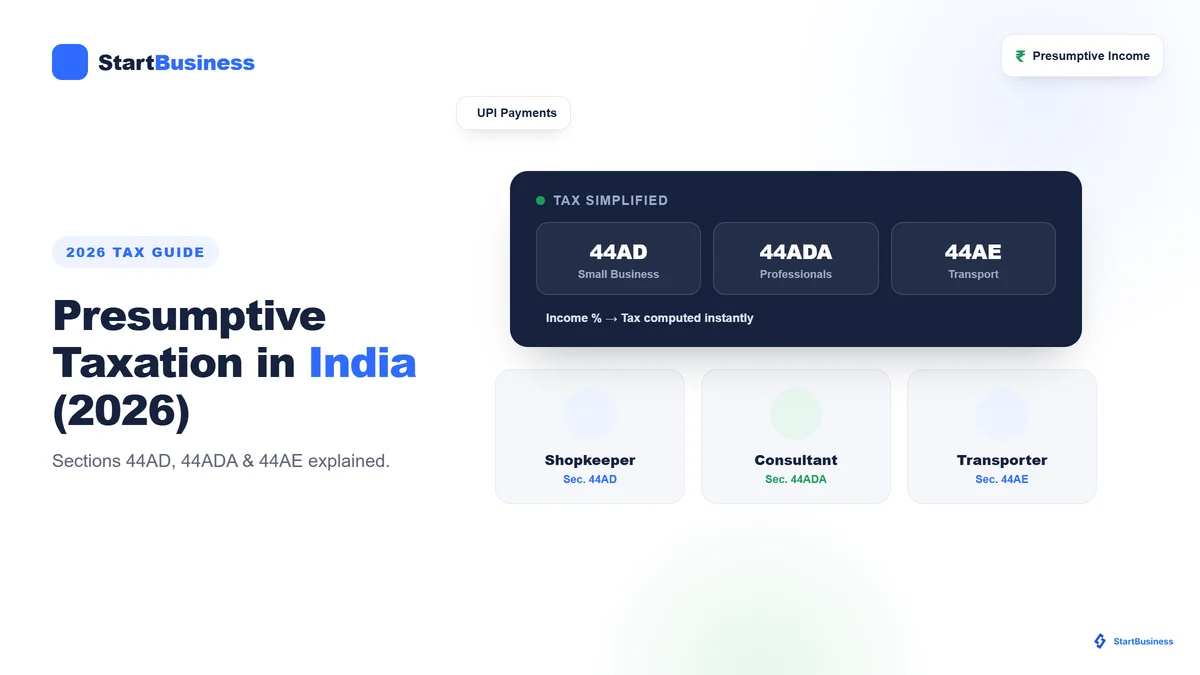
Presumptive taxation is a scheme under the Income Tax Act, 1961 — consolidated as Section 58 of the Income Tax Act, 2025 from Tax Year 2026-27 onward — that lets eligible taxpayers declare income as a fixed percentage of turnover or gross receipts, instead of computing actual profit after deducting every business expense. In return, they're exempt from maintaining detailed books of accounts and from a tax audit, provided they meet the prescribed conditions.
Three provisions govern this scheme: Section 44AD for small businesses, Section 44ADA for specified professionals, and Section 44AE for goods transport operators. Each has its own eligibility criteria, presumptive rate, and turnover or receipt limit. From Tax Year 2026-27, all three are consolidated into a single Section 58 under the Income Tax Act, 2025, using a serial-number table to distinguish the three categories — the rates and limits below are unchanged, only the statutory home moves. See the dedicated section below for the full mapping.
This guide covers all three as they apply for FY 2025-26 (AY 2026-27), including eligibility, tax calculation, turnover limits, audit triggers, advance tax rules, and how the three sections compare. You can also use an Income Tax Calculator to estimate your tax liability before choosing between different taxation options.
Presumptive Taxation: Quick Answer
Presumptive taxation allows eligible businesses and professionals to calculate taxable income at a fixed percentage of turnover instead of maintaining detailed expense records. Section 44AD applies to businesses, Section 44ADA to professionals, and Section 44AE to transport operators.
Quick Summary
| Section | Applicable To | Presumptive Income | Eligibility Limit |
|---|---|---|---|
| 44AD | Small businesses (individuals, HUFs, firms; not LLP) | 8% of turnover (6% for digital receipts) | ₹2 crore (₹3 crore if 95% digital) |
| 44ADA | Specified professionals (individuals, firms; not LLP) | 50% of gross receipts | ₹50 lakh (₹75 lakh if 95% digital) |
| 44AE | Goods transport operators (max 10 vehicles) | ₹7,500/vehicle/month (₹1,000/ton for heavy vehicles) | Not turnover-based — capped at 10 goods carriages |
What Is Presumptive Taxation?
Presumptive taxation is a scheme under the Income Tax Act, 1961 that allows certain taxpayers to declare their taxable income as a fixed percentage of turnover or gross receipts, instead of calculating actual profit after deducting every business expense.
The idea is simple: rather than tracking every invoice, expense receipt, and ledger entry, an eligible taxpayer can apply a prescribed rate to their turnover and treat that as their business income for the year. In exchange, they give up the ability to claim individual expense deductions — the presumptive rate is deemed to already account for all business expenses, including depreciation.
Businesses that do not qualify for presumptive taxation need accurate financial records and regular accounting and bookkeeping support to calculate taxable income under normal provisions.
Three sections govern this scheme, each aimed at a different category of taxpayer:
● Section 44AD — for small businesses (traders, manufacturers, shopkeepers, and similar)
● Section 44ADA — for specified professionals (doctors, lawyers, architects, consultants, and others)
Section 44AE — for taxpayers running a goods transport business (plying, hiring, or leasing goods carriages)
Section 44AD, 44ADA & 44AE Explained
Section 44AD — Presumptive Taxation for Businesses
Section 44AD applies to resident individuals, Hindu Undivided Families (HUFs), and partnership firms (excluding LLPs) carrying on an eligible business. Income is presumed at 8% of turnover, reduced to 6% for the portion of turnover received through digital or banking channels.
It does not apply to commission or brokerage income, agency businesses, or businesses already covered under Section 44AE. Small businesses should also review their other business compliance requirements to avoid penalties and filing issues.
Professionals must use Section 44ADA instead — they cannot opt into 44AD.
Section 44ADA — Presumptive Taxation for Professionals
Section 44ADA is available to resident individuals and partnership firms (excluding LLPs) engaged in a profession specified under Section 44AA(1) — legal, medical, engineering, architectural, accountancy, technical consultancy, interior decoration, and certain other notified professions. Income is presumed at 50% of gross receipts. Professionals opting for this scheme should also ensure timely income tax return filing and proper reporting of professional income.
Unlike 44AD, there's no separate rate for digital receipts under 44ADA — the 50% presumption applies regardless of how payment is received, though the eligibility threshold itself does change based on digital receipts (covered below).
Section 44AE — Presumptive Taxation for Goods Transport Businesses
Section 44AE covers individuals, HUFs, and partnership firms (excluding LLPs) engaged in the business of plying, hiring, or leasing goods carriages, provided they own no more than 10 goods vehicles at any time during the year. Unlike 44AD and 44ADA, income here is not a percentage of turnover — it's a fixed monthly amount per vehicle, regardless of actual freight income.
Eligibility Criteria
| Criteria | Section 44AD | Section 44ADA |
|---|---|---|
| Who can opt | Resident individuals, HUFs, partnership firms (not LLP) | Resident individuals, partnership firms (not LLP) |
| Nature of activity | Eligible business (trading, manufacturing, small contractors, etc.) | Specified profession under Section 44AA(1) |
| Excluded | Commission/brokerage income, agency business, transport business | Professions not notified under 44AA(1) |
| LLPs | Not eligible | Not eligible |
| Companies | Not eligible | Not eligible |
Section 44AE eligibility is different in structure: any individual, HUF, or partnership firm (excluding LLP) can opt in, as long as they own 10 or fewer goods carriages at any point during the financial year — irrespective of the nature of goods carried or freight earned.
A taxpayer who has claimed deductions under Sections 10A, 10AA, 10B, 10BA, or 80HH to 80RRB in the relevant year cannot opt for Section 44AD.
Tax Calculation Method
Section 44AD Calculation
● 8% of turnover — for turnover received in cash or non-digital modes
● 6% of turnover — for turnover received through banking channels, UPI, NEFT, RTGS, cheque, or other prescribed digital modes
A business can have a mix of both — cash turnover is taxed at 8% and digital turnover at 6%, and both figures can be declared together in ITR-4.
Example: A trader with ₹80 lakh turnover, entirely through digital payments, declares 6% of ₹80 lakh = ₹4.8 lakh as taxable business income, without maintaining detailed books.
Section 44ADA Calculation
Taxable income = 50% of gross receipts. The remaining 50% is deemed to cover all professional expenses — rent, staff salaries, equipment, depreciation, and so on — no separate deduction can be claimed for these.
Example: A freelance architect with ₹40 lakh in gross receipts declares 50% of ₹40 lakh = ₹20 lakh as taxable professional income.
Section 44AE Calculation
Income is computed per vehicle, per month (or part of a month) of ownership — not as a percentage of freight revenue:
● Heavy goods vehicles (gross vehicle weight above 12,000 kg): ₹1,000 per ton of gross vehicle weight, per month or part thereof
● Other goods vehicles: ₹7,500 per vehicle, per month or part thereof
A taxpayer who believes actual profits are higher than the fixed amount can voluntarily declare a higher figure; the presumptive rate is a floor, not a cap, under all three sections.
Turnover & Receipt Limits for FY 2025-26 (AY 2026-27)
| Section | Standard Limit | Enhanced Limit (≥95% Digital Receipts) |
|---|---|---|
| 44AD | ₹2 crore | ₹3 crore |
| 44ADA | ₹50 lakh | ₹75 lakh |
| 44AE | Applies by vehicle count (max 10 goods carriages), not turnover | Not applicable |
The enhanced limits apply only when cash receipts do not exceed 5% of total receipts. Businesses should remember that income tax turnover limits and GST Registration requirements are separate and must be evaluated independently.
In other words, at least 95% of turnover or gross receipts must come through banking channels, UPI, or other prescribed digital modes. Budget 2025 did not change these thresholds; they remain the same as those introduced from FY 2023-24 onward. These same limits carry over unchanged into Section 58 of the Income Tax Act, 2025 from Tax Year 2026-27.
Benefits and Limitations
Benefits
● No requirement to maintain detailed books of accounts under Section 44AA (Section 62 from Tax Year 2026-27)
● No tax audit, provided the prescribed income is declared and turnover stays within limits
● Simpler, faster ITR filing through ITR-4 (Sugam)
● Predictable tax outgo, which helps with cash flow planning
● Chapter VI-A deductions (like Section 80C and 80D) can still be claimed against the presumptive income under the old tax regime
Limitations
● No deduction for actual business expenses — if real costs are high, presumptive tax can mean paying more tax than under normal provisions. Under Section 58 of the 2025 Act this is stated more explicitly: no additional deductions, allowances, or set-off of losses are permitted against presumptively computed income.
● Section 44AD carries a 5-year lock-in: opting out early bars re-entry into the scheme for the next five assessment years
● Section 44ADA has no lock-in, giving professionals more year-to-year flexibility
● Section 44AE income is fixed per vehicle regardless of actual freight earned, which can work against operators with low utilisation
● Not available to companies or LLPs under any of the three sections
● From Tax Year 2026-27, businesses that stay outside the presumptive scheme entirely lose a protection they used to have — see "Tax Audit Applicability" below.
Presumptive Taxation under the New Tax Regime
Presumptive taxation under Sections 44AD, 44ADA, and 44AE can be opted for under both the old and the new tax regime — the choice of regime and the choice of taxation basis are separate decisions. The presumptive income figure itself doesn't change depending on which regime you're in: 8%/6% of turnover under 44AD, 50% of gross receipts under 44ADA, and the fixed per-vehicle amount under 44AE apply the same way regardless of regime.
What changes is what you can do with that income afterward. Under the old regime, eligible Chapter VI-A deductions — such as Section 80C (PPF, ELSS, life insurance) and Section 80D (health insurance premiums) — can still be claimed against the presumptive income, reducing the final tax payable. Under the default new tax regime, most Chapter VI-A deductions are not available, apart from a small set specifically permitted by law (such as the employer's contribution to NPS under Section 80CCD(2)).
This makes the regime choice worth running through both ways before filing: a taxpayer with meaningful 80C/80D investments may end up better off under the old regime despite its higher slab rates, while someone with few such deductions may find the new regime's lower rates more beneficial even on the same presumptive income.
Advance Tax Rules
Taxpayers opting for Section 44AD or Section 44ADA get a compliance concession: instead of the usual four quarterly instalments, the entire advance tax liability can be paid in a single instalment on or before 15th March of the financial year.
Missing this deadline attracts interest under Sections 234B and 234C, so it's worth setting a reminder even though there's only one payment to track. (These interest provisions are expected to be renumbered under the Income Tax Act, 2025 for Tax Year 2026-27 onward — confirm the corresponding section numbers against the Act text before citing them in print.)
Taxpayers opting for Sections 44AD and 44ADA may pay their entire advance tax liability in a single instalment by 15 March. Taxpayers under Section 44AE generally remain subject to the normal advance tax provisions applicable to them.
Taxpayers can estimate their advance tax requirement using an Advance Tax Calculator before the payment deadline.
Tax Audit Applicability
Audit exemption is one of the main draws of presumptive taxation, but it's conditional, not automatic. Whether a tax audit under Section 44AB is required depends on the specific statutory conditions in Sections 44AD(4), 44ADA(4), and 44AB read together — not on the mere fact that declared income is lower than the presumptive rate.
Broadly, the conditions that can trigger an audit under the 1961 Act include:
● Under 44AD: the taxpayer declares income below the prescribed rate (8%/6% of turnover) in a year, and their total income exceeds the amount not chargeable to tax — this combination is what activates the audit requirement, not the lower declaration alone
● Under 44ADA: the taxpayer declares income below 50% of gross receipts, and total income exceeds the basic exemption limit
● Under 44AD: having opted for the scheme, a taxpayer subsequently declares income below the prescribed rate within the five-year lock-in period — this can trigger both the loss of presumptive status and an audit requirement, subject to the income-exceeds-exemption-limit condition
Section 44AE works differently since income is a fixed per-vehicle amount rather than a self-declared percentage of turnover. A taxpayer who wants to declare profits lower than the prescribed 44AE amount must maintain regular books of accounts and have them audited, since the presumptive computation no longer applies to them by choice.
What changes under Section 63 (Income Tax Act, 2025) — a substantive shift, not just a renumbering
This is the most consequential change in the 2025 Act's presumptive taxation framework, and it deserves more than a passing footnote: under the 1961 Act, a business that never opted into Section 44AD at all could keep regular books, file a return showing profit below the 6%/8% deemed rate, and face no audit obligation under Section 44AB purely on that basis — the audit trigger for low declared profit was linked to having opted into the scheme and then exited it, not to declared profit alone.
Section 63 of the 2025 Act removes that route. Reporting suggests its Table under sub-section (1) adds a standalone entry — for businesses of the type covered under Section 58(2), Table Sl. No. 1 (turnover up to ₹2 crore / ₹3 crore) — that mandates an audit whenever declared profit falls below the deemed rate, regardless of whether the taxpayer ever opted into the presumptive scheme. If that reading holds, "maintain books, report a genuine lower margin, skip the audit" stops being a viable strategy for a large share of small and thin-margin businesses from Tax Year 2026-27 — including many who were never using 44AD in the first place.
This is based on secondary commentary on Section 63, not a first-principles reading of the enacted text against Section 44AB. Confirm the exact wording of Section 63(1)'s table against the Act and the final Income Tax Rules, 2026 before stating this as settled fact in a client-facing publication. Until then, keep this section descriptive of what commentators are reporting rather than a definitive audit-applicability ruling.
Because the interplay between these provisions and the general audit thresholds can vary by fact pattern, it's worth confirming applicability for your specific situation with a tax professional rather than relying on rules of thumb.
Comparison Table: Section 44AD vs 44ADA vs 44AE
| Parameter | Section 44AD | Section 44ADA | Section 44AE |
|---|---|---|---|
| Applicable to | Small businesses | Specified professionals | Goods transport operators |
| Eligible entities | Resident individuals, HUFs, firms (not LLP) | Resident individuals, firms (not LLP) | Individuals, HUFs, firms (not LLP) |
| Limit | ₹2 crore (₹3 crore if 95% digital) | ₹50 lakh (₹75 lakh if 95% digital) | Max 10 goods carriages |
| Presumptive rate | 8% (6% for digital receipts) | 50% of gross receipts | ₹7,500/vehicle/month (or ₹1,000/ton for heavy vehicles) |
| 5-year lock-in | Yes | No | No |
| ITR form | ITR-4 | ITR-4 | ITR-4 |
| Advance tax | Single instalment by 15 March | Single instalment by 15 March | Regular quarterly schedule |
When Should You Choose Presumptive Taxation?
Presumptive taxation tends to work well when:
● Actual profit margins are close to or higher than the presumptive rate (8%/6% for business, 50% for professionals)
● You want to avoid the cost and time of maintaining formal books of accounts
● Turnover comfortably falls within the prescribed limits and is unlikely to fluctuate sharply
● You're a transport operator whose vehicles run at reasonably consistent utilisation, making the fixed per-vehicle rate under 44AE workable
It tends to work against you when actual expenses are high relative to revenue — a consultant with heavy office and staff costs, or a trader with thin margins, may end up paying tax on income they haven't actually earned. In such cases, it's worth comparing the presumptive tax outgo against a normal computation before opting in.
Running the numbers both ways — presumptive versus normal computation — before deciding is usually the difference between this scheme working for you and against you. An Income Tax Calculator can help you compare the two outcomes for your specific turnover and expense profile.
When Should You NOT Choose Presumptive Taxation?
Presumptive taxation isn't automatically the better option just because it's simpler. It tends to work against you in these situations:
● Your actual profit margin is well below the presumptive rate — for instance, a trader operating at 3-4% margin would still be taxed on 6-8% of turnover under 44AD, paying tax on income they haven't earned
● You have high deductible business expenses — significant rent, salaries, interest on business loans, or depreciation that would meaningfully reduce taxable income under normal computation but can't be claimed separately under the presumptive scheme
● You need to report a business loss, or carry forward and set off losses against future income — presumptive taxation only works with positive presumed income; losses can only be reported, carried forward, and set off under regular books-of-accounts computation
● Your turnover is close to or likely to exceed the eligibility limit — opting in now only to breach the threshold next year forces a switch back to normal provisions, and for Section 44AD, complicates the 5-year lock-in
From Tax Year 2026-27: you were planning to stay outside the presumptive scheme and report a genuinely lower margin through regular books — under Section 63 of the 2025 Act this route may no longer avoid audit (see "Tax Audit Applicability" above)
In any of these cases, it's worth computing your tax liability under normal provisions (with books of accounts) alongside the presumptive figure before opting in — the simplicity of presumptive taxation isn't worth much if it costs more in actual tax.
Filing Returns Under Presumptive Taxation
Taxpayers opting for Section 44AD, 44ADA, or 44AE file their return using ITR-4 (Sugam). If you opt out of the presumptive scheme, or if a tax audit is triggered, the return must be filed on ITR-3 along with full books of accounts and an audit report.
Picking the correct form matters — filing on the wrong one is a common reason returns get flagged for defective-return notices. It's a detail worth getting right regardless of who prepares the return, whether that's you, a CA, or a service such as StartBusiness's Income Tax Return Filing assistance.
It's worth remembering that presumptive taxation under the Income Tax Act and GST Registration are governed by entirely separate thresholds. Businesses approaching either limit should evaluate their GST liability separately using a GST Calculator before making compliance decisions.
— crossing the income tax turnover limit doesn't automatically mean you've crossed the GST threshold, or vice versa. Businesses approaching either limit are usually better off checking both positions together rather than assuming one implies the other; a GST Calculator is a reasonable starting point for estimating that separate liability.
What Changes Under the Income Tax Act 2025 (From Tax Year 2026-27)
The Income Tax Act, 2025 replaces the 1961 Act with effect from Tax Year 2026-27 (1 April 2026 – 31 March 2027), and consolidates the three presumptive taxation provisions into a single Section 58, using a serial-number ("Sl. No.") table within the section to distinguish general business, transport business, and professionals. The rates and turnover/receipt limits you've read above are unchanged — business retains ₹2 crore/₹3 crore, professionals retain ₹50 lakh/₹75 lakh, and goods-carriage taxation stays vehicle-count based. What changes is the statutory structure, the terminology, and — materially — one audit trigger.
| Old (IT Act 1961) | New (IT Act 2025) | Change |
|---|---|---|
| 44AD / 44ADA / 44AE | Section 58 (Sl. No.–based table) | Consolidated into one section; rates & limits unchanged |
| 44AA (books) | Section 62 | Specified professions expanded to include IT and company secretary; income/turnover thresholds for maintaining books are restated in updated figures — not a like-for-like carryover |
| 44AB (tax audit) | Section 63 | Turnover thresholds broadly unchanged, but a new standalone audit trigger applies to businesses that never opted into presumptive taxation — see "Tax Audit Applicability" above. Form No. 26 replaces Forms 3CA/3CB/3CD |
| Previous Year / Assessment Year | "Tax Year" | Single-year terminology; the first Tax Year under the new Act is 2026-27 |
Forms 3CA, 3CB, and 3CD continue to apply for tax audits up to AY 2025-26; Form No. 26 under Section 63 applies for Tax Year 2026-27 onward.
Keep this section descriptive — mapping old to new, noting "substance retained" only where it genuinely is — rather than interpretive, particularly on the Section 63 audit-trigger point above, until the final Income Tax Rules, 2026 settle and the Act's text has been checked directly rather than through secondary commentary.
Read more>> Section 194C TDS Explained
When Should You Choose Presumptive Taxation? - Conclusion
Presumptive taxation benefits taxpayers whose actual profit margins are at or above the prescribed rate — a business earning better than 6-8% margins, a professional keeping more than half of gross receipts as profit, or a transport operator whose vehicles run at reasonably steady utilisation. For these taxpayers, the compliance saved on books and audits comes at little or no extra tax cost.
It's a poor fit for anyone with thin margins, high deductible expenses, a loss to report, or turnover hovering near the eligibility ceiling. In those cases, the simplicity comes at the price of paying tax on income that doesn't reflect actual earnings — and for Section 44AD, an early exit from the scheme carries a five-year re-entry penalty on top of that.
The decision isn't really about which section you're eligible for — most taxpayers already know that. It's about whether the presumptive figure is close enough to your real numbers to make the trade-off worthwhile. That's only answered by computing both — presumptive and actual — side by side before you file, not after.
Frequently Asked Questions
Who is eligible for presumptive taxation under Section 44AD?
Resident individuals, HUFs, and partnership firms (excluding LLPs) running an eligible business, with turnover up to ₹2 crore (₹3 crore if at least 95% of receipts are digital), are eligible. Professionals, commission agents, and businesses covered under Section 44AE cannot use this section.
What is the turnover limit for presumptive taxation in FY 2025-26?
For Section 44AD, the limit is ₹2 crore, extended to ₹3 crore where 95% or more of receipts are digital. For Section 44ADA, the limit is ₹50 lakh, extended to ₹75 lakh under the same digital-receipts condition. Section 44AE is based on vehicle count (up to 10 goods carriages), not turnover. These limits are unchanged under Section 58 of the Income Tax Act, 2025.
When is a tax audit required under presumptive taxation?
Under the 1961 Act, a tax audit becomes mandatory if a taxpayer declares income below the prescribed presumptive rate (8%/6% under 44AD, 50% under 44ADA) and their total income exceeds the basic exemption limit. From Tax Year 2026-27, Section 63 of the 2025 Act is reported to extend this trigger to businesses that declare below the deemed rate even if they never opted into the presumptive scheme — confirm against the enacted text before relying on this for a specific case.
Can professionals use Section 44AD instead of 44ADA?
No. Professionals specified under Section 44AA(1) — such as doctors, lawyers, architects, and consultants — must use Section 44ADA. Section 44AD is restricted to eligible businesses and specifically excludes specified professions.
What happens if I opt out of Section 44AD before 5 years?
If you opt out of Section 44AD before completing five consecutive assessment years, you become ineligible to opt back into the scheme for the next five assessment years, and may need to maintain books of accounts and undergo an audit if your income exceeds the basic exemption limit.
Which ITR form applies for income under Sections 44AD, 44ADA, or 44AE?
Taxpayers opting for presumptive taxation under any of these three sections file ITR-4 (Sugam). If the presumptive scheme isn't opted for, or an audit is triggered, ITR-3 must be used instead, along with the relevant books and audit report.
We handle business incorporation and deed drafting end-to-end, tailored to your needs.

Practising from Deccan Gymkhana, Pune since 2017. Has handled 1,000+ incorporations and ongoing compliance for founders across Maharashtra, from single-partner proprietorships to funded private limited companies.