

Key takeaways
- Checked and verified against current regulatory guidelines by practising CAs/CSs.
- Covers key requirements, step-by-step registration procedures, and statutory compliance timelines.
- Includes actionable insights tailored for Indian founders and business owners.
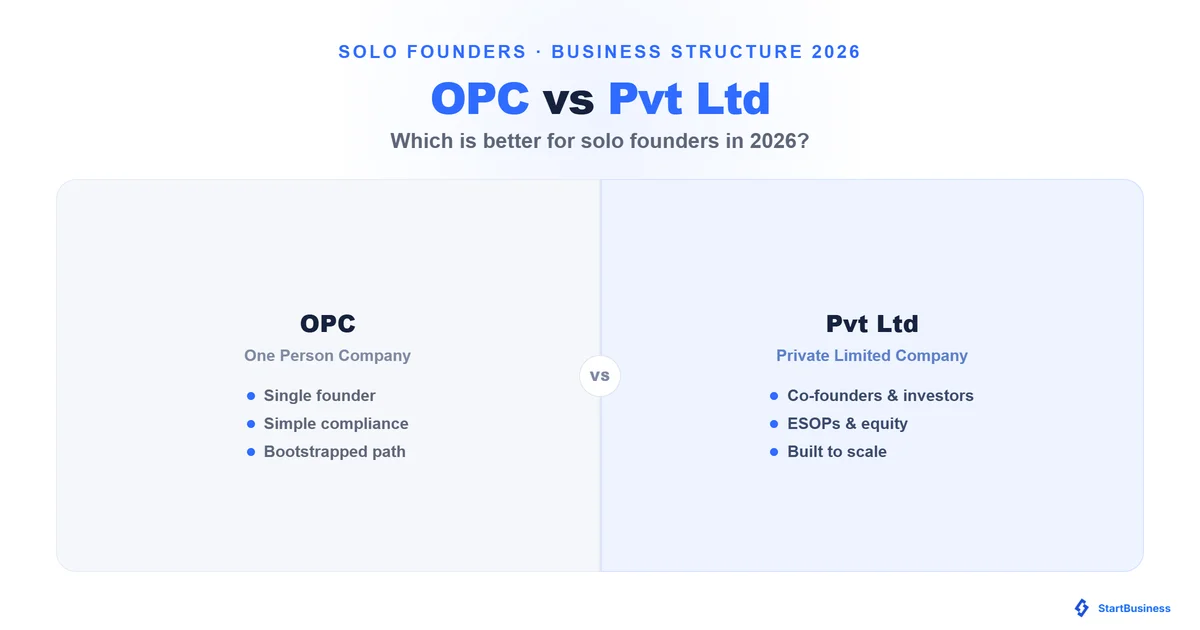
Choosing between an OPC and a Private Limited Company depends on your ownership and growth plans. An OPC is generally suitable for a solo founder who plans to remain the only owner, while a Pvt Ltd is better if you expect to add a co-founder, raise equity funding, or offer employee equity. The key question is simple: Will someone else need to own part of your business in the future?
OPC vs Pvt Ltd for Solo Founders: The Decision in One Minute
There's no universal winner between OPC and Pvt Ltd — it depends on your ownership plans, not your current headcount. Choose an OPC if you expect to remain the sole owner and fund growth through revenue or debt, with no near-term plan to add a co-founder, investor, or equity-holding employee. Choose a Pvt Ltd — even while you're still solo — if a co-founder, angel/VC funding, or an ESOP pool is realistically part of your plan in the next 18–36 months, since a Pvt Ltd is already built for multiple shareholders and an OPC is not.
The one question that decides it: Will someone other than you realistically need to own part of this company within the next 18–36 months?
• No → an OPC may be the better fit.
• Yes → a Pvt Ltd is generally the better starting point.
That “yes” covers three specific situations: a co-founder is realistically likely, angel/VC equity funding is part of the plan, or ESOPs/equity-based hiring will be needed to attract talent. A “no” — genuinely staying solo, funded by revenue or debt — points toward OPC. The rest of this guide works through each of those situations in more depth, along with what OPC’s limitation actually is (ownership, not revenue) and what changes once you commit to a direction.
OPC vs Pvt Ltd at a Glance
This table is deliberately built around what a solo founder needs to decide — not an exhaustive feature list. For a complete side-by-side breakdown of every legal and structural difference between the two entities, see StartBusiness’s OPC vs Private Limited Company comparison.
| Decision factor | OPC | Pvt Ltd |
|---|---|---|
| Ownership flexibility | One member while operating as an OPC; conversion required to add another | Built for 2–200 shareholders |
| Adding a co-founder | Requires conversion to Pvt Ltd/public company first | Native — share issue or transfer |
| Equity fundraising (angel/VC) | Not structurally compatible without conversion | Standard vehicle Indian investors expect |
| ESOP readiness | Not a natural fit; ownership pool can’t extend beyond one member | Well-established route for employee equity |
| Bootstrapping suitability | Strong fit for revenue/debt-funded growth | Works, but carries governance overhead a bootstrapped solo business may not need yet |
| Scaling suitability | No revenue/turnover ceiling, but ownership stays capped at one | Built for institutional scale and multiple stakeholders |
| Conversion requirement | Needed the moment ownership needs to expand | None — already the end-state structure for most funded startups |
| Governance/compliance burden | Lighter with a single director; grows if more directors are added | Higher by default once more than one director is appointed |
| Best-fit founder profile | Consultant, freelancer, owner-run service business with no near-term funding plan | Founder actively planning a co-founder, investors, or fast scale |
Choose Based on Your 3-Year Business Plan, Not Your Current Headcount
Headcount today is a snapshot; ownership plans are the actual variable that determines whether OPC or Pvt Ltd fits. Four scenarios cover most solo founders.
Planning to Stay a Solo Owner
If you’re confident you’ll remain the only owner — no co-founder, no outside equity — an OPC gives you an incorporated entity and limited liability without carrying shareholder mechanics you don’t need. This is the scenario OPC was designed for.
Planning to Add a Co-Founder
An OPC can have only one member while it continues to operate as an OPC. If ownership needs to expand to another person, the company must first follow the applicable conversion process. If a co-founder is a realistic near-term possibility, starting as a Pvt Ltd avoids that conversion step entirely.
Planning to Raise Angel or VC Funding
Equity investment means issuing shares to a new shareholder, which an OPC cannot do while remaining an OPC. Founders who expect to raise even a small angel round typically either convert before the raise or incorporate as a Pvt Ltd from day one, since investors’ term sheets are written around a multi-shareholder cap table.
Planning to Offer ESOPs or Employee Equity
If you intend to use equity — not just cash bonuses — to attract early hires or advisors, you need a structure that can hold an ownership pool beyond one person. That’s a Pvt Ltd, not an OPC.
When an OPC Is the Better Starting Structure
An OPC fits a founder who is genuinely planning to stay solo: a consultant, a freelancer scaling into an agency, or an owner-run service or product business that intends to fund growth through revenue and debt rather than outside equity. It gives you the credibility and liability protection of an incorporated company while keeping the shareholder structure as simple as possible. It is not a “lesser” choice for these founders — it’s the structure built for exactly this situation, and forcing a Pvt Ltd on a genuinely solo, non-funding-seeking business just adds governance overhead with no corresponding benefit.
The point where OPC stops fitting is specific and mechanical: the moment you need a second person with real ownership, or an equity pool for employees. That’s not a matter of degree — it’s a structural wall built into the “one member” rule. If this describes your situation, the practical next step is registering your OPC rather than defaulting to Pvt Ltd out of caution.
When a Pvt Ltd Is the Better Starting Structure for a Solo Founder
A person can choose Pvt Ltd as the intended structure even when they are the only real founder or business promoter — but a Pvt Ltd cannot be incorporated with just one member. The legal minimum still applies: at least two shareholders and two directors. That second shareholder doesn’t have to be an operational co-founder, but their ownership and economic interest need to be genuine and properly documented, not a name added purely to satisfy the headcount requirement. Using a nominal or artificial shareholder to work around the minimum can create real problems later: disputes over beneficial ownership, complications in a future funding round or exit, tax exposure, and governance issues if that person’s intent was never to actually hold equity. If you don’t yet have someone you’re prepared to bring in on genuine terms, that itself is useful information about whether you’re ready for a Pvt Ltd structure or better served starting as an OPC and converting later.
Where Pvt Ltd earns its overhead: founders expecting a real co-founder, an equity fundraise, an ESOP pool, or scale that will eventually need institutional capital. Building the cap table and governance structure correctly at incorporation is simpler than retrofitting it under the time pressure of a term sheet. If that’s your trajectory, registering as a Private Limited Company from the outset avoids a conversion event later.
Funding Readiness: OPC vs Pvt Ltd for Startups
Debt funding — business loans, working capital lines — is available to an OPC on the same basis as any registered company; an OPC’s structure doesn’t restrict borrowing. Equity funding is where the two structures diverge. Angel investors and VCs in India generally structure investments around a Pvt Ltd with a standard cap table, preference shares, and board representation, and in practice most won’t fund an OPC as-is, because doing so would require creating a second shareholder — something an OPC cannot do without converting. A founder who wants an equity raise typically converts to Pvt Ltd ahead of the round, or simply avoids the conversion step by incorporating as a Pvt Ltd from the outset if fundraising is a realistic near-term plan.
Adding a Co-Founder Later: What Changes?
An OPC’s single-member status isn’t a default that can be adjusted — it’s the defining feature of the entity. Adding a co-founder as an actual owner requires converting the OPC into a Pvt Ltd (or public company): a formal process involving a resolution, a revised memorandum and articles of association, and filing with the Registrar of Companies, followed by the share issuance itself. A Pvt Ltd sidesteps all of this — adding a co-founder is simply a share issuance or transfer under the existing articles of association and any shareholders’ agreement already in place. If a co-founder is more likely than not in your near-term plans, that likelihood alone is a reasonable basis to start as a Pvt Ltd.
ESOPs, Employee Equity and Future Ownership
An OPC’s ownership pool cannot extend beyond its single member, which makes it structurally unsuited to a genuine ESOP program — there’s no mechanism to hold equity in trust or allot it to a second person without breaking the one-member structure. That doesn’t mean an OPC-owned business can’t compensate people well; it can pay cash bonuses, profit-linked incentives, or performance pay. What it can’t do is give someone real ownership. If equity is going to be part of how you attract talent before you can pay full market salaries, that need points toward Pvt Ltd, which has an established, well-understood ESOP route.
Compliance: Is the OPC Advantage Really That Big?
Not as big as “OPC means no compliance” implies. Both structures require a statutory audit, annual filings with the Registrar of Companies (including financial statements and annual returns), and maintenance of statutory registers — an OPC is not a low-compliance shortcut compared with a sole proprietorship. The real gap is narrower and specific: a Pvt Ltd with more than one director must hold a minimum number of board meetings each year and observe quorum and resolution formalities that a single-director OPC doesn’t. A single-director OPC’s governance routine is genuinely lighter. But if you’re weighing OPC purely because you assume it means dramatically less paperwork than Pvt Ltd overall, that assumption doesn’t hold once you account for audit and ROC filing, which apply to both — see StartBusiness’s ROC annual compliance breakdown for what’s actually involved year to year.
Growth Without the Old OPC Turnover Conversion Limit
A rule that shows up constantly in outdated content: OPCs used to be required to convert into a Pvt Ltd or public company if paid-up capital exceeded ₹50 lakh or average annual turnover exceeded ₹2 crore. That automatic conversion trigger was removed by the Companies (Incorporation) Second Amendment Rules, 2021, effective 1 April 2021. As of 2026, there is no statutory turnover or paid-up capital ceiling that forces an OPC to convert — an OPC can scale its revenue indefinitely and remain an OPC for as long as its owner chooses. If you’re reading older material that cites the ₹50 lakh/₹2 crore thresholds as a reason to avoid OPC or plan for forced conversion, that specific concern is outdated.
The Practical Limit of an OPC Is Ownership, Not Revenue
This is the distinction that gets lost in most OPC-vs-Pvt-Ltd content: an OPC’s real ceiling was never about how much money the business makes. It’s about who is allowed to own it. A single-member OPC can generate substantial revenue, hire a large team, and operate at real scale, and none of that forces a conversion. What does force the issue is the moment the business needs a second owner — an investor, a co-founder, or an employee equity pool. At that point, revenue size is irrelevant; ownership structure is the constraint. Founders evaluating OPC vs Pvt Ltd should be asking “will I need a second owner?” far more than “will I outgrow this financially?” — because financial growth alone never requires you to leave OPC status, but ownership growth always does.
OPC vs Sole Proprietorship: A Different Decision
This is a separate question from OPC vs Pvt Ltd, worth only a brief note here. An OPC is a separate legal entity incorporated under the Companies Act — the company, not the founder personally, is liable for its debts, and personal assets are generally protected. A sole proprietorship has no such separation: the owner and the business are legally the same, so personal assets are exposed to business liabilities. In exchange, a proprietorship is simpler and cheaper to run, without an OPC’s mandatory audit and ROC filing obligations. The right choice depends on risk exposure and the credibility an incorporated entity gives you with clients, lenders, or platforms. For a deeper look at this specific comparison, see StartBusiness’s OPC vs Sole Proprietorship comparison. If you’ve ruled out OPC too and are weighing Pvt Ltd against a proprietorship directly, the Private Limited Company vs Sole Proprietorship comparison covers that pairing.
Question Decision Framework for Solo Founders
1. Will I remain the only owner for the next 18–24 months? If yes with real confidence, OPC is worth serious consideration.
2. Do I expect to raise equity funding? Even a “maybe, eventually” angel round is a strong signal toward Pvt Ltd.
3. Is a co-founder realistically likely? Not “possible” — likely. If you’re already in conversations with someone, start as Pvt Ltd.
4. Will I need equity to attract employees or advisors? If cash compensation alone won’t get you the hires you need, that points to Pvt Ltd.
5. Would I rather convert later or build for the expected end-state now? Conversion is a known, manageable process — but it adds cost, paperwork and timing risk right when you’re trying to close a round or bring someone on. Weigh that against the lighter overhead of starting simple.
Final Verdict: OPC or Pvt Ltd for Your Business?
| If your priority is… | Consider… |
|---|---|
| Remaining the sole owner | OPC |
| Bootstrapped, revenue/debt-funded growth | OPC generally fits |
| A co-founder is expected | Pvt Ltd |
| Angel or VC funding | Pvt Ltd |
| ESOPs or equity-based hiring | Pvt Ltd |
| Fast, institutional-style scaling | Pvt Ltd |
| Genuinely uncertain future ownership | Pvt Ltd tends to offer more flexibility, since it avoids a conversion event if your plans change |
This is a structural decision with legal and tax consequences specific to your situation. Confirm the current regulatory position with a company secretary or chartered accountant before filing incorporation documents. If you’re still weighing this against other structures — LLP included — StartBusiness’s Business Structure Finder gives a personalised recommendation in about two minutes.
This article provides general information and is not a substitute for legal, tax or professional advice. Companies Act, MCA and GST rules can change, so confirm current requirements with a qualified company secretary, chartered accountant or other appropriate professional before incorporating or restructuring a company.
Frequently Asked Questions
Which is better, OPC or Pvt Ltd?
Neither is universally better — it depends on your ownership plans, not your current headcount. OPC suits a solo founder with no near-term plan to add shareholders. Pvt Ltd suits a founder, solo or not, who expects a co-founder, equity investors, or ESOPs within the next couple of years.
What is the difference between One Person Company and Private Limited Company?
An OPC has exactly one shareholder and 1–15 directors. A Pvt Ltd requires a minimum of two shareholders and two directors, up to 200 shareholders. OPCs cannot add owners without converting first; Pvt Ltd is natively built for multiple shareholders, funding rounds, and ESOPs.
Can an OPC company buy property?
Yes. An OPC is a separate legal entity and can own immovable property in its own name, subject to the same transaction, stamp duty, and registration requirements as any company. This is distinct from property the founder owns personally.
Can OPC have two directors?
Yes. “One person” refers to the single shareholder, not the number of directors. Under Section 149(1) of the Companies Act, 2013, an OPC can appoint between 1 and 15 directors, so a solo-owned OPC can legally have two or more people on its board.
Is GST registration mandatory for OPC?
Not automatically. It depends on turnover crossing the applicable threshold (currently ₹40 lakh for most goods suppliers and ₹20 lakh for most service providers, lower in special-category states) and on specific triggers like inter-state supply of goods or e-commerce activity, regardless of entity structure. See StartBusiness’s GST registration page to check whether your specific situation crosses a mandatory-registration trigger.
Is OPC good for startups?
It depends on the funding path. OPC can work well for a bootstrapped, revenue-funded solo business, but in practice, Pvt Ltd is the standard structure for Indian startups seeking equity investment because it readily accommodates multiple shareholders, share issuances and investor rights.
We handle business incorporation and deed drafting end-to-end, tailored to your needs.

Practising from Deccan Gymkhana, Pune since 2017. Has handled 1,000+ incorporations and ongoing compliance for founders across Maharashtra, from single-partner proprietorships to funded private limited companies.