

Key takeaways
- Checked and verified against current regulatory guidelines by practising CAs/CSs.
- Covers key requirements, step-by-step registration procedures, and statutory compliance timelines.
- Includes actionable insights tailored for Indian founders and business owners.
Introduction
Until recently, getting a GST registration in India was rarely a fast process. Applicants routinely waited anywhere from a week to several weeks for a GSTIN, especially if the officer flagged the application for clarification or physical verification. For a new business trying to raise its first invoice or a freelancer waiting to onboard a client, that delay was often the single biggest bottleneck in getting started.
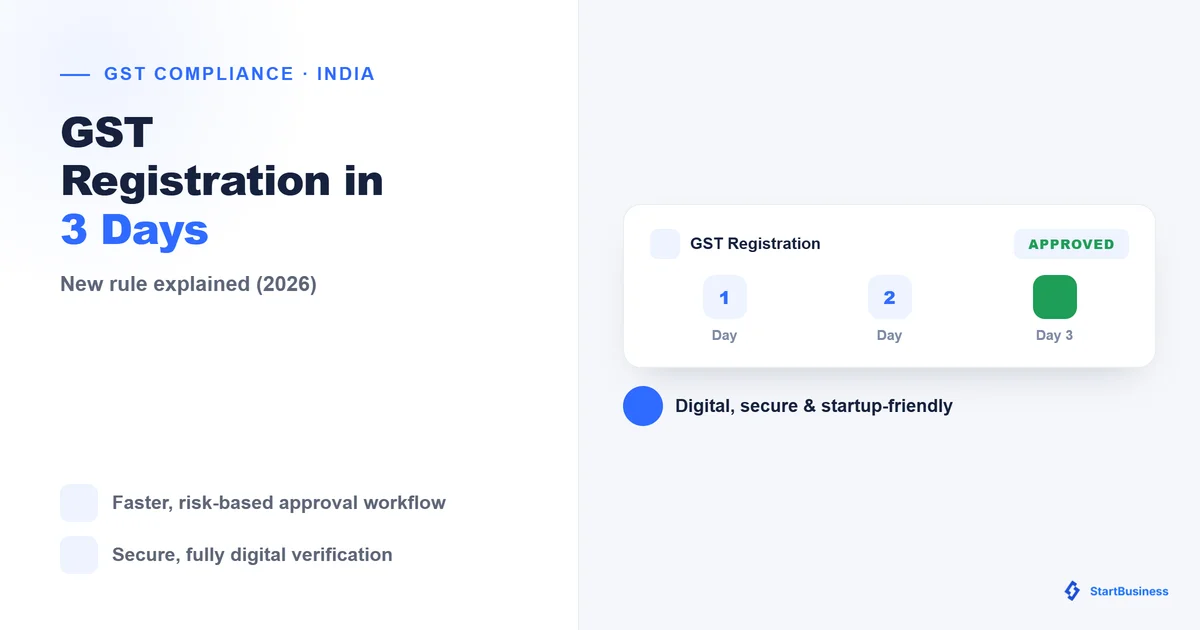
That changed with the rollout of the simplified GST registration scheme under CGST Rule 14A, effective 1 November 2025 as part of the broader 'GST 2.0' reforms. Low-risk applicants who complete Aadhaar authentication can now get their GSTIN auto-approved within 3 working days, provided there's no query or notice from the officer.
This article explains exactly how the new timeline works, who actually qualifies for it, how it compares with the older process, and why some applications still take much longer despite the new rule.
If you're applying for GST registration itself, our team can walk you through the process directly — see our GST registration service page for end-to-end assistance.
What is the new GST Registration in Just 3 Days rule?
| The new rule, introduced under CGST Rule 14A, allows low-risk applicants who complete Aadhaar authentication to get GST registration auto-approved within 3 working days, instead of the earlier 7-day timeline, provided the officer raises no query. |
|---|
Rule 14A was notified as part of the 56th GST Council meeting's simplified registration scheme and came into effect on 1 November 2025. It targets small and low-risk businesses — particularly those with modest monthly tax liability — who previously faced the same lengthy scrutiny as larger, higher-risk applicants regardless of their actual risk profile.
Under this scheme, if you opt in during registration, complete Aadhaar e-KYC for the primary authorised signatory and at least one promoter or partner, and your application doesn't get flagged for a Show Cause Notice or clarification request, your GSTIN is deemed approved within 3 working days of submission. No manual sign-off is required from the officer in the default case — approval happens automatically once the window passes without an objection.
What has changed under the new GST registration rule in 2026?
| The core change is a shift from uniform scrutiny for every applicant to risk-based, tiered processing: low-risk, Aadhaar-authenticated applicants get 3-day auto-approval, while higher-risk or non-Aadhaar cases still go through the older, longer verification track. |
|---|
Before this reform, every GST application — regardless of the size or risk profile of the business — went through broadly the same review process, which typically took 7 working days at minimum and often longer if the officer needed clarification. The system didn't differentiate between a small consultant billing a few clients and a business with a complex ownership structure or a history of GST fraud in similar categories.
The 2026 framework changes that by using AI-assisted, risk-based verification to sort applications into two tracks:
● Aadhaar-authenticated, low-risk applications: deemed approved within 3 working days if no notice is issued.
● Biometric or non-Aadhaar, higher-risk applications: verified within 21 working days, with up to 7 additional working days if clarification is needed.
There are also related process changes from the same reform cycle — such as the requirement to link bank account details within 30 days of registration under Rule 10A, and stricter rules from 1 April 2026 around exiting the Rule 14A scheme once a business's monthly output tax liability grows beyond the eligibility cap.
What is the new GST registration approval time limit?
| The statutory time limit is 3 working days for Aadhaar-authenticated, low-risk applications under Rule 14A, and up to 21 working days (plus up to 7 more for clarification) for applications requiring biometric verification or falling into a higher-risk category. |
|---|
It's worth being precise about what '3 days' actually means here: it's 3 working days from the date of submission of a complete application, not 3 calendar days, and not 3 days from when you start filling the form. Weekends and holidays don't count toward the clock, and the clock only starts once the application is complete and Aadhaar authentication is done — an incomplete submission doesn't trigger the timeline.
If the officer doesn't act — approve, reject, or raise a query — within that 3-working-day window, the registration is deemed approved automatically. This 'deemed approval' mechanism is what makes the timeline meaningfully enforceable, rather than just an internal service-level target with no consequence for missing it.
How much time is required for new GST registration now?
| For a fully prepared, low-risk, Aadhaar-eligible application, expect a GSTIN within 3 working days of submission. Realistically, factor in extra time for document preparation, address verification, and HSN/SAC code selection before that clock even starts. |
|---|
The 3-day figure covers the government's processing window — it doesn't include the time you spend gathering documents, choosing the correct HSN or SAC codes for your business activity, pinning your business location accurately on the portal's mapping tool, or fixing any PAN/Aadhaar name mismatches before you submit. In practice, a well-prepared applicant can go from 'starting the application' to 'GSTIN in hand' in about a week when you include this preparation time — but the government-controlled portion of that wait really has come down to 3 working days.
Who can get GST registration within 3 days?
| Any entity type — proprietorships, partnerships, LLPs, Private Limited Companies, OPCs, and freelancers — can use the 3-day track, but only if their estimated monthly B2B output tax liability stays under ₹2.5 lakh and they complete Aadhaar authentication. It isn't a blanket entitlement for every applicant. |
|---|
This is the part of the rule that gets oversimplified in a lot of coverage. The 3-day scheme is not restricted by business structure — it's restricted by risk profile and tax liability. That means:
● Proprietorships and partnerships qualify if their expected monthly B2B output tax liability is under ₹2.5 lakh.
● LLPs and Private Limited Companies also qualify under the same monetary condition — company structure alone doesn't disqualify you.
● One Person Companies (OPCs) are eligible on the same basis as any other low-risk applicant.
● Startups with modest early-stage turnover are typically well within the ₹2.5 lakh monthly liability threshold, making them strong candidates for the fast-track route.
● Import-export businesses can qualify, but cross-border transactions sometimes trigger additional risk flags, so approval isn't guaranteed even with Aadhaar authentication.
● Freelancers and independent consultants generally have low monthly liability and are among the most common beneficiaries of this scheme.
So yes — LLPs and Private Limited Companies can get GST registration in 3 days, but only if they meet the tax-liability threshold and complete Aadhaar e-KYC. A company with high projected turnover or a complex ownership structure may still be routed to the longer, non-Aadhaar verification track regardless of entity type. If you're setting up a new entity alongside registration, see our guides on Private Limited Company registration, LLP registration, and One Person Company registration for entity-specific requirements.
What is the GST registration threshold limit?
| For normal category states, the threshold is ₹40 lakh annual turnover for goods suppliers and ₹20 lakh for service providers. In special category states, these limits drop to ₹20 lakh and ₹10 lakh respectively. Certain categories must register regardless of turnover. |
|---|
The threshold limit determines whether you need GST registration at all — it's a separate question from how fast you'll get it once you apply. As of 2026, the limits are:
● ₹40 lakh — goods suppliers in normal category states.
● ₹20 lakh — service providers in normal category states.
● ₹20 lakh — goods suppliers in special category states (North Eastern states, Uttarakhand, and similar).
● ₹10 lakh — service providers in special category states.
These thresholds are based on aggregate turnover across all business verticals under the same PAN, computed on an all-India basis — not just turnover in one state. Regardless of turnover, registration is mandatory in certain situations, including:
● Inter-state supply of goods or services, under Section 24(i) of the CGST Act.
● E-commerce sellers, including those operating on marketplaces like Amazon or Flipkart.
● Businesses liable to pay tax under reverse charge.
● Casual taxable persons and non-resident taxable persons.
If you're unsure whether your turnover has crossed the applicable threshold, that's worth checking before you apply — an unnecessary registration creates ongoing compliance obligations (returns, ITC reconciliation, record-keeping) that a business below the threshold doesn't need to carry.
Old Process vs New 3-Day GST Registration
| Parameter | Old Process | New 3-Day Process (Rule 14A) |
|---|---|---|
| Processing Time | Minimum 7 working days, often longer | 3 working days for eligible, Aadhaar-authenticated applicants |
| Verification | Manual review for every applicant, regardless of risk | AI-assisted, risk-based sorting into fast-track or standard track |
| Document Review | Full manual scrutiny of every document | Streamlined review; deeper checks reserved for flagged/high-risk cases |
| Clarification | Common, with no fixed resolution window in practice | Up to 7 additional working days if clarification is genuinely needed |
| Expected Timeline | 7–30+ working days depending on case complexity | 3 working days (fast-track) or up to 21 working days (standard track) |
Why is my GST registration taking longer than 3 days?
| The most common reasons are a mismatch between PAN and Aadhaar details, incomplete or unclear address proof, opting out of Aadhaar authentication, or the application being flagged by the risk-based system for manual or physical verification. |
|---|
If your application is taking longer than 3 working days, it's almost always one of these:
● Document mismatch — the business name, address, or promoter details on your documents don't exactly match what's entered in the application.
● PAN mismatch — even a minor difference between PAN records and the application data can trigger a hold.
● Aadhaar issues — failed e-KYC, expired OTP sessions, or a promoter who hasn't linked Aadhaar to their PAN.
● Risk-based verification — the system's fraud-detection layer flags applications with certain turnover patterns, business categories, or address types (like shared or virtual office spaces) for closer review.
● Physical verification — in specific cases, the officer may require an in-person visit to the business premises before approving the application, which by definition can't be completed within 3 days.
● Notice from officer — once a clarification notice (Form GST REG-03) is issued, the 3-day fast-track window no longer applies, and the timeline resets around your response and the officer's review of it.
Does the new rule guarantee GST approval in 3 days?
| No. The 3-day timeline applies only to complete, eligible, Aadhaar-authenticated applications that raise no red flags. Incomplete applications, non-Aadhaar cases, or anything flagged for verification will take longer — sometimes significantly longer. |
|---|
This is worth stating plainly because a lot of marketing around this rule implies a universal 3-day guarantee, and that's not accurate. The rule creates a fast lane for applications that meet specific conditions; it doesn't shorten the process for everyone. Final approval also still depends on the assessing officer's judgment within the review window — the automation determines the track and the deadline, not the outcome.
How can businesses ensure faster GST approval?
| Complete Aadhaar authentication for all promoters and the signatory, double-check that PAN and Aadhaar details match exactly, use accurate and verifiable address proof, select the correct HSN/SAC codes, and avoid errors that commonly trigger a clarification notice. |
|---|
A practical checklist before you submit:
● Confirm PAN details match your Aadhaar exactly — spelling, date of birth, and address formatting included.
● Complete Aadhaar e-KYC for the primary authorised signatory and at least one promoter or partner upfront.
● Use address proof that clearly and unambiguously supports your registered business location — utility bill, rent agreement, or ownership document, correctly pinned on the portal's mapping tool.
● Select HSN/SAC codes that accurately reflect your actual business activity, not a generic or overly broad category.
● Keep bank account details ready to link within 30 days of approval, as required under Rule 10A.
● Respond immediately and completely if a clarification notice is issued — delayed or partial responses are the single biggest cause of extended timelines.
Key Takeaways
GST registration can now be approved in 3 working days under CGST Rule 14A — down from the earlier 7-day baseline.
Eligibility depends on Aadhaar authentication and a monthly B2B output tax liability under ₹2.5 lakh — not on entity type alone.
LLPs, Private Limited Companies, OPCs, proprietorships, and partnerships can all qualify if they meet these conditions.
The 3-day window is not a guarantee — incomplete applications, PAN/Aadhaar mismatches, or risk flags still lead to longer processing.
Preparation — accurate documents, matched details, correct HSN/SAC codes — determines whether you actually get the 3-day outcome.
Frequently Asked Questions
Can I really get GST registration in 3 days?
Yes, if you're a low-risk applicant with monthly B2B output tax liability under ₹2.5 lakh and you complete Aadhaar authentication. If your application is flagged for verification or you skip Aadhaar authentication, it will take longer.
Is Aadhaar authentication mandatory for the 3-day approval?
Yes. Aadhaar authentication for the primary authorised signatory and at least one promoter or partner is a core requirement of the fast-track scheme. Without it, your application is routed to the standard, longer verification track.
Can GST registration still take longer than 3 days?
Yes. If the officer issues a clarification notice, if your application needs physical verification, or if you fall outside the Rule 14A eligibility criteria, your registration can take anywhere from 7 to 21 working days, or longer in complex cases.
Who is eligible for the fast-track GST registration?
Any entity type — proprietorship, partnership, LLP, Private Limited Company, or OPC — is eligible provided the estimated monthly B2B output tax liability is under ₹2.5 lakh and Aadhaar authentication is completed.
What happens if GST registration is rejected?
If your application is rejected, the officer will record specific reasons, typically related to document mismatches, incomplete information, or failed verification. You can usually correct the identified issues and reapply, though repeated rejections may invite closer scrutiny on future applications.
Need Help With Your GST Registration?
The 3-day timeline only works in your favour if the application is filed correctly the first time — mismatched documents or an incomplete Aadhaar authentication step can push you straight into the slower, 21-day track. If you'd rather not risk that, StartBusiness GST experts handle the entire application end-to-end — document preparation, Aadhaar authentication, HSN/SAC selection, and follow-up on any officer queries. Get in touch with our GST registration team for a hassle-free application, or explore our related services for company registration and trademark registration if you're setting up a new business from scratch.
We handle business incorporation and deed drafting end-to-end, tailored to your needs.

Practising from Deccan Gymkhana, Pune since 2017. Has handled 1,000+ incorporations and ongoing compliance for founders across Maharashtra, from single-partner proprietorships to funded private limited companies.