
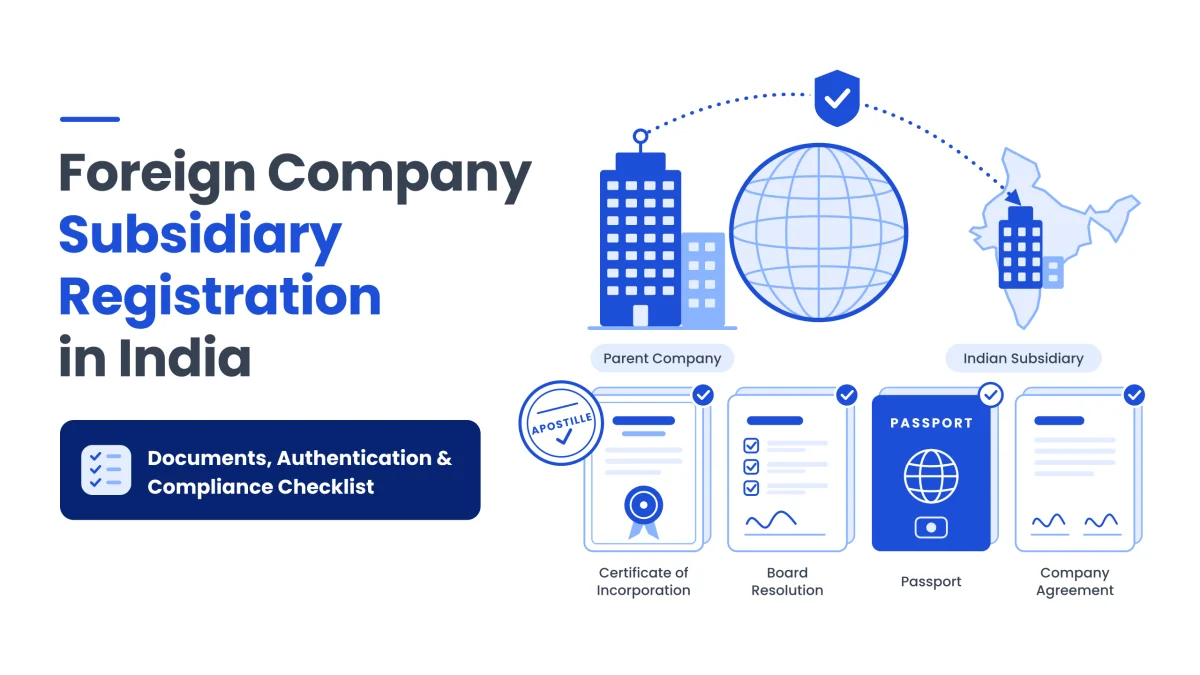
A foreign parent company generally needs its certificate of incorporation, memorandum and articles (or equivalent constitutional documents), a board resolution approving the investment and authorising a signatory, and shareholding details. Foreign directors add a passport and overseas address proof, Indian directors add PAN-based KYC, and the Indian registered office needs address proof and an owner’s NOC. Authentication depends on the country where documents are executed.
This guide covers documents and authentication only. Requirements vary with the parent’s home country, the sector and the Registrar’s queries, so treat the tables as a working checklist, not a guarantee of acceptance.
What Documents Does a Foreign Parent Company Need to Register a Subsidiary in India?
A foreign parent must show that it legally exists, that its board approved the investment, and who owns and controls it. The documents below cover those points. Some are part of the MCA’s incorporation process; others are asked for by the Indian bank or advisers, so the table marks which is which.
Documents Required from the Foreign Parent Company
Status key: MCA = required by the MCA’s SPICe+ filing or the Incorporation Rules. Case = depends on the facts. Practice = commonly requested by the authorised dealer (AD) bank, the Registrar or advisers.
| Document | Purpose | Important details | Status |
|---|---|---|---|
| Certificate of Incorporation | Proves legal existence | Issued by the home company registry. MCA’s SPICe+ guidance lists a copy for a foreign body-corporate subscriber. Translate into English if needed. | MCA |
| MOA/AOA or equivalent | Shows objects, powers and governance | Name varies: articles of incorporation, bylaws, constitution or charter. Confirms the parent may hold shares in an Indian company. | Practice |
| Board resolution | Authorises the investment | Approves the share subscription and names the authorised signatory (see below). | MCA |
| Registered office proof | Confirms the parent’s address | Registry extract, certificate of good standing (where issued) or similar official record. | Practice |
| List of directors | Identifies who controls the parent | Names, nationalities and addresses, usually from a registry extract or certified list. | Practice |
| Authorised representative details | Identifies the signatory | Name, designation, specimen signature and passport copy of the person signing for the parent. | MCA (Rule 13(4)); copies are Practice |
| Ownership and shareholding structure | Establishes ownership and beneficial owners | Chart tracing to the individuals who ultimately own or control the parent, used for the FDI route check and bank KYC. | Case |
Sources: MCA SPICe+ FAQs; Rule 13, Companies (Incorporation) Rules, 2014; RBI Master Direction – Foreign Investment in India, para 3.2. A private company needs two members, so a group company or nominee usually holds a second share; that holder’s KYC is needed too. Where a nominee holds the share, beneficial-interest declarations (MGT-4, MGT-5 and MGT-6) follow after incorporation.
Why the board resolution matters. It is the parent’s formal approval to become a shareholder. It should approve subscribing to a stated number of shares at face value (RBI para 8.5), name the proposed Indian company and authorise one person to sign the MOA, AOA and declarations. Under Rule 13(4) that person must be board-authorised and cannot also be a subscriber.
StartBusiness prepares the resolution and signatory pack as part of its subsidiary registration services in India, and confirms the sector route first.
Planning to Establish Your Subsidiary in India?
StartBusiness can assist with foreign parent company documentation, incorporation filings and applicable regulatory requirements.
[Get Expert Assistance]
Documents Required from Foreign Directors
Each foreign individual who will be a director or subscriber provides:
· Passport. The mandatory identity proof for a foreign national.
· Overseas address proof. A recent bank statement, utility bill or driving licence showing the residential address. Check the age limit before notarising; two months is common.
· Recent passport-size photograph.
· Email address and phone number.
· DIN details, if already allotted. An existing DIN is reused; nobody holds two.
· Digital Signature Certificate (DSC), issued by a licensed Indian certifying authority. For foreign nationals it typically needs authenticated identity documents and video verification.
· Security clearance, where applicable. A director who is a national of a country sharing a land border with India needs Ministry of Home Affairs security clearance before appointment.
If there is no DIN yet, the person is named as a proposed first director in SPICe+ and the DIN is allotted on incorporation. A director added later applies on Form DIR-3. Each first director also signs the DIR-2 consent. Where a subscriber or director has neither DIN nor PAN, INC-9 is not auto-generated and a signed declaration is attached instead (MCA FAQs).
Documents Required from Indian Directors
· PAN, mandatory for Indian nationals.
· Identity proof: Aadhaar, passport, voter ID or driving licence.
· Residential address proof dated within the last two months.
· Photograph, personal email and mobile number.
· DSC, issued after video verification.
Section 149(3) of the Companies Act, 2013 requires at least one director who has stayed in India for 182 days or more in the period it prescribes, applied proportionately in the year of incorporation. An Indian director often fills this role, though a foreign national meeting the stay test also qualifies. StartBusiness’s documents checklist for company registration covers Indian-side KYC in more detail.
Need expert help?
We handle incorporation end-to-end, fully online.
Free 15-min consultationNo obligation. Usually replies within a couple of hours.Documents Required for the Indian Registered Office
What you attach depends on who owns the premises.
| Premises | Documents | Note |
|---|---|---|
| Owned by a director or promoter | Utility bill (not older than two months); sale deed or other ownership proof; NOC from the owner | An owner-director issues the NOC to the company. |
| Rented | Utility bill; rent or lease agreement; owner’s NOC | The bill may be in the owner’s name. |
| Provided by a group company, co-working or business centre | Utility bill; leave-and-licence or service agreement; NOC from the premises owner | Confirm the agreement permits use as a registered office. |
Do Foreign Company Documents Need to Be Apostilled or Notarised?
Not always. Rule 13(5) of the Companies (Incorporation) Rules, 2014 sets three routes for foreign nationals signing from abroad: notarisation alone in Commonwealth countries, notarisation plus apostille in Hague Apostille Convention countries, and notarisation plus Indian embassy authentication elsewhere. Where a country is both a Commonwealth and a Hague member (UK, Singapore, Australia), get the apostille as well: the MCA’s SPICe+ FAQs refer to apostilled MOA and AOA for overseas corporate subscribers. Banks and advisers may ask for more.
Notarisation: a notary public verifies a signature or certifies a copy. Apostille: a certificate from a Hague member country’s designated authority confirming the notary’s signature. Consular authentication: the Indian embassy or consulate authenticates the notary’s certificate (section 3, Diplomatic and Consular Officers (Oaths and Fees) Act, 1948). Rule 13 is silent on translation, but MCA filings are in English, so translate and notarise anything in another language.
| Country where documents are executed | What Rule 13(5) requires | Practical points | Examples |
|---|---|---|---|
| Commonwealth country — clause (a) | Notarisation by a notary public in that country | The rule asks only for notarisation, but these countries are also Hague members. Get the apostille too; MCA’s FAQs refer to apostilled MOA and AOA, and it avoids resubmission. | UK, Singapore, Australia (these are also Hague members) |
| Hague Apostille Convention country outside the Commonwealth — clause (b) | Notarisation, then apostille | Notarise first, then apostille; wrong sequencing is a common cause of resubmission. | USA, France, Japan |
| Neither — clause (c) | Notarisation, then authentication by an Indian diplomatic or consular officer | Allow extra time; Indian missions often use appointed attestation centres. | UAE (not listed in HCCH sources reviewed in 2026; check the live table) |
| Foreign national visiting India — clause (d) | Incorporation is allowed if the person holds a valid business visa | Not required for persons of Indian origin or OCI holders. Confirm accepted identity proof. | — |
Statutory versus additional. Rule 13(5) is the statutory baseline and is worded for individual foreign nationals subscribing to the memorandum. For a corporate parent, the Registrar in practice expects the same authentication of the parent’s documents and its signatory’s signature, based on where they are executed. Bank KYC or investor diligence requests are separate. Apostille status changes, so check the HCCH status table before certifying anything.
Not Sure Whether Your Foreign Documents Need Apostille?
Request a document review before you begin incorporation, so each document is certified once and in the right order.
[Request a Document Review]
What Are the Common Forms Used for Foreign Company Registration in India?
“Foreign company registration” can mean two things. Incorporating an Indian subsidiary uses SPICe+ (INC-32) and its linked forms. A foreign company that sets up its own place of business in India files Form FC-1 instead. FC-1 is not the incorporation form for an Indian subsidiary.
| Form | Purpose | Subsidiary relevance |
|---|---|---|
| SPICe+ (INC-32) | Single application to incorporate an Indian company, including name reservation, DIN, PAN and TAN | Core form |
| INC-33 | Electronic Memorandum of Association | The same exception applies where an individual foreign subscriber does not hold a valid business visa. |
| INC-34 | Electronic Articles of Association | Same exception as INC-33. |
| INC-35 (AGILE-PRO-S) | Linked application for GSTIN, EPFO, ESIC and other registrations | Filed with SPICe+; coverage varies by state |
| INC-9 | Declaration by subscribers and first directors (Section 7(1); Rule 15) | Auto-generated in many cases; attached manually if a subscriber or director has neither DIN nor PAN |
| FC-1 | Filing by an existing foreign company within 30 days of establishing a place of business in India (Section 380) | Not used to incorporate a subsidiary |
The legal distinction. An Indian subsidiary is a separate Indian company incorporated through SPICe+. A foreign company with its own place of business in India remains a foreign company (Section 2(42)) and registers under Section 380 using FC-1. Branch, liaison and project offices also follow the RBI Master Direction on such offices (RBI permission or general permission under FEMA), not the subsidiary route.
What Are the Different Options for a Foreign Company to Establish a Business in India?
A foreign company can enter India through a wholly owned subsidiary, a joint venture, or an office of the foreign company itself: a branch, liaison or project office. Subsidiaries and joint ventures are separate Indian entities, while the three offices are extensions of the foreign company regulated by the RBI. The right choice depends on activity, control and liability.
| Option | Legal structure | Ownership | Permitted activity | Suits |
|---|---|---|---|---|
| Wholly owned subsidiary | Separate Indian company, usually private limited | Up to 100% foreign: under the automatic route where the sector allows it, or with Government approval where the sector is under the approval route | Any activity open to an Indian company in that sector | Operating businesses, hiring |
| Joint venture | Indian company or LLP with a local partner | Shared, per the JV agreement and any sector cap | As for the subsidiary | Capped sectors, local market access |
| Branch office | Extension of the foreign company; RBI permission | Held by the parent directly | Only RBI-permitted activities; no retail trading or manufacturing | Parent-led services |
| Liaison office | Extension of the foreign company; RBI permission | Held by the parent directly | Liaison only; no business or income in India | Market research, representation |
| Project office | Extension of the foreign company | Held by the parent directly | Executing a specific contract | Contractors on a defined project |
Foreign money can also go into an LLP, but only in 100% automatic-route sectors without FDI-linked performance conditions, with different reporting. See our guide on FDI in an Indian LLP. For help choosing, see our foreign subsidiary registration in India page.
What Happens After the Documents Are Prepared?
Once documents are authenticated, the work moves to eligibility checks, digital signatures, name approval and the SPICe+ filing. The Registrar then reviews the application and, if satisfied, issues the Certificate of Incorporation. This is an overview, not a filing manual.
1. Verify parent documents. Check names, dates, signatures and authentication before upload.
2. Check sector-specific FDI eligibility, including the land-border rule (RBI para 3.2, as revised by DPIIT Press Note 2 of 2026, which applies a 10% beneficial-ownership test). Investment caught by the rule needs prior Government approval.
3. Arrange DSC and DIN for directors and signatories.
4. Reserve the company name through SPICe+ Part A.
5. Prepare the MOA and AOA, with objects matching the real business.
6. Submit SPICe+ and linked forms, with attachments.
7. Obtain the Certificate of Incorporation, with PAN and TAN where applied for.
8. Complete post-incorporation requirements, covered next.
What Compliance Is Required After Incorporating a Foreign Subsidiary in India?
After incorporation, the subsidiary must open a bank account, receive the parent’s share capital through banking channels, report the investment to the RBI, and begin regular company-law, tax and FEMA filings. These compliance documents differ from incorporation documents: they are created after the company exists and are tied to deadlines.
| Requirement | What it involves | Timing note |
|---|---|---|
| PAN and TAN | Issued through SPICe+ | With the Certificate of Incorporation |
| Bank account | Opened with an AD bank; company and parent KYC | Before funds arrive |
| Initial share capital | Inward remittance through banking channels; shares issued | Issue shares within 60 days of receipt. If not issued, refund within 15 days after the 60 days end (RBI Master Direction). |
| FC-GPR | Reports shares issued to the non-resident on RBI’s FIRMS portal via the AD bank | Within 30 days of issue. For the parent’s subscriber shares, confirm with the AD bank which date it treats as the date of issue (incorporation or receipt of funds). |
| Annual FLA return | Foreign Liabilities and Assets return | By 15 July every year on RBI’s FLAIR portal; revise by 30 September if filed on unaudited figures. |
| Auditor, first board meeting | First auditor appointed and first board meeting held | Within 30 days of incorporation |
| INC-20A | Declaration of commencement of business | Within 180 days of incorporation |
| Statutory audit and ROC filings | Audited accounts, AOC-4 and MGT-7 after the AGM | Annual |
| Income tax and GST | Returns and registrations, where applicable | Per turnover and activity |
| Transfer pricing | Documentation for international or specified domestic transactions | Verify current forms and dates |
Incorporation documents prove who the parent and directors are. Compliance documents (bank FIRC and KYC, valuation certificates, share certificates, audited accounts) come later. Late filing can mean fees or FEMA compounding, so confirm dates against current MCA and RBI notifications.
Frequently Asked Questions
What documents are required for a foreign company to register a subsidiary in India?
A foreign parent needs its certificate of incorporation, constitutional documents, a board resolution and ownership details. Foreign directors provide a passport, overseas address proof and a photograph; Indian directors provide PAN-based KYC; the registered office needs a utility bill and the owner’s NOC. Authentication depends on the country of execution.
Can a foreign company own 100% of an Indian subsidiary?
Yes, in most sectors. Under the automatic route, 100% foreign ownership is generally permitted where the sector has no cap, approval requirement or prohibition. A private company needs at least two members, so a group company or nominee usually holds a minimal stake.
Do foreign company documents need to be apostilled in India?
Not always. Rule 13(5) requires notarisation alone for Commonwealth countries, notarisation plus apostille for Hague Convention countries, and notarisation plus Indian embassy authentication elsewhere. The route depends on where the documents are executed. If the country is a Hague member, including Commonwealth countries such as the UK, Singapore and Australia, get the apostille as well.
Can a foreign national become a director of an Indian subsidiary?
Yes. The Companies Act does not require a director to be an Indian citizen. A foreign national needs a DIN, a DSC and authenticated identity and address documents, and the company must still have a director who meets the residency test in Section 149(3).
Is an Indian resident director compulsory for a foreign subsidiary?
Yes. Section 149(3) requires at least one director who has stayed in India for 182 days or more in the prescribed period, applied proportionately in the year of incorporation. That director can be an Indian citizen or a foreign national who meets the stay test.
Which MCA form is used to register a foreign subsidiary in India?
SPICe+ (INC-32) is the main incorporation form. It is filed with linked forms such as AGILE-PRO-S (INC-35) and INC-9, and with the MOA and AOA, either electronically or as attachments. DIN, PAN and TAN are applied for through the same filing.
Is FC-1 mandatory for an Indian subsidiary?
No. FC-1 is filed by an existing foreign company within 30 days of setting up its own place of business in India under Section 380. An Indian subsidiary is a separate Indian company incorporated through SPICe+, so FC-1 does not apply to it.
Can a foreign company register a subsidiary in India without visiting India?
Generally yes. Documents can be notarised, apostilled or consularised in the home country, DSCs are issued after video verification, and filings are made online. Banks may have their own KYC steps, so confirm those early.
Register Your Foreign-Owned Subsidiary in India with StartBusiness
Our CA/CS-backed team assists with document verification, incorporation filings, foreign investment compliance and applicable post-incorporation requirements. Registration is subject to the Registrar’s review, so we cannot promise approval, but we can check your documents before you start.
We handle incorporation end-to-end, fully online.

Practising from Deccan Gymkhana, Pune since 2017. Has handled 1,000+ incorporations and ongoing compliance for founders across Maharashtra, from single-partner proprietorships to funded private limited companies.